- Plants
- ›Vascular Plants
- ›flowering plants
- ›monocots
- ›Agaves, Orchids, Irises, and Allies
- ›Aloe family
- ›Aloes and allies
- ›Haworthia
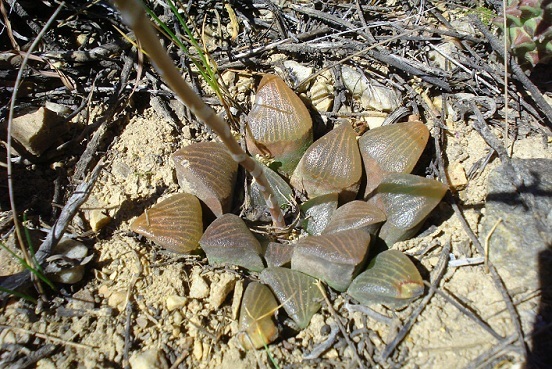
Uniondale Haworthia
Haworthia bayeri
Haworthia bayeri is a species of the genus Haworthia in the family Asphodelaceae, endemic to the southern Cape Provinces in South Africa.
From the article Haworthia bayeri on Wikipedia (CC BY-SA), quoted section by section
Description
It can be distinguished from its Haworthia relatives, by its rounded leaf tips and its dark colour. The upper leaf faces are semi-translucent. They are usually marked with longitudinal lines or reticulated patterns, rather than with spots or flecks. Rosettes are usually solitary, as the plant rarely forms offsets. This species is variable and has multiple different regional forms:
Flowers appear in September and October.
Relatives. This is a "retuse" species of Haworthia and is easily confused with its relatives (e.g. Haworthia pygmaea, Haworthia retusa, Haworthia springbokvlakensis, Haworthia mirabilis, Haworthia emelyae and Haworthia magnifica). A western form, inhabiting shale rocks near Oudtshoorn, is sometimes considered a separate species, Haworthia truteriorum. It is smaller, dull-green, with silver lines or flecks on its leaves, which have more strongly toothed margins. An outlying population of similar plants in the Rooinek Pass, south of Laingsburg, is now usually classed as a separate species, Haworthia marxii.
Range & habitat
The natural range of this species is in the arid Little Karoo area around the boundary between the Western Cape and the Eastern Cape Provinces, South Africa. Here is occurs roughly between Oudtshoorn in the west and Uniondale in the east. This is an arid summer rainfall region. In the east of its range, the plants have a rougher, more scabrid leaf surface. It grows easily in cultivation, but requires very well draining soil. It can be propagated by leaf cuttings and seed, as it rarely offsets. It is threatened by illegal collection for the horticultural trade, as well as habitat destruction. Populations have therefore suffered considerable decline.
== References ==
Wikipedia: “Distribution”
Where it lives
Recorded sightings
—
geo-referenced records in GBIF, from museums, herbaria and field observers.
Drag the globe to turn it. Dots are where records exist, not a range map; darker means more records.
In the stacks
Searching the stacks…
Every page naming Haworthia bayeri in the Biodiversity Heritage Library →
This page is assembled live from iNaturalist, GBIF, Wikipedia, the Source Library and the Internet Archive. It is not yet part of the hand-edited codex. iNaturalist taxon 586775.