- Plants
- ›Vascular Plants
- ›flowering plants
- ›monocots
- ›Agaves, Orchids, Irises, and Allies
- ›Aloe family
- ›Aloes and allies
- ›Haworthia
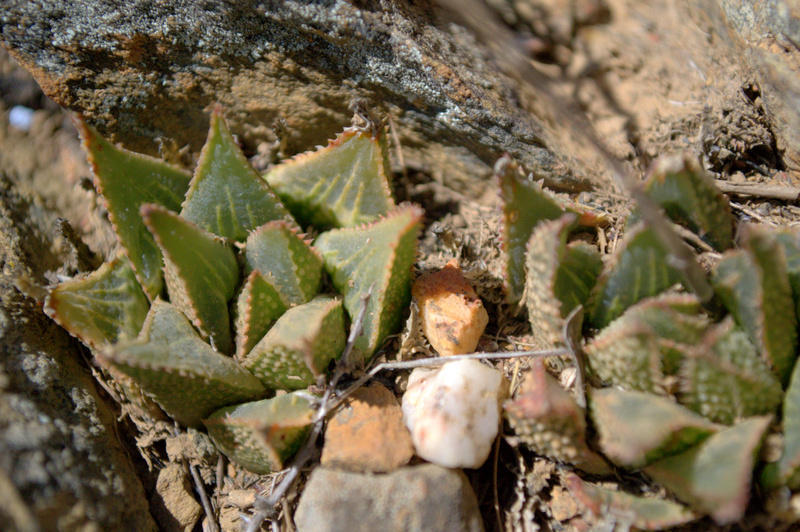
Window Haworthia
Haworthia mirabilis
Haworthia mirabilis is a species of the genus Haworthia belonging to the family Asphodelaceae.
From the article Haworthia mirabilis on Wikipedia (CC BY-SA), quoted section by section
Description
Haworthia mirabilias is a succulent evergreen slow-growing species reaching a size of 4 to 45 centimetres (1.6 to 17.7 in) in height. It is usually a solitary stemless plant. The leaves are green, with longitudinal pale green lines along the upper surfaces and small teeth along the margins. They turn to brownish or reddish in the sun. The leaves form a rosette and the flowers are white and small, in an inflorescence. This highly variable species is one of the "retuse" species of Haworthia, meaning that it usually grows sunken beneath the ground with its flattened leaves only showing on the surface. Its rosette of succulent leaves are turned back ("retuse") so as to provide a flat and level face on the surface of the ground. In this form, it is similar to other retuse haworthias (e.g. Haworthia pygmaea, Haworthia bayeri, Haworthia springbokvlakensis, Haworthia magnifica, Haworthia emelyae and Haworthia retusa). However Haworthia mirabilias can be distinguished from its relatives by the marginal bristles on the leaves, and the way that the leaves end in sharp points. They also usually have lines on the upper leaf faces.
Range & habitat
This species is native to the Western Cape, South Africa. Specifically it occurs in the Overberg District, near the far southern point of the country.
Wikipedia: “Distribution”
In human culture
The genus name Haworthia honors the British botanist Adrian Hardy Haworth (1767–1833), while the species epitheton mirabilis derives from Latin and means "wonderful".
Wikipedia: “Etymology”
Where it lives
Recorded sightings
—
geo-referenced records in GBIF, from museums, herbaria and field observers.
Drag the globe to turn it. Dots are where records exist, not a range map; darker means more records.
In the stacks
Searching the stacks…
Every page naming Haworthia mirabilis in the Biodiversity Heritage Library →
This page is assembled live from iNaturalist, GBIF, Wikipedia, the Source Library and the Internet Archive. It is not yet part of the hand-edited codex. iNaturalist taxon 586791.