- Fungi Including Lichens
- ›Basidiomycete Fungi
- ›Higher Basidiomycetes
- ›Mushrooms, Bracket Fungi, Puffballs, and Allies
- ›Agaricomycetidae
- ›Common Gilled Mushrooms and Allies
- ›Pluteineae
- ›amanita mushrooms and allies
- ›Amaniteae
- ›Amanita
- ›Amanitina
- ›Phalloideae
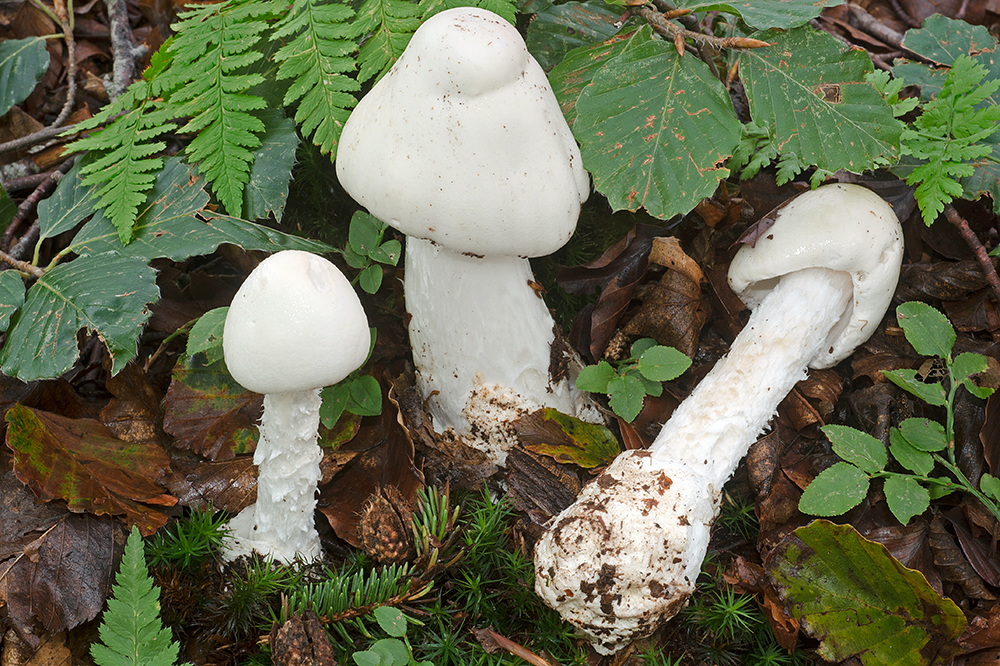
European Destroying Angel
Amanita virosa
Amanita virosa is a species of fungus in the class Agaricomycetes. In the UK, it has the recommended English name of destroying angel and is known internationally as the European destroying angel. Basidiocarps (fruit bodies) are agaricoid (mushroom-shaped) and pure white with a ring on the stipe and a sack-like volva at the base.
The species occurs in Europe and northern Asia. It was formerly reported from North America, but similar-looking American species like A. bisporigera and A. ocreata are distinct. As the name suggests, the destroying angel is poisonous.
From the article Amanita virosa on Wikipedia (CC BY-SA), quoted section by section
Description
Amanita virosa first appears as a white, egg-shaped object covered with a universal veil. As it expands, the mushroom-shaped fruit body breaks free, though ragged patches of veil may persist at the cap edges. The cap is initially conical with inturned edges, before becoming hemispherical and flattening with a diameter up to 12 cm (4+3⁄4 in). The cap often has a distinctive boss; it is able to be peeled and is white, though the centre may be ivory. The crowded, free gills are white, as is the stipe and volva. The thin stipe is up to 15 cm (5.9 in) tall, with a hanging, grooved ring. The spore print is white and the spores are subglobose and 7–10 μm long. They are amyloid, staining purple with Melzer's reagent. The flesh is white, with a smell reminiscent of radishes, and turns bright yellow with sodium hydroxide.
Similar species. In Europe, the spring-fruiting Amanita verna is a similar all-white species, as is the autumn-fruiting, white form of Amanita phalloides (deathcap). Both are equally poisonous. In their immature, button-mushroom stage, all these poisonous species could be mistaken for young, white-capped, edible mushrooms (Agaricus species), highlighting the danger of picking immature fruit bodies for food. In general, there are about 22 species that are considered destroying angels.
Range & habitat
Amanita virosa is found in woodland in late summer and autumn, especially in association with beech and chestnut, but also with pine, spruce, and fir. As with most Amanita species, it forms a mutually beneficial, ectomycorrhizal relationship with the roots of these trees. Amanita virosa was originally described from Sweden and is known throughout Europe, with additional confirmed records from northern Asia (China). The name was formerly used for similar-looking agarics in North America, but research has shown that these American species, including the eastern Amanita bisporigera, the western A. ocreata, and the northern Amanita amerivirosa, are distinct.
Wikipedia: “Habitat and distribution”
At the table
Amanita virosa extract has antibacterial efficacy against Pseudomonas aeruginosa and Staphylococcus aureus in vitro. It also has shown inhibitory activity on thrombin.
Wikipedia: “Potential uses”
Toxicity
Amanita virosa is highly toxic, and has been responsible for severe mushroom poisonings. Eating just one cap of A. virosa is enough to kill an adult human. The symptoms of poisoning generally come several hours after consumption, a delay which may make treatment more difficult. Fruit bodies contain both amatoxins and phallotoxins. Amatoxins consist of at least eight compounds with a similar structure, that of eight amino-acid rings; they were isolated in 1941 by Heinrich O. Wieland and Rudolf Hallermayer of LMU Munich. Of the amatoxins, α-Amanitin is the chief component and along with β-Amanitin is probably responsible for the toxic effects. Their major toxic mechanism is the inhibition of RNA polymerase II, a vital enzyme in the synthesis of messenger RNA (mRNA), microRNA, and small nuclear RNA, (snRNA). Without mRNA essential protein synthesis and hence cell metabolism cease and the cell dies. The liver is the principal organ affected, as it is the organ which is first encountered after absorption in the gastrointestinal tract, though other organs, especially the kidneys, are susceptible. Phallotoxins consist of at least seven compounds, all of which have seven similar peptide rings. Phalloidin was isolated in 1937 by Feodor Lynen, Heinrich Wieland's student and son-in-law, and Ulrich Wieland of LMU Munich. …
In human culture
The specific epithet is derived from the Latin adjective virōsus meaning 'toxic' (compare virus).
Wikipedia: “Etymology”
Where it lives
Recorded sightings
—
geo-referenced records in GBIF, from museums, herbaria and field observers.
Drag the globe to turn it. Dots are where records exist, not a range map; darker means more records.
In the stacks
Searching the stacks…
Every page naming Amanita virosa in the Biodiversity Heritage Library →
This page is assembled live from iNaturalist, GBIF, Wikipedia, the Source Library and the Internet Archive. It is not yet part of the hand-edited codex. iNaturalist taxon 58685.