tamarack
Larix laricina
Larix laricina, commonly known as the tamarack, hackmatack, eastern larch, black larch, red larch, or American larch, is a species of larch native to Canada, from eastern Yukon and Inuvik, Northwest Territories east to Newfoundland, and also south into the upper northeastern United States from Minnesota to Cranesville Swamp, Maryland; there is also an isolated population in central Alaska. The word tamarack is the Algonquian name for the species and means "wood used for snowshoes".
From the article Larix laricina on Wikipedia (CC BY-SA), quoted section by section
Description
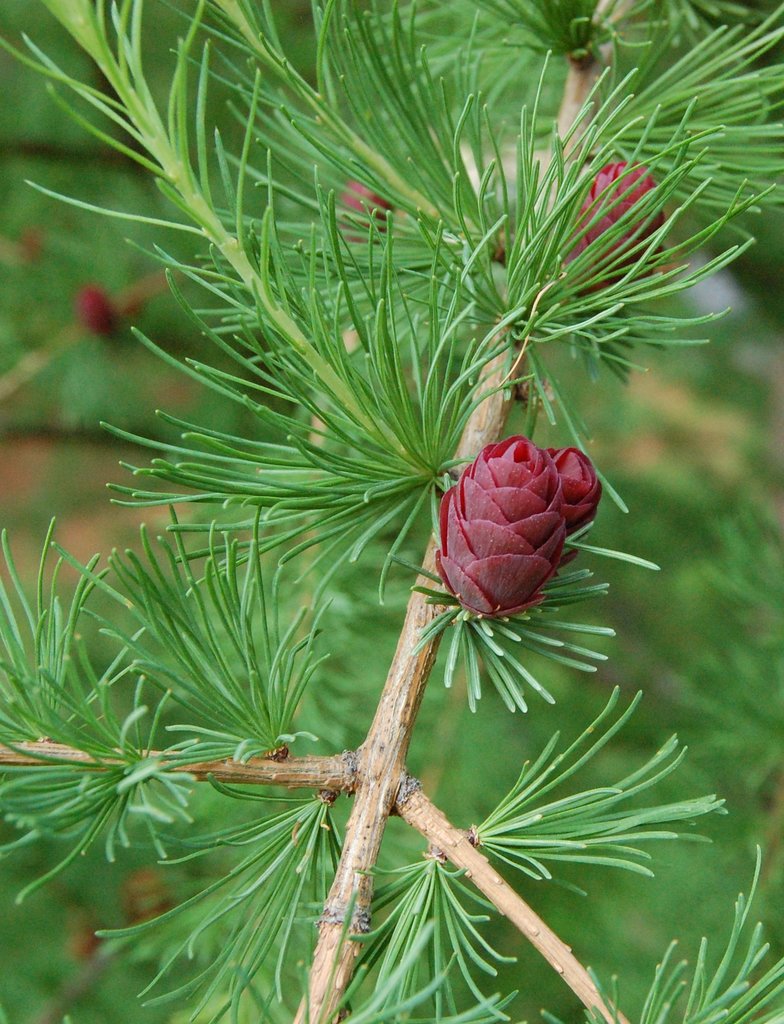
Larix laricina is a small to medium-size boreal deciduous conifer tree common to low-land areas such as swamps, fens, and bogs, reaching 15–23 m (49–75 ft) tall, with a trunk up to 60 cm (24 in) in diameter. The bark of mature trees is reddish, the young trees are gray with smooth bark. The leaves are needle-like, 2.5 cm (1 in) long, and light blue-green, produced on long woody spur shoots in groups of 10–20. Prior to falling off in the autumn, the leaves turn bright yellow, leaving the shoots bare until the next spring. The cones are the smallest of any larch, only 1–2.3 cm (3⁄8–7⁄8 in) long, with 12–25 seed scales; they are bright red, turning brown before opening to release the seeds once mature 4 to 6 months after pollination.
Range & habitat
Tamaracks are very cold tolerant, able to survive temperatures down to at least −62 °C (−80 °F), and commonly occurs at the Arctic tree line at the edge of the tundra. Trees in these severe climatic conditions are smaller than farther south, often only 3 m (10 ft) tall. They can tolerate a wide range of soil conditions but grow most commonly in swamps, bogs, or muskegs, in wet to moist organic soils such as sphagnum, peat, and woody peat.They are also found on mineral soils that range from heavy clay to coarse sand; thus texture does not seem to be limiting. Although tamarack can grow well on calcareous soils, it is not abundant on the limestone areas of eastern Ontario.
Tamarack is generally the first forest tree to grow on filled-lake bogs. In the lake states, tamarack may appear first in the sedge mat, sphagnum moss, or not until the bog shrub stage. Farther north, it is the pioneer tree in the bog shrub stage. Tamarack is fairly well adapted to reproduce successfully on burns, so it is one of the common pioneers on sites in the boreal forest immediately after a fire. The central Alaskan population, separated from the eastern Yukon populations by a gap of about 700 kilometres (430 mi), is treated as a distinct variety Larix laricina var. alaskensis by some botanists, though others argue that it is not sufficiently distinct to be distinguished.
Damaging agents. …
Wikipedia: “Distribution and ecology”
At the table
The wood is tough and durable, but also flexible in thin strips, and was used by the Algonquian people for making snowshoes and other products where toughness was required. The natural crooks located in the stumps and roots are also preferred for creating knees in wooden boats. Currently, the wood is used principally for pulpwood, but also for posts, poles, rough lumber, and fuelwood; it is not a major commercial timber species. Tamarack wood is also used as kickboards in horse stables. Older log homes built in the 19th century sometimes incorporated tamarack along with other species like red or white oak. The hewn logs have a coarse grainy surface texture. It is also grown as an ornamental tree in gardens in cold regions. Several dwarf cultivars have been created that are available commercially. Tamarack is commonly used for bonsai. Tamarack poles were used in corduroy roads because of their resistance to rot. Tamarack posts were used before 1917 in Alberta to mark the northeast corner of sections surveyed within townships. They were used by the surveyors because at that time the very rot-resistant wood was readily available in the bush and was light to carry. …
Wikipedia: “Uses”
Where it lives
Recorded sightings
—
geo-referenced records in GBIF, from museums, herbaria and field observers.
Drag the globe to turn it. Dots are where records exist, not a range map; darker means more records.
In the stacks
Searching the stacks…
Every page naming Larix laricina in the Biodiversity Heritage Library →
This page is assembled live from iNaturalist, GBIF, Wikipedia, the Source Library and the Internet Archive. It is not yet part of the hand-edited codex. iNaturalist taxon 58721.