- Plants
- ›Vascular Plants
- ›conifers
- ›conifers
- ›pine family
- ›pines, spruces, larches, and allies
- ›Pinus
- ›Pinus
- ›Pinus
- ›Pinus
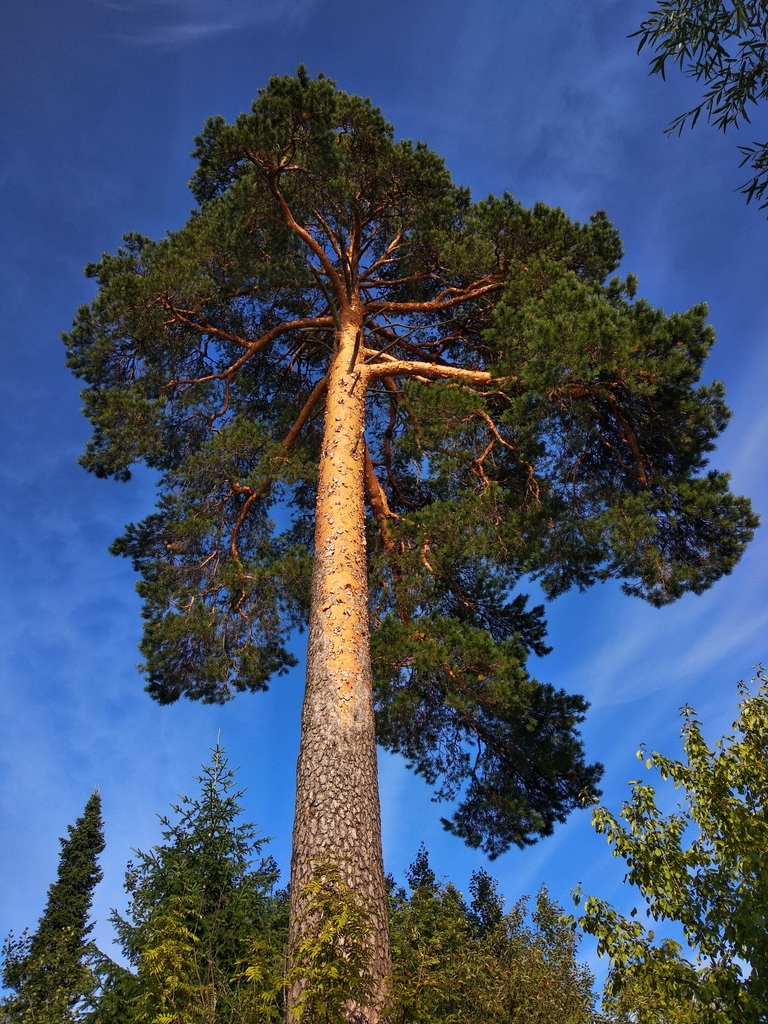
Scots pine
Pinus sylvestris
Scots pine (Pinus sylvestris) is a species of pine that is native to Eurasia, ranging from Western Europe to Eastern Siberia, south to the Caucasus Mountains and Anatolia, and north to well inside the Arctic Circle in Scandinavia. In the north of its range, it occurs from sea level to 1,000 m (3,300 ft), while in the south of its range it is a high altitude mountain tree, growing at 1,200–2,600 m (3,900–8,500 ft) altitude. It is readily identified by...
From the article Pinus sylvestris on Wikipedia (CC BY-SA), quoted section by section
Description
Pinus sylvestris is an ancient species of coniferous tree. A fossil seed cone of Pinus montana fossilis sent by the Naturmuseum Senckenberg to the Swedish Museum of Natural History was dated to the late Pliocene epoch (Reuverian stage ~ 2.6 million years ago). Its longevity might be due to its genetics. Genes of Scots Pine during the haploid stage of its life cycle are subject to stronger negative selection. Selective removal of alleles that contain potentially unhelpful mutations has the efficacy of efficient natural selection. Modern trees can grow up to 35 metres (115 feet) in height and 1 m (3 ft 3 in) in trunk diameter when mature, exceptionally over 45 m (148 ft) tall and 1.7 m (5+1⁄2 ft) in trunk diameter on very productive sites. The tallest on record is a tree over 210 years old growing in Estonia which stands at 46.6 m (153 ft). The lifespan is normally 150–300 years, with the oldest recorded specimens in Lapland, Northern Finland over 760 years. The bark is thick, flaky and orange-red when young to scaly and gray-brown in maturity, sometimes retaining the former on the upper portion. The habit of the mature tree is distinctive due to its long, bare and straight trunk topped by a rounded or flat-topped mass of foliage. The shoots are light brown, with a spirally arranged scale-like pattern. …
Range & habitat
Pinus sylvestris is the only pine native to northern Europe, ranging from Western Europe to Eastern Siberia, south to the Caucasus Mountains and Anatolia, and north to well inside the Arctic Circle in Fennoscandia. In the north of its range, it occurs from sea level to 1,000 m (3,300 ft), while in the south of its range it is a mountain tree, growing at 1,200–2,600 m (3,900–8,500 ft) altitude. Its distribution intersects with T. piniperda's habitat, making the beetle a primary pest of the tree. The species is mainly found on poorer, sandy soils, rocky outcrops, peat bogs or close to the forest limit. On fertile sites, the pine is out-competed by other tree species, usually spruce or broad-leaved trees.
Britain and Ireland. The tree spread across Britain and Ireland after the Last Glacial Maximum. Pollen records show that pine was present locally in southern England by 9,000 years ago having entered from northeast France and that it had spread as far north as the Lake District and North Pennines 500 years later. It was present in Ireland over 8,800 years ago but absent from Wales at that time which suggests that the pine in Ireland had a separate Iberian origin or contained surviving populations, although evidence towards its survival is lacking. …
Wikipedia: “Distribution and habitat”
What it does
It forms either pure forests or mixes with Norway spruce, common juniper, silver birch, European rowan, Eurasian aspen and other hardwood species. In central and southern Europe, it occurs with numerous additional species, including European black pine, mountain pine, Macedonian pine, and Swiss pine. In the eastern part of its range, it occurs with Siberian pine, among others. In 2020, black spot needle blight was found on hundreds of Pinus sylvestris var. mongolica trees in four forest farms in northeastern China. It first appeared on the upper part of the needles, and then the needles became withered and gradually showed light black spots, although they still remained green. As the fungal disease progressed, the needles eventually died and turned gray with many dark black spots. The fungus was identified as Heterotruncatella spartii (within the family Sporocadaceae) based on morphology and molecular methods.
Wikipedia: “Ecology”
At the table
Pinus sylvestris is an important tree in forestry. The wood is used for pulp and sawn timber products. A seedling stand can be created by planting, sowing, or natural regeneration. Commercial plantation rotations vary between 50 and 120 years, with longer rotations in northeastern areas where growth is slower. In Scandinavian countries, the pine was used for making tar in the preindustrial age. Some active tar producers still exist, but that industry has almost ceased. The pine has also been used as a source of rosin and turpentine. The wood is pale brown to red-brown, and used for general construction work. It has a dry density around 470 kg/m3 (varying with growth conditions), an open porosity of 60%, a fibre saturation point of 0.25 kg/kg, and a saturation moisture content of 1.60 kg/kg. The pine fibres are used to make the textile known as vegetable flannel, which has a hemp-like appearance, but with a tighter, softer texture. The pine has also been widely planted in New Zealand and much of the colder regions of North America; it was one of the first trees introduced to North America, in about 1600. It is listed as an invasive species in some areas there, including Ontario, Michigan. It has been widely used in the United States for the Christmas tree trade, and was one of the most popular Christmas trees from the 1950s through the 1980s. …
Wikipedia: “Uses”
In human culture
The Scots pine is the plant badge of Clan Gregor and Clan Farquharson. It is the national tree of Scotland.
Wikipedia: “In culture”
Where it lives
Recorded sightings
—
geo-referenced records in GBIF, from museums, herbaria and field observers.
Drag the globe to turn it. Dots are where records exist, not a range map; darker means more records.
In the old herbals & bestiaries


In the stacks
Searching the stacks…
Every page naming Pinus sylvestris in the Biodiversity Heritage Library →
This page is assembled live from iNaturalist, GBIF, Wikipedia, the Source Library and the Internet Archive. It is not yet part of the hand-edited codex. iNaturalist taxon 58722.