- Plants
- ›Vascular Plants
- ›flowering plants
- ›Dicots
- ›Mints, Plantains, Olives, and Allies
- ›olive family
- ›Jasminum
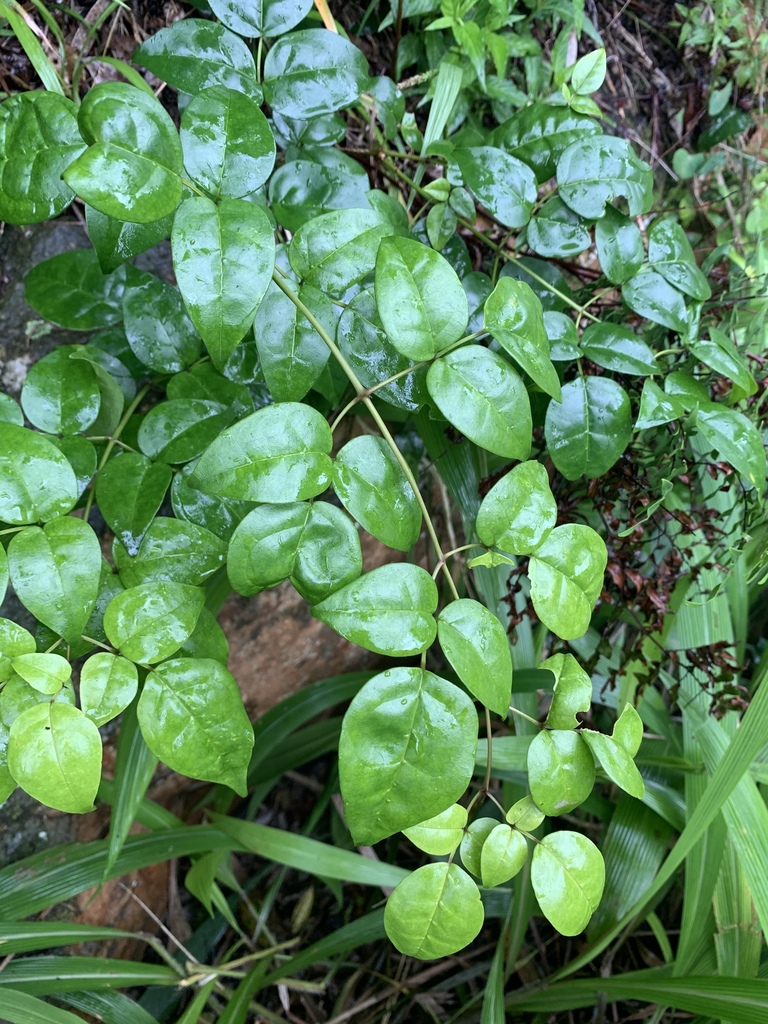
Jasminum abyssinicum
Jasminium abyssinicum (forest jasmine) is a species of jasmine, in the family Oleaceae.
Jasminum abyssinicum is a strong to slender woody climber in high-altitude montane forests, climbing into the forest canopy with stems that can be robust up to 13 cm in diameter. The leaves are opposite, trifoliolate; leaflets are broadly ovate with a distinct driptip, dark glossy green above, hairless except for pockets of hairs in the axils of the leaves. The flowers are produced at the ends twigs or in axils of leaves. The flowers are white, tinged with pink on the outside, sweetly scented with a corolla with 5 or sometimes 6 elliptic lobes. The fruits are a single- or bi-lobed berry 7 mm long, fleshy, glossy black.
From the article Jasminum abyssinicum on Wikipedia (CC BY-SA), quoted section by section
At the table
The Maasai people of Kenya use this plant as a medicinal remedy for wounds. In sheep, it is traditionally used as a treatment for the parasitic nematode Hemonchus contortus.
Wikipedia: “Uses”
In human culture
'Jasminum' is a Latinized form of the Persian word, 'yasemin' for sweetly scented plants.
Wikipedia: “Etymology”
Where it lives
Recorded sightings
—
geo-referenced records in GBIF, from museums, herbaria and field observers.
Drag the globe to turn it. Dots are where records exist, not a range map; darker means more records.
In the stacks
Searching the stacks…
Every page naming Jasminum abyssinicum in the Biodiversity Heritage Library →
This page is assembled live from iNaturalist, GBIF, Wikipedia, the Source Library and the Internet Archive. It is not yet part of the hand-edited codex. iNaturalist taxon 588152.