- Plants
- ›Vascular Plants
- ›flowering plants
- ›Dicots
- ›Sunflowers, Bellflowers, Fanflowers, and Allies
- ›Sunflowers, Daisies, Asters, and Allies
- ›Asteroideae
- ›tarweeds, silverswords, and allies
- ›Deinandra
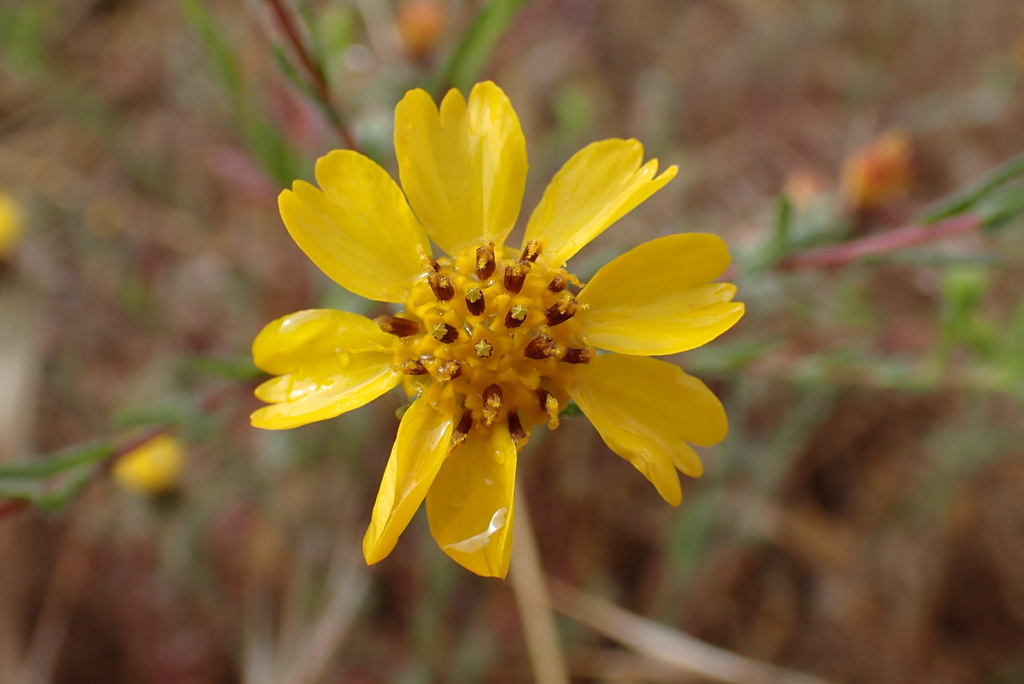
Otay tarplant
Deinandra conjugens
Deinandra conjugens (syn. Hemizonia conjugens) is a rare species of flowering plant in the family Asteraceae known by the common names Otay tarplant and Otay tarweed. It is native to a small section of far northern Baja California in Mexico, its range extending north into San Diego County, California, in the United States. One isolated population has been reported from the hills east of Cayucos in San Luis Obispo County.
Deinandra conjugens is threatened by habitat destruction and degradation. It was federally listed as a threatened species in 1998.
From the article Deinandra conjugens on Wikipedia (CC BY-SA), quoted section by section
Description
Deinandra conjugens is an annual herb growing up to about 0.5 metres (1.6 ft) in height with a solid, bristly, gland-dotted stem. The lower leaves are hairy and lobed or toothed, and measure up to about 4.5 centimeters long. The inflorescence is made up of one or more flower heads, sometimes with many heads in clusters. The underside of the head is covered in phyllaries with many glands. Each head has 7 to 10 yellow ray florets no more than 6 millimeters long. Most ray florets have three tiny lobes at the tips. The center of the head is filled with yellow disc florets tipped with black, dark purple or red anthers. The flowers are most often pollinated by bees. The fruit is an achene. The achenes arising from the disc florets have pappi of white scales. Disc achenes germinate sooner than those from ray florets. Many achenes drop into the soil seed bank.
Range & habitat
Deinandra conjugens grows in clay soils in several types of habitat, including grassland and maritime and inland coastal sage scrub. It tolerates some disturbance in its habitat, and low levels of grazing and road maintenance activities such as mowing are probably beneficial. Most of the known occurrences of Deinandra conjugens are in San Diego County in the United States. Most of them are located in the southern part of the county in areas such as Otay Mesa and Proctor Valley. The city of San Diego has a conservation plan for this species and monitors it. There are about 34 to 37 occurrences remaining; some known occurrences are thought to have been extirpated since the plant was federally listed.
Wikipedia: “Distribution”
Where it lives
Recorded sightings
—
geo-referenced records in GBIF, from museums, herbaria and field observers.
Drag the globe to turn it. Dots are where records exist, not a range map; darker means more records.
In the stacks
Searching the stacks…
Every page naming Deinandra conjugens in the Biodiversity Heritage Library →
This page is assembled live from iNaturalist, GBIF, Wikipedia, the Source Library and the Internet Archive. It is not yet part of the hand-edited codex. iNaturalist taxon 58821.