- Plants
- ›Vascular Plants
- ›flowering plants
- ›Dicots
- ›proteas, lotuses, planes, and allies
- ›Protea family
- ›Singlet Proteas
- ›Nutseed Proteoid Clade
- ›Cape Nutseed Proteoids
- ›Leucospermum
- ›Tumiditubus
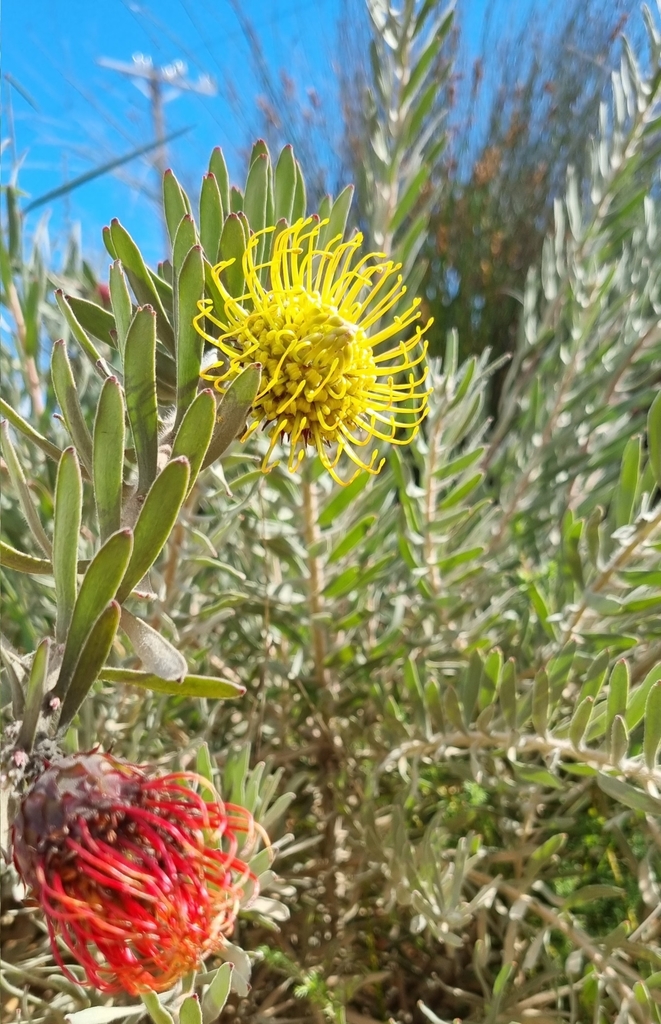
Redelinghuys Pincushion
Leucospermum arenarium
Leucospermum arenarium is a lax, evergreen shrub, with arching and drooping branches, that has been assigned to the family Proteaceae. It has loosely spaced, upright, greyish, narrowly egg-shaped to line-shaped leaves, mostly without teeth and flattened globe-shaped flower heads of 5–7 cm (2–2¾ in) across, consisting of mostly creamy, seldom yellow flowers, that curve in the bud to the center of the head. From the center of the flowers emerge curved styles that jointly give the impression of a pincushion. The common name in English is Redelinghuys pincushion. It only occurs in a very small area in the Western Cape province of South Africa. It flowers between July and October. Unlike in related species the flowers are pollinated by hairy-footed gerbils and striped field mice.
From the article Leucospermum arenarium on Wikipedia (CC BY-SA), quoted section by section
Description
Leucospermum arenarium is a low spreading shrub of up to ¾ (2½ ft) high and 1–1½ m (3–5 ft) in diameter, that grows from a single trunk at its base of 4–5 cm (1½–2 in) thick, covered with a smooth grey bark. The flowering stems are lax, arching and drooping to the ground, sometimes even trailing. The leaves on the flowering stems are loosely spaced, upright, narrowly egg-shaped to line-shaped, 6–8 cm (2½–3¼ in) long and about 7 mm (¼ in) wide, mostly with an entire margin, rarely with two or three teeth near the tip, the base slightly wedge-shaped and twisted, greyish due to a dense layer of fine crisped hairs. The flower heads are flattened globe-shaped, 5–7 cm (2–2¾ in) in diameter, mostly individually set but sometimes grouped in pairs at the end of the drooping branches, each on a very short or short stalk of up to 4 cm long. The common base of the flowers in the same head is flattened, wide cone-shaped, both about 1½ cm (0.6 in) long and wide. …
Range & habitat
The Redelinghuys pincushion can be found near the Piketberg where it grows on a level plain at 120–150 m (400–500 ft) altitude, between the Mierberg and the Klein Tafelberg (approximately midway between Redelinghuys and Aurora). The rather widely scattered plants grow in deep white Tertiary sands, in a vegetation that also contains other Proteaceae such as Leucadendron pubescens and Serruria fucifolia, large tufts of the Restionid Willdenowia lucaeana, Rhus rosmarinifolia and Erica (Griesebachia) species. In this area, the average annual precipitation is 250–380 mm (10–15 in), which mainly falls during the winter. The flowers are pollinated by rodents. Hairy-footed gerbils Gerbillurus paeba, and striped field mice Rhabdomys pumilio were observed to visit the flowers of L. arenarium, and both carried its pollen on forehead and breast. L. arenarium nectar is thick and is present in a cup-like structure at the tips of the perianth lobes. Here, mice can lick it off without having to damage the flowers. While the styles are rather short and straight in the insect-pollinated relatives, the Redelinghuys pincushion has much longer styles that curve strongly towards the center of the head, making the pollen transfer to the mice more effective. …
Wikipedia: “Distribution, habitat and ecology”
Where it lives
Recorded sightings
—
geo-referenced records in GBIF, from museums, herbaria and field observers.
Drag the globe to turn it. Dots are where records exist, not a range map; darker means more records.
In the stacks
Searching the stacks…
Every page naming Leucospermum arenarium in the Biodiversity Heritage Library →
This page is assembled live from iNaturalist, GBIF, Wikipedia, the Source Library and the Internet Archive. It is not yet part of the hand-edited codex. iNaturalist taxon 589114.