- Plants
- ›Vascular Plants
- ›flowering plants
- ›Dicots
- ›proteas, lotuses, planes, and allies
- ›Protea family
- ›Singlet Proteas
- ›Nutseed Proteoid Clade
- ›Cape Nutseed Proteoids
- ›Leucospermum
- ›Tumiditubus
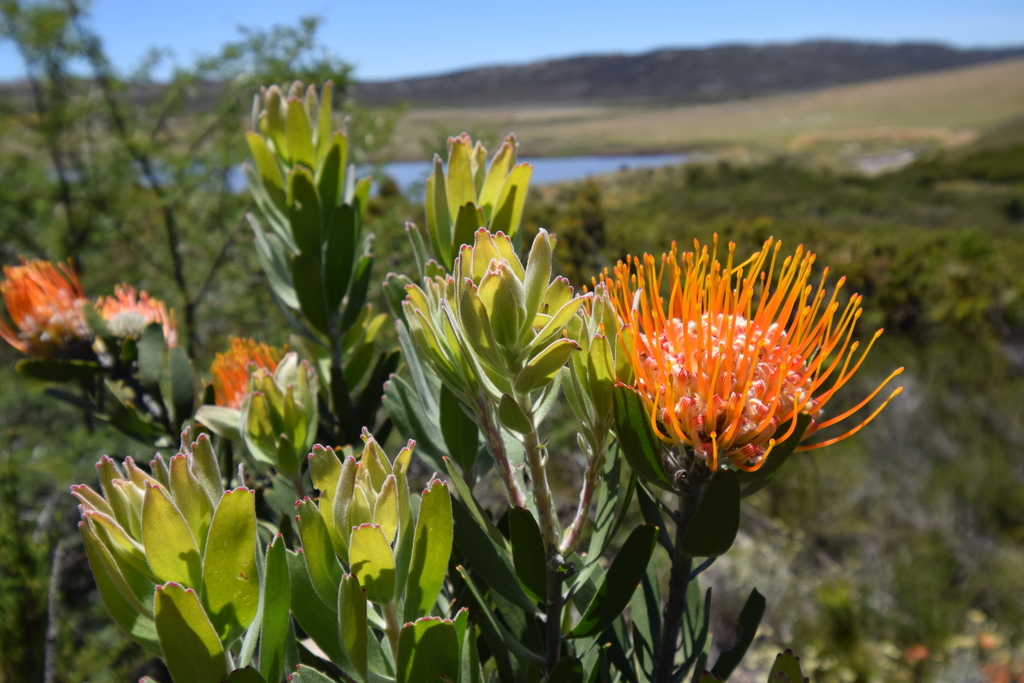
Oudtshoorn Pincushion
Leucospermum erubescens
Leucospermum erubescens is an evergreen shrub of up to 2 m (6 ft) high, with hairless, lancet-shaped to oval leaves with three to seven teeth near the tip of 7–8½ cm (2.8–3.4 in) long and 1–2 cm (0.2–0.4 in) wide, slightly asymmetric, oval flower heads of 5–6½ cm (2–2½ in) in diameter, and usually with four to eight clustered near the end of the branches, with initially yellow flowers, that change to deep crimson, from which long styles stick out, giving the flowerhead as a whole the appearance of a pincushion. It is called orange flame pincushion in English and oranjevlamspeldekussing in Afrikaans. It can be found in South Africa. Flowers may be found between August and January.
From the article Leucospermum erubescens on Wikipedia (CC BY-SA), quoted section by section
Description
The orange flame pincushion is an evergreen upright shrub of 1–1½, at most 2 m (6 ft) high, which has a single stem, and whose branches are covered with a smooth grey bark. The flowering stems are upright and ½–1 cm (0.2–0.4 in) thick and covered by a dense layer of fine cringy hairs. The leaves are hairless, pointing slightly upward, somewhat overlapping, oblong to lance-shaped, with the widest part nearer to the tip, 7–8½ cm (2.8–3.4 in) long and 1–2 cm (0.4–0.8 in) wide, the tip more or less squared off and often with three, sometimes up to seven teeth near the tip. The oval flower heads are 5–6 cm (2.0–2.4 in) in diameter and set on a 2–3 cm (1.8–2.2 in) long stalk and usually grouped with four to eight together near the end of the stems. They are somewhat asymmetrical with the styles leaning a bit towards the stem. The common base of the flowers in the same head is asymmetric broadly cone-shaped or like half a sphere, about 1.3 cm (0.52 in) in diameter and clearly distinguished from the stalk. …
Range & habitat
The orange flame pincushion has a very limited range on the northern foothills of the Langeberg, where it can be found between Muiskraal and Brandrivier, in a narrow strip of arid fynbos bordering the Little Karoo and an isolated population at Warmbad, situated on the Warmwaterberg. The plants grow on gravel flats or the rocky hill of weathered Table Mountain Sandstone, at elevations between 450–600 m (1,480–1,970 ft). In these locations, the annual precipitation is 250–375 mm (10–15 in), which mainly falls during the winter. Nectar-feeding birds, such as the Cape sugarbird and several sunbirds pollinate the flowers. Large insects, such as monkey beetles also visit the flower, but do not necessarily brush along the pollen presenters and may be inefficient as pollinators. The fruits are ripe approximately two months after flowering and subsequently fall to the ground. These are collected by ants that carry them underground into their nests. Here, the soft, pale elaiosome is eaten, and the hard, smooth seed remains underground. After a wildfire has destroyed the above ground vegetation, the seeds germinate at 5–10 °C (41–50 °F) at night and 15–20 °C (59–68 °F) during the day, and germination is stimulated by smoke residues in the water.
Wikipedia: “Distribution, habitat and ecology”
Where it lives
Recorded sightings
—
geo-referenced records in GBIF, from museums, herbaria and field observers.
Drag the globe to turn it. Dots are where records exist, not a range map; darker means more records.
In the stacks
Searching the stacks…
Every page naming Leucospermum erubescens in the Biodiversity Heritage Library →
This page is assembled live from iNaturalist, GBIF, Wikipedia, the Source Library and the Internet Archive. It is not yet part of the hand-edited codex. iNaturalist taxon 589116.