- Plants
- ›Vascular Plants
- ›flowering plants
- ›Dicots
- ›proteas, lotuses, planes, and allies
- ›Protea family
- ›Singlet Proteas
- ›Nutseed Proteoid Clade
- ›Cape Nutseed Proteoids
- ›Leucospermum
- ›Crinitae
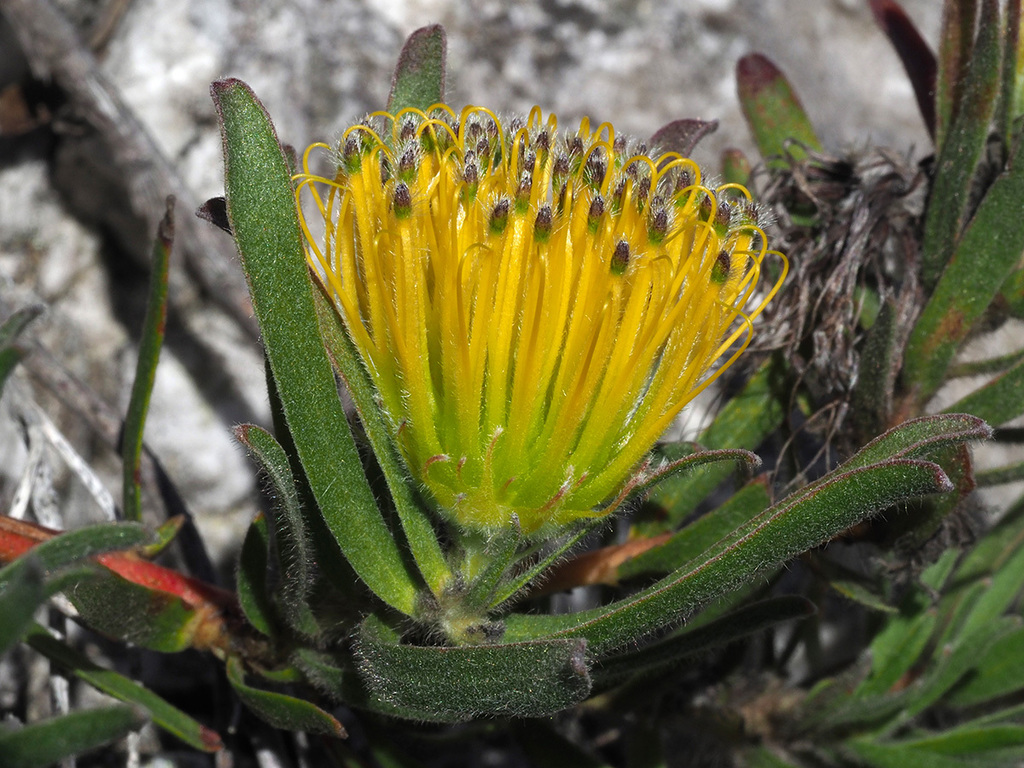
Hermanus Pincushion
Leucospermum gracile
Leucospermum gracile is a low spreading shrub of 30–40 cm (1–1⅓ ft) high and forms open mats of 1½ m (5 ft) in diameter, from the family Proteaceae. It has reddish flowering stems, oblong to linear leaves of 2–4½ cm (0.8–1.8 in) long and 2–5 mm (0.08–0.20 in) wide, with one or three teeth. The initially yellow, later orange flower heads of 2½–3 cm (1.0–1.2 in) in diameter are flat-topped. The flower heads occur from July to October. From the flowers occur long styles with a slightly thicker tip, which together give the impression of a pincushion. It is called Hermanus pincushion in English. It naturally occurs in fynbos in the southern mountains of the Western Cape province of South Africa.
From the article Leucospermum gracile on Wikipedia (CC BY-SA), quoted section by section
Description
Leucospermum gracile is a low spreading shrub of 30–40.0 cm (1–1⅓ ft) high that develops from a trunk at the base and forms open mats of 1½ m (5 ft) in diameter. The reddish flowering stems are slender, 2–3 mm (0.08–0.12 in) thick, felty and sometimes later hairless, that trail across the ground. The thinly felty or powdery leaves are oblong to linear, 2–4½ cm (0.8–1.8 in) long and 2–5 mm (0.08–0.20 in) wide, the far end blunt, entire or split in three lobes ending in a thick, bony tooth, and with a blunt or cut-off base. The leaves are mostly spaced widely and directed straight upwards, sometimes at a more relaxed angle. The flower heads have a whorl shape (or are turbinate), are 2½–3 cm (1.0–1.2 in) in diameter, seated or with a stalk of up to 2 cm long, usually at a right angle with the stem. The common base of the flowers in the same head is flat and about ½ cm (0.2 in) wide. …
Range & habitat
Leucospermum gracile can be found on Shaw's Mountain between Caledon in the north and Hermanus and through the Onrus Mountains and Kleinrivier Mountains, eastwards to the hillsides near Napier, usually at 100–300 m (300–1000 ft) altitude, sometimes reaching 900 m (3000 ft). It always grows in very well drained locations, particularly in the sandy surface layers of weathered and crumbling Table Mountain Sandstone. The location further to the north near Bot River where Schlechter collected, probably went extinct as a result of agricultural introduction. The species is pollinated by birds. The ripened fruit fall to the ground approximately two months after flowering. Native ants carry them to their underground nests to eat the elaiosome. The seed remains dormant until a fire has destroyed the above-ground biomass.
Wikipedia: “Distribution, habit and ecology”
Where it lives
Recorded sightings
—
geo-referenced records in GBIF, from museums, herbaria and field observers.
Drag the globe to turn it. Dots are where records exist, not a range map; darker means more records.
In the stacks
Searching the stacks…
Every page naming Leucospermum gracile in the Biodiversity Heritage Library →
This page is assembled live from iNaturalist, GBIF, Wikipedia, the Source Library and the Internet Archive. It is not yet part of the hand-edited codex. iNaturalist taxon 589119.