- Plants
- ›Vascular Plants
- ›flowering plants
- ›Dicots
- ›proteas, lotuses, planes, and allies
- ›Protea family
- ›Singlet Proteas
- ›Nutseed Proteoid Clade
- ›Cape Nutseed Proteoids
- ›Leucospermum
- ›Crinitae
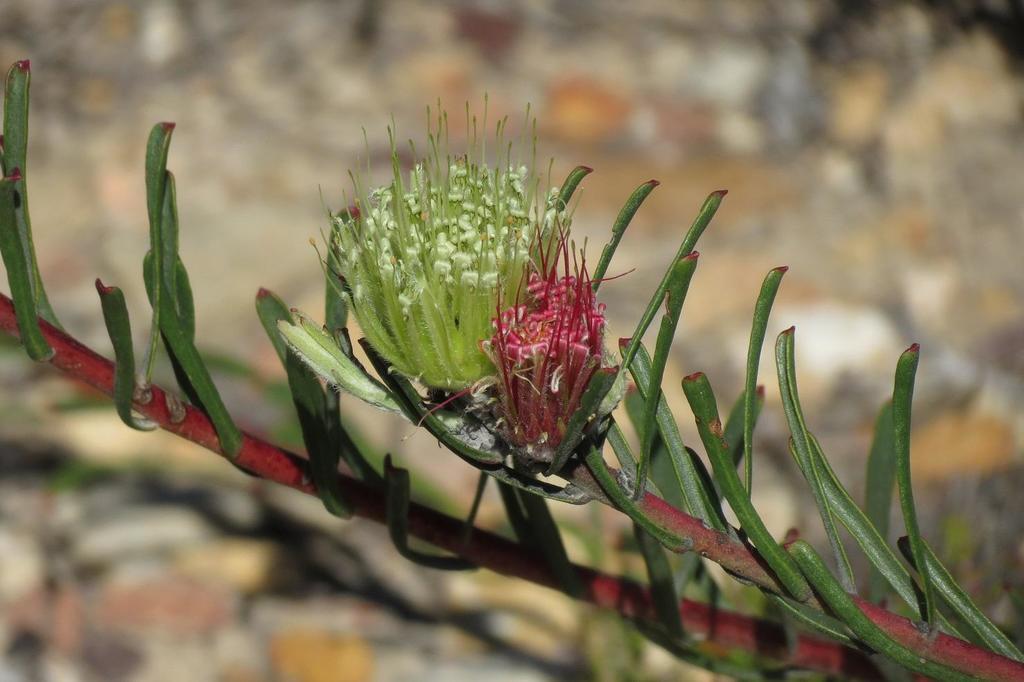
Karoo Pincushion
Leucospermum saxatile
Leucospermum saxatile is an evergreen, rising to sprawling shrub of 0.5–0.8 m (1.7–2.5 ft) high and 1–1.5 m (3.3–5 ft) wide, from the family Proteaceae. It has reddish tinged flowering stems and line-shaped, narrowing wedge-shaped leaves of 2.5–5 cm(1–2 in) long and 2–5 mm (0.08–0.20 in) wide, with one to three blunt teeth, whorl-shaped, flat-topped, at first pale lime green but later carmine flower heads of 2.5–3 cm (1–1.3 in) across, mostly individually but sometimes grouped with two or three, each on a stalk. The flower heads occur from July to October. From the flowers occur long styles with a slightly thicker tip, which together give the impression of a pincushion. It is called Karoo pincushion in English. Flowering heads can be found from July until February. It naturally occurs in fynbos in the Western Cape province of South Africa.
From the article Leucospermum saxatile on Wikipedia (CC BY-SA), quoted section by section
Description
Leucospermum saxatile is a low, rising to sprawling shrub of 0.5–0.75 m (1.7–2.5 ft) high and 1–1.5 m (3.3–5 ft) wide. The reddish tinged flowering stems initially carry some soft hairs, which are soon lost, and are 2–4 mm (0.08–0.16 in) thick. The leaves are loosely pointing at an angle towards the tip of the stem, or are very rarely pointed upward, are line-shaped, narrowing wedge-shaped to the foot, 2.5–5 cm(1–2 in) long and 2–5 mm (0.08–0.20 in) wide, initially covered in powdery hairs, which are soon lost. The tip mostly has one thickened tooth, sometimes two or three and the margins often curl inwards. The flower heads are whorl-shaped (or turbinate), 2.5–3 cm (1–1¼ in) across, usually set individually but occasionally grouped with two or three, each on a stalk of 0.5–1.5 cm (0.2–0.6 in) long. The common base of the flowers in the same head is flat, approximately 7 mm (0.28 in) across. The bracts that subtend the head are lance-shaped with a pointy or pointed tip, 0.5–1 cm (0.2–0.4 in) long and about 2 mm (0.08 in) wide, cartilaginous in consistency, softly hairy, and set in four overlapping whorls. The bract that subtends each flower individually is densely silky hairy, with a regular row of equal-length hairs along the edge, lance-shaped with a pointy or pointed tip, 1¼–2.5 cm (0.5–0.6 in) long and 2–2.5 mm (0.08–0.10 in) wide. …
Range & habitat
Leucospermum saxatile only occurs in a narrow zone of so-called arid fynbos, along the northern slopes of the Langeberg near Riversdale district, fringing the renosterveld of the Little Karroo, from Rietvlei westwards to Muiskraal, a distance of just 30 km (20 mi), at an altitude of 450–600 m (1500–2000 ft). Locally dense stands either scramble over the neighboring shrubs or spread across the barren rock.
Wikipedia: “Distribution and ecology”
Where it lives
Recorded sightings
—
geo-referenced records in GBIF, from museums, herbaria and field observers.
Drag the globe to turn it. Dots are where records exist, not a range map; darker means more records.
In the stacks
Searching the stacks…
Every page naming Leucospermum saxatile in the Biodiversity Heritage Library →
This page is assembled live from iNaturalist, GBIF, Wikipedia, the Source Library and the Internet Archive. It is not yet part of the hand-edited codex. iNaturalist taxon 589131.