- Plants
- ›Vascular Plants
- ›flowering plants
- ›Dicots
- ›proteas, lotuses, planes, and allies
- ›Protea family
- ›Singlet Proteas
- ›Nutseed Proteoid Clade
- ›Cape Nutseed Proteoids
- ›Leucospermum
- ›Tumiditubus
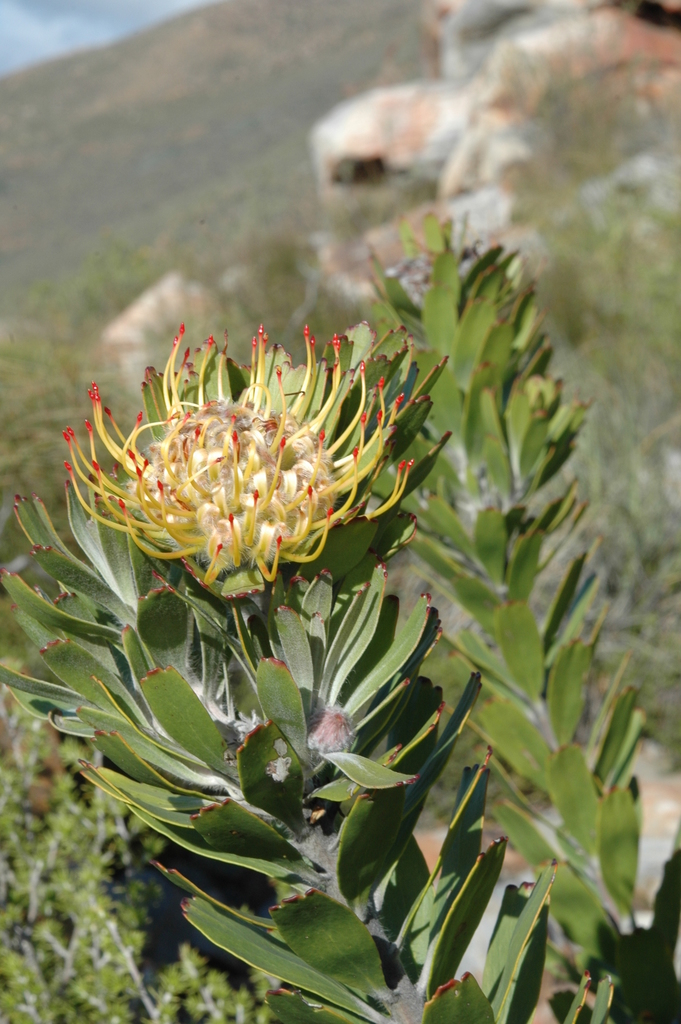
Breede River Pincushion
Leucospermum utriculosum
Leucospermum utriculosum is a lax, evergreen, upright and arching shrub of 1–2 m (3–6½ ft) high, from the family Proteaceae. It has hairless inverted lance-shaped to oblong leaves tipped with three to five teeth and globe-shaped to flattened light yellow to coppery flowerheads of 5–8 cm (2.0–3.2 in) in diameter. From the center of the flowers emerge almost straight styles that jointly give the impression of a pincushion. It is called Breede River pincushion in English. Although flower heads may occur on and off between May and March, the peak season is from September to November. It is known from the Western Cape province of South Africa.
From the article Leucospermum utriculosum on Wikipedia (CC BY-SA), quoted section by section
Description
Leucospermum utriculosum is an upright or spreading shrub of 1–2 m (3–6½ ft) high and 2–3 m (6½–10 ft) across, with an informal habit. Its branches grow out at an angle up to the horizontal and often droop to the ground. It grows from a stout single main stem that branches low down, and is covered in a smooth, grey bark. The flowering stems are about 3½ mm (0.14 in) thick, and covered in fine crisped hairs and long, straight, silky hairs. The hairless leaves are inverted lance-shaped with a wedge-shaped base narrowing to a stalk, the tip cut-off, with three to five stout teeth of 4½–7 cm (1.8–2.8 in) long and 1–2 cm (0.4–0.8 in) wide. The more or less flattened globe-shaped flowerheads of 5–8 cm (2.0–3.2 in) in diameter have a stalk of about 1 cm (0.4 in) long, are usual set individually but sometimes grouped in twos or threes. The common base of the flowers in the same head is broadly cone-shaped, about 1 cm (0.4 in) long and approximately ¾ cm across. …
Range & habitat
The Breederiver pincushion can be primarily found in the area of McGregor, Robertson and Stormsvlei, and along the north slopes of the Potberg, all the way to the mouth of the Breede River. L. utriculosum exclusively grows on north facing, dry and very rocky slopes at 60–600 m (200–2000 ft) elevation. Along its distribution range, average annual precipitation is 250–380 mm (10–15 in), most of which falls during the winter half year. The soil it grows on is weathered Table Mountain Sandstone/Quartzite in the southeast and either Table Mountain Sandstone or Witteberg Quartzite to the northwest. The species may form quite dense stands locally. Some of the locations have such sparse vegetation that fire is not sustained, and many old plants can be found, their main stems tightly wedged in the crevices between the rocks.
Wikipedia: “Distribution, habitat and ecology”
Where it lives
Recorded sightings
—
geo-referenced records in GBIF, from museums, herbaria and field observers.
Drag the globe to turn it. Dots are where records exist, not a range map; darker means more records.
In the stacks
Searching the stacks…
Every page naming Leucospermum utriculosum in the Biodiversity Heritage Library →
This page is assembled live from iNaturalist, GBIF, Wikipedia, the Source Library and the Internet Archive. It is not yet part of the hand-edited codex. iNaturalist taxon 589137.