- Plants
- ›Vascular Plants
- ›flowering plants
- ›Dicots
- ›Sunflowers, Bellflowers, Fanflowers, and Allies
- ›Sunflowers, Daisies, Asters, and Allies
- ›Thistles and Allies
- ›Dicomeae
- ›Macledium
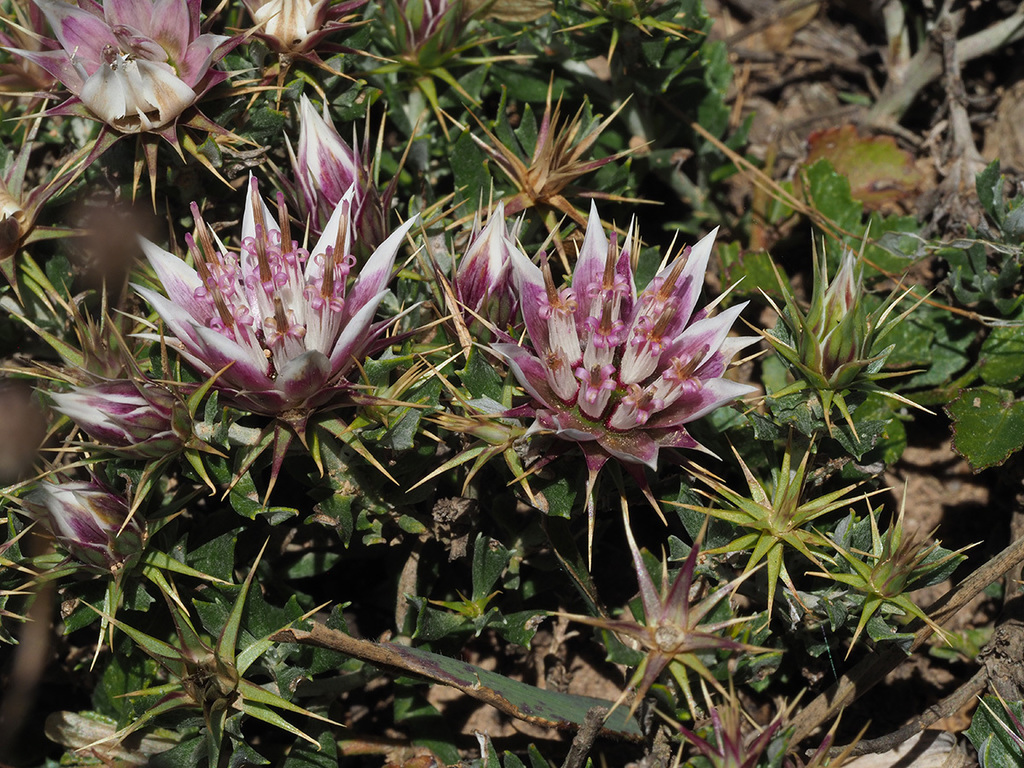
Spiny Dollprotea
Macledium spinosum
Macledium spinosum is a variable species of flowering plant in the family Asteraceae, that is endemic to the southern Cape regions of South Africa.
From the article Macledium spinosum on Wikipedia (CC BY-SA), quoted section by section
Description
A low, compact, spreading shrub, reaching a maximum of 50 cm in height. The leaves are small (15 x 5mm), spiny, with a grey, velvet leaf-surface. The wide (20 mm) protea-like flowerheads appear in Spring and Summer, and range in colour from white to purple.
Related species. A closely related species, Macledium relhanioides, occurs in similar areas in the western Little Karoo and Overberg, but tends to be confined to quartzitic outcrops and quartz-fields. Macledium relhanioides differs by having longer leaves (20 mm) and smaller flowerheads (10 mm) that have prominent pink, spiny bracts (but only rudimentary ray-florets).
Range & habitat
This species can be found from Worcester in the west, eastwards through the Little Karoo and Overberg regions, as far east as Somerset East. It is most common in clay-rich, shale-derived soils, in Renosterveld and Succulent Karoo vegetation types.
Wikipedia: “Distribution and habitat”
Where it lives
Recorded sightings
—
geo-referenced records in GBIF, from museums, herbaria and field observers.
Drag the globe to turn it. Dots are where records exist, not a range map; darker means more records.
In the stacks
Searching the stacks…
Every page naming Macledium spinosum in the Biodiversity Heritage Library →
This page is assembled live from iNaturalist, GBIF, Wikipedia, the Source Library and the Internet Archive. It is not yet part of the hand-edited codex. iNaturalist taxon 589516.