- Plants
- ›Vascular Plants
- ›flowering plants
- ›Dicots
- ›begonias, gourds, and allies
- ›gourd family
- ›Momordiceae
- ›Momordica
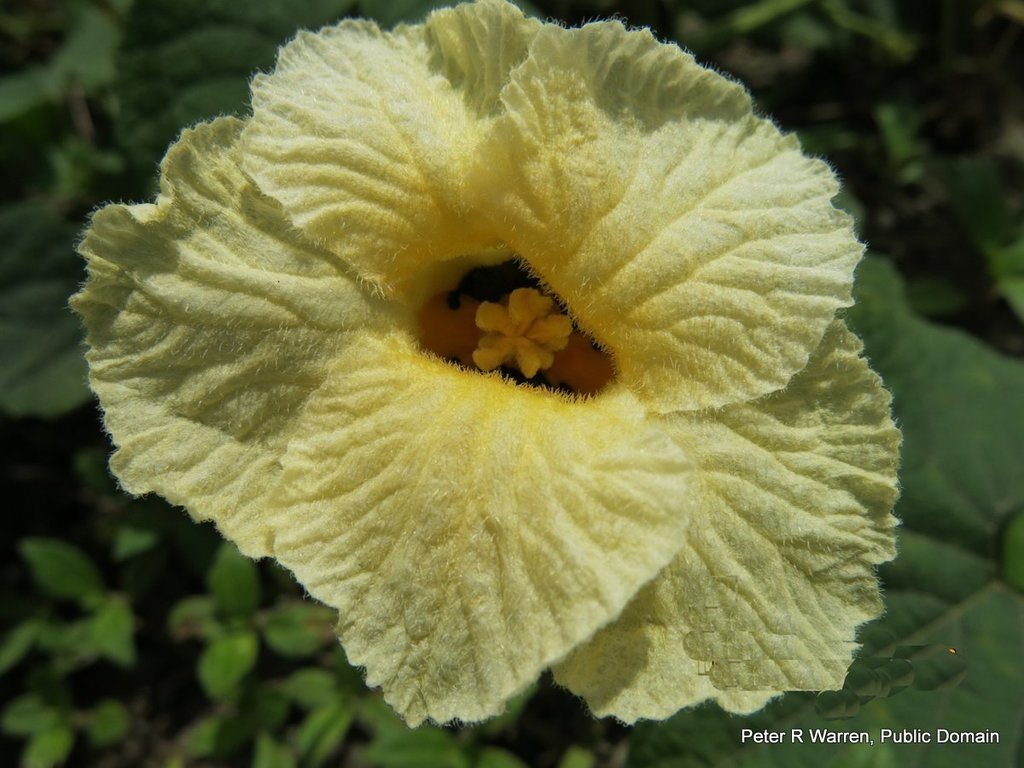
Momordica foetida
Momordica foetida is a perennial climbing vine native of tropical Africa, closely related to the bitter melon (M. charantia) and balsam apple (M. balsamina). Its species name ("bad-smelling") refers to its unpleasant smell. It was previously named M. morkorra (A. Rich) and M. cordata (Cogn.)
The plant grows in forest edges and similar habitats (including disturbed and cultivated land), woodland, and wooded grassland. Its leaves are wrinkled, heart-shaped with irregular edges, up to 18 cm wide. The flowers are yellow to yellow-orange. The fruit is a prolate spheroid, 3.5–7.5 cm long and 2.5–5 cm wide, bright orange and covered with soft spines. When fully ripe it splits from the bottom into three valves, exposing a cluster of black seeds, individually covered by a bright red, sticky, sweet pulp. The plant has perennial tuberous roots.
From the article Momordica foetida on Wikipedia (CC BY-SA), quoted section by section
What it does
In the Ivory Coast a preparation of the leaves is used as an aphrodisiac and is taken by women as an emmenagogue and as childbirth helper. In Uganda, tea from leaves or roots is used as an abortifacient and an ecbolic.
Wikipedia: “Reproduction”
At the table
The leaves have a bitter taste, but are eaten in Gabon and Malawi. The fruit are edible and are consumed in various countries, including Ghana, Gabon, Sudan, and Tanganyika. The root is considered edible in Sudan.
Wikipedia: “Food”
In medicine
Like its relative M. charantia, the plant contains a number of bioactive compounds, including sitosteryl glucoside, 5,25-stigmastadien-3β-yl glucoside, and 1β-hydroxyfriedel-6-en-3-one, and several cucurbitane-type triterpenoid derivatives.
Digestive disorders. In Tanganika, young leaves are taken for stomachache and the root is considered a purgative. The Edo of Nigeria drink leaf sap for intestinal disorders. The Igbo take it for iba ozi. In Gabon, the leaves are used as emetic and for enemas. The leaf is also as used against roundworm.
Pain relief. The leaf sap is used to treat severe headache and earache. In Malawi, headache is treated by binding the head with the plant stem.
Reproduction. In the Ivory Coast a preparation of the leaves is used as an aphrodisiac and is taken by women as an emmenagogue and as childbirth helper. In Uganda, tea from leaves or roots is used as an abortifacient and an ecbolic.
Skin conditions. In the Ivory Coast, a leaf-decoction is used to treat smallpox. The root is used in Tanganyika to wash small children and mothers' breasts. In South Africa, a root decoction with other plants is taken for boils.
Snake bites. The inflammation caused by the venom of the spitting cobra, (Naja nigrocollis) can be prevented by promptly rubbing the skin with crushed leaves and chewing them. The leaf sap is drunk to treat snakebite.
Other conditions. …
Wikipedia: “Folk medicine”
Where it lives
Recorded sightings
—
geo-referenced records in GBIF, from museums, herbaria and field observers.
Drag the globe to turn it. Dots are where records exist, not a range map; darker means more records.
In the stacks
Searching the stacks…
Every page naming Momordica foetida in the Biodiversity Heritage Library →
This page is assembled live from iNaturalist, GBIF, Wikipedia, the Source Library and the Internet Archive. It is not yet part of the hand-edited codex. iNaturalist taxon 590055.