- Plants
- ›Vascular Plants
- ›flowering plants
- ›monocots
- ›grasses, sedges, cattails, and allies
- ›Sedges
- ›Cyperoideae
- ›Schoenoplectieae
- ›Schoenoplectus
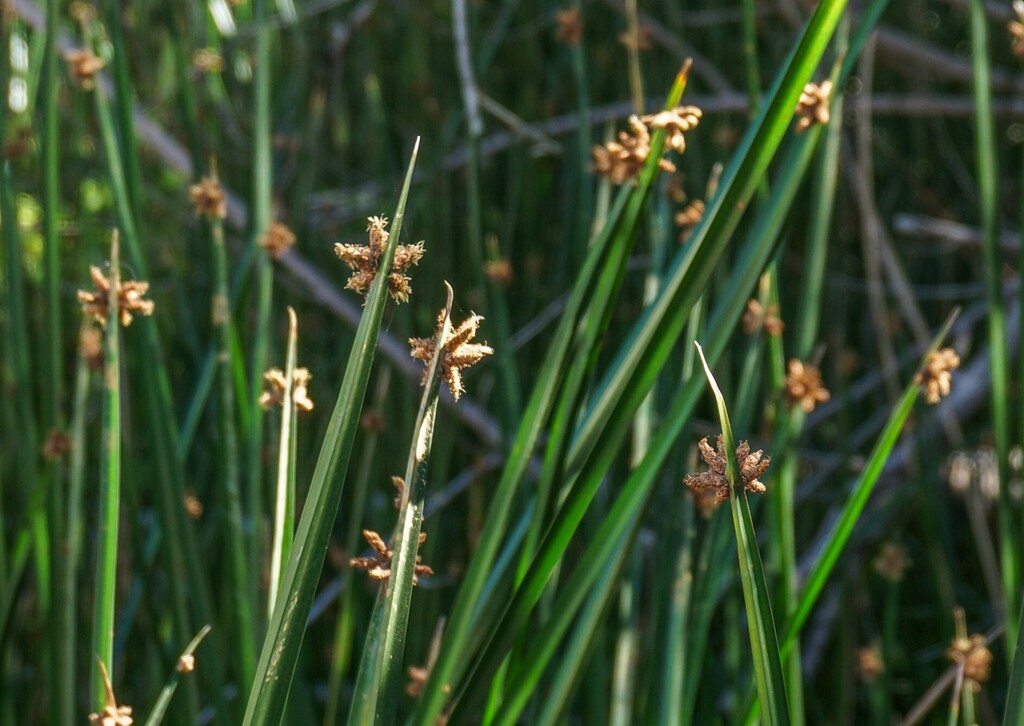
American three-square bulrush
Schoenoplectus americanus
Schoenoplectus americanus (syn. Scirpus americanus) is a species of flowering plant in the sedge family known by the common names chairmaker's bulrush and Olney's three-square bulrush. It is native to the Americas, where it is known from Alaska to Nova Scotia and all the way into southern South America; it is most common along the East and Gulf Coasts of the United States and in parts of the western states. It grows in many types of...
From the article Schoenoplectus americanus on Wikipedia (CC BY-SA), quoted section by section
Description
This perennial herb easily exceeds 2 metres (6+1⁄2 ft) in height. The stiff stems are sharply three-angled and usually very concave between the edges. Each plant has three or fewer leaves which are short and narrow. The inflorescence is a small head of several spikelets which may be brown to bright orange, red, purplish, or pale and translucent. They have hairy edges. The fruit is a brown achene. The plant reproduces sexually by seed and colonies spread via vegetative reproduction, sprouting from the rhizomes.
Range & habitat
It is native to the Americas, where it is known from Alaska to Nova Scotia and all the way into southern South America; it is most common along the East and Gulf Coasts of the United States and in parts of the western states. It grows in many types of coastal and inland wetland habitat, as well as sagebrush, desert scrub, chaparral, and plains.
Wikipedia: “Distribution and habitat”
What it does
This plant, particularly the rhizomes, are a food source of muskrat, nutria, and other animals; it is strongly favored by the snow goose in its wintering grounds.
Wikipedia: “Ecology”
At the table
Native American groups used this plant for many purposes, including food, basketry, and hatmaking. It is used for revegetation projects in salt marsh habitat in its native range. It is a model organism in the study of salt marsh ecology and its response to climate change (currently global warming).
Wikipedia: “Uses”
Where it lives
Recorded sightings
—
geo-referenced records in GBIF, from museums, herbaria and field observers.
Drag the globe to turn it. Dots are where records exist, not a range map; darker means more records.
In the stacks
Searching the stacks…
Every page naming Schoenoplectus americanus in the Biodiversity Heritage Library →
This page is assembled live from iNaturalist, GBIF, Wikipedia, the Source Library and the Internet Archive. It is not yet part of the hand-edited codex. iNaturalist taxon 59066.