- Plants
- ›Vascular Plants
- ›flowering plants
- ›monocots
- ›lilies, supplejacks, and allies
- ›Herb-Paris, False Hellebores, Trilliums and allies
- ›Melanthieae
- ›Toxicoscordion
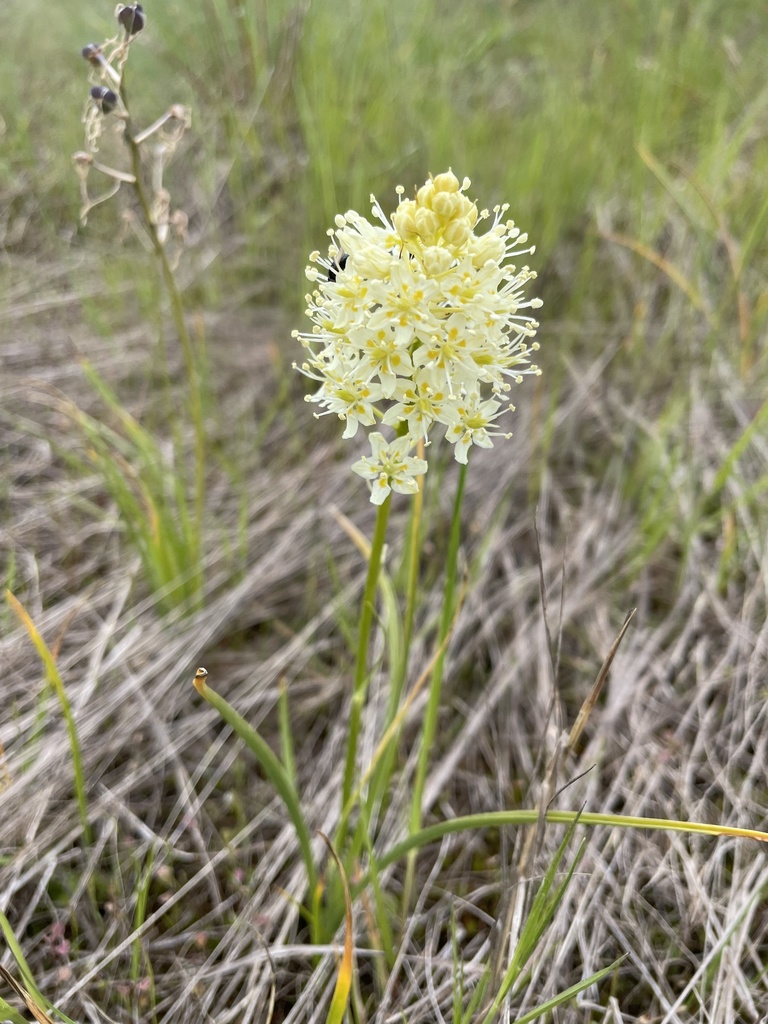
Meadow Deathcamas
Toxicoscordion venenosum
Toxicoscordion venenosum, with the common names death camas and meadow death camas, is a species of flowering plant in the family Melanthiaceae. It grows up to 70 centimetres (27+1⁄2 in) tall. Both its common names and its scientific name reference its toxic qualities.
The species is native to western North America. Because its nectar is poisonous, it is mainly pollinated by the death camas miner bee.
From the article Toxicoscordion venenosum on Wikipedia (CC BY-SA), quoted section by section
Description
Toxicoscordion venenosum is a bulb plant 20–70 centimetres (8–27+1⁄2 in) tall when flowering in the spring or early summer. The underground bulbs are egg-shaped (ovoid) and tunicate, made up of multiple layers protected by dried outer layers like an onion. The plant's leaves appear very early in the spring and are narrow. Most of the leaves are basal, springing directly from the ground, though a few much smaller ones may attach to the flowering stem. The length of the leaf blade is 12–50 cm (4+1⁄2–19+1⁄2 in) long while only being 2–10 millimetres (1⁄8–3⁄8 in) wide. The leaves are sharply folded into a "V" shape along their length, quite unlike the leaves of wild onions, with a keel, a ridge at the bottom of the fold.
Flowering. The inflorescence usually does not have branches and is a raceme, but will sometimes have one or two branches near the base and be a panicle. If a plant does have branches, they will be one tenth to one third the length of the stem. It may be as much as 20 cm (8 in) long, or as short as 2 cm (3⁄4 in). There may be ten to fifty flowers on the flowering stem. The top of the flowering stem will be pyramidal in shape when blooming begins with smaller buds and immature flowers towards the top and open flowers towards the base. The flowers are off-white and resemble six pointed stars. …
Range & habitat
Meadow death camas is found through much of western North America. In Canada it is found in three western provinces: Alberta, British Columbia, and Saskatchewan. In the United States, it grows from the West Coast to the Rocky Mountains (with the exception of Arizona). This includes California, Colorado, Idaho, Montana, Nebraska, Nevada, New Mexico, North Dakota, Oregon, South Dakota, Utah, Washington, and Wyoming. It also grows in the Mexican state of Baja California. The meadow death camas grows in more open, sunny habitats. The variety venenosum grows in grasslands and open pine woodlands of the interior from 500 to 1,300 metres (1,600 to 4,300 ft). The variety gramineum grows in well drained grasslands and coastal areas from sea level to as much as 2,500 m (8,200 ft). They prefer wet areas, but can grow in much drier habitats than common camas (Camassia quamash) such as on hillsides in the Sierra Nevada. They may also be found in opening in coniferous forests and among the sagebrush of the interior.
Wikipedia: “Distribution and habitat”
What it does
The nectar is also poisonous; controlled experiments have shown that honeybees can be fatally poisoned by the flowers, and it or its relative are suspected in a few cases of honeybee poisonings. The plant is visited by a specialist miner bee, the death camas miner bee (Andrena astragali), which is likely the only bee that can tolerate its toxins. In turn the bee is an oligolege, a species that specializes in the pollen of only a few species of flower. The death camas miner bee specializes in meadow death camas and the closely related Toxicoscordion paniculatum. Seed production for the plant is also significantly increased by bees visiting the flowers. Theories as to what advantages specialization and toleration of the toxicity of the nectar and pollen provide include that the lack of competitors for the food resources provided by the flowers and that, as with the monarch butterfly, ingesting toxic food protects the bees from predators and parasites by making them toxic. Though the death camas bee is the only bee that feeds upon death camas flowers, a fly species, Earomyia melnickae, was described in 2022 which was discovered feeding on the meadow death camas flowers. As of 2024 it is unknown where or what the species may feed upon as a larva. Extensive searches were made on the bulbs in the area where the flies were discovered, but no signs of feeding or larvae were discovered. …
Wikipedia: “Ecology”
At the table
Though well aware of the poisonous nature of the plants, the indigenous Paiute people have made use of crushed bulbs as poultices for a range of ailments in an identical manner to Toxicoscordion paniculatum, which they called by the same name. It was used for burns, rattlesnake bites, rheumatism, and swellings. The naturalist Ira Noel Gabrielson dismissed the species and all of its relatives (except for Toxicoscordion fremontii) as a cultivated plant due to lacking "charm enough to take up room in a garden when so many more beautiful things are available". Despite this, the species is occasionally grown in wildflower meadows or perennial borders for its spring flowers in either full sun or partial shade. Due to the toxic nature of it and all its relatives, caution is urged to avoid planting it where herbivores would have access. In the Manual of Bulbs from the Royal Horticultural Society it is listed as tolerating winter temperatures at least as cold as −15 °C (5 °F). It is hardy in USDA zones 3b–9b.
Wikipedia: “Traditional uses”
Toxicity
This variety was first described by Per Axel Rydberg as a species named Zigadenus gramineus in 1900. However, it was generally recognized as a separate species until the 21st century. This variety is differentiated by more often having branches on it flowering stems and the outer tepals being less curved (clawed) than in var. venenosum. It is found in the Pacific Northwest, Colorado, Canada, and the northern plains, much more widely spread than the other variety.
Wikipedia: “Toxicoscordion venenosum var. gramineum”
Where it lives
Recorded sightings
—
geo-referenced records in GBIF, from museums, herbaria and field observers.
Drag the globe to turn it. Dots are where records exist, not a range map; darker means more records.
In the stacks
Searching the stacks…
Every page naming Toxicoscordion venenosum in the Biodiversity Heritage Library →
This page is assembled live from iNaturalist, GBIF, Wikipedia, the Source Library and the Internet Archive. It is not yet part of the hand-edited codex. iNaturalist taxon 59087.