- Plants
- ›Vascular Plants
- ›flowering plants
- ›Dicots
- ›proteas, lotuses, planes, and allies
- ›Protea family
- ›Singlet Proteas
- ›Nutseed Proteoid Clade
- ›Cape Nutseed Proteoids
- ›Paranomus
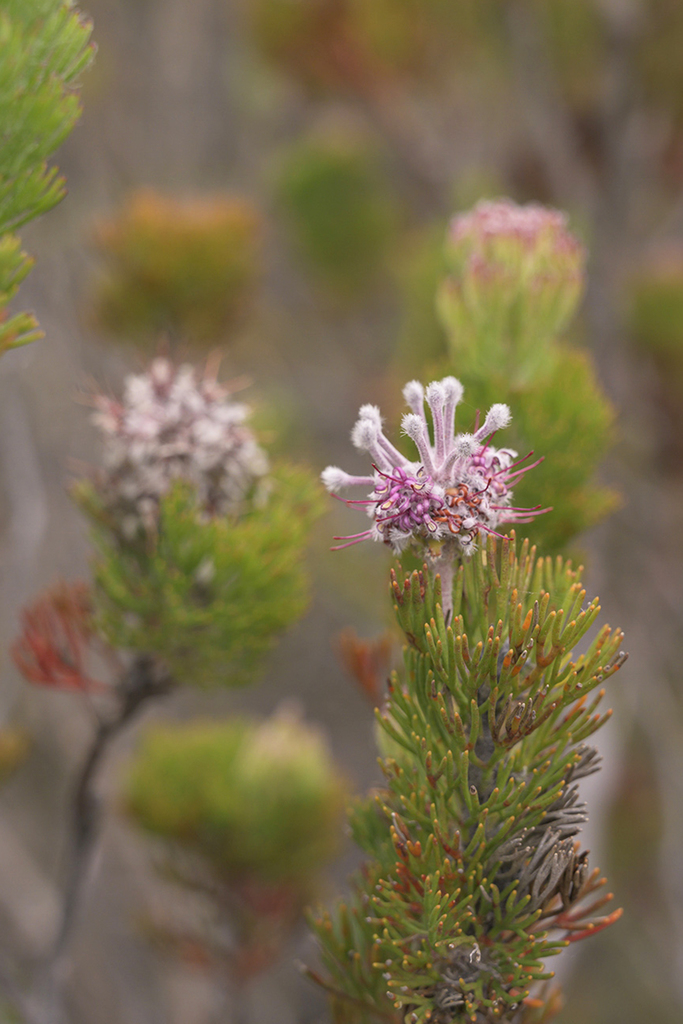
Bredasdorp Sceptre
Paranomus abrotanifolius
Paranomus abrotanifolius, commonly known as the Bredasdorp sceptre, is a richly branching shrub to 90 cm (35 in) high, with bisexual flowers that can be found from May to December, that is assigned to the protea family. It does not survive the periodic wild fires that occur in the fynbos, where it occurs. It is pollinated by insects. The fruits are ripe and release the seeds about two months after flowering, and the seeds are collected by ants, which take them to their underground nests to feed on their elaiosomes, a behaviour known as myrmecochory. This ensures that the seeds do not burn, so new plants can grow from them. It is a rare endemic species that is only known from ten locations near the southern coast of the Western Cape province of South Africa. It grows on weathered sandstone on the Potberg in De Hoop Nature Reserve and the Elim Flats.
From the article Paranomus abrotanifolius on Wikipedia (CC BY-SA), quoted section by section
Description
Paranomus abrotanifolius is a richly branching shrub that grows up to 90 cm (35 in) high, with branches covered with soft, weak, thin and clearly separated hairs (or pilose), alternately set with leaves that are all alike (unlike in some other Paranomus species), 4–5 cm (1.6–2.0 in) long, twice pinnately divided in the top half, soon losing the soft hairs, ending in slender segments that are circular in cross section with a stump tip and up to 1¼ cm (½ in) long. The flowers are grouped with four together in heads, and the heads themselves in dense spikes of about 6⅓ cm (2½ in) long and 1¼ cm (½ in) in diameter, and the spikes are on their own or with a few together at the tip of the branches. The stem of each spike is covered in felty hairs. The narrow, awl-shaped, densely felty bract that subtends each group of four flowers is about 8½ mm (⅓ in) long, while the almost papery bract supporting the individual flower is covered in dense long felty hairs on the outside, about 5 mm (0.2 in) long and 2½ mm (0.1 in) wide, oval in shape, with a gradually pointed tip. Just before opening, the flower is up to 8½ mm (⅓ in) long, the corolla tube may have soft short hairs or not, while the four free lobes are 7⅓ mm (0.3 in) long and coil when the flower opens. The anthers are directly attached to the inside of the corolla lobes with no discernible filament. …
Where it lives
Recorded sightings
—
geo-referenced records in GBIF, from museums, herbaria and field observers.
Drag the globe to turn it. Dots are where records exist, not a range map; darker means more records.
In the stacks
Searching the stacks…
Every page naming Paranomus abrotanifolius in the Biodiversity Heritage Library →
This page is assembled live from iNaturalist, GBIF, Wikipedia, the Source Library and the Internet Archive. It is not yet part of the hand-edited codex. iNaturalist taxon 591392.