- Plants
- ›Vascular Plants
- ›flowering plants
- ›monocots
- ›grasses, sedges, cattails, and allies
- ›grasses
- ›Pooideae
- ›Bromeae
- ›Bromus
- ›Genea
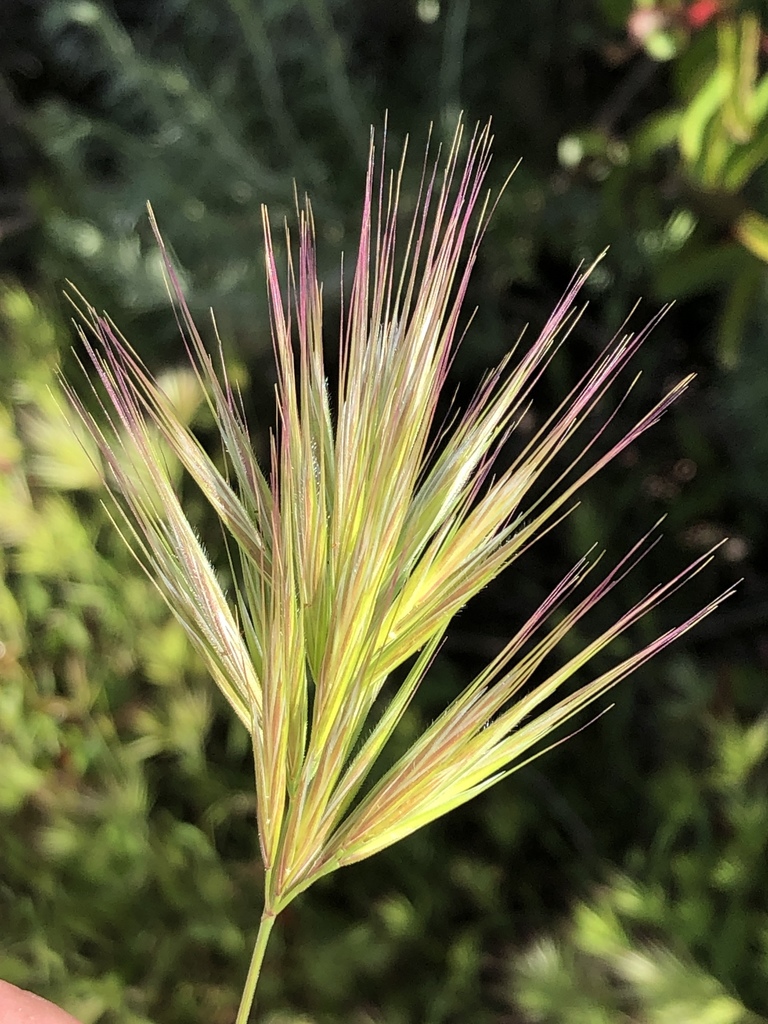
Red Brome
Bromus rubens
Bromus madritensis is a species of brome grass known by the common name compact brome. The specific epithet madritensis refers to Madrid, Spain. It has a diploid number of 28.
There are two subspecies:
From the article Bromus madritensis on Wikipedia (CC BY-SA), quoted section by section
Description
Bromus madritensis is a winter annual grass, growing solitary or tufted, with erect or ascending culms growing 20–70 cm (7.9–27.6 in) high. The leaf sheaths are downy or slightly hairy. The grass lacks auricles and the glabrous ligules are 1.5–2 mm (0.059–0.079 in) long. Its flat leaf blades are either glabrous or slightly hairy, and measure 4–20 cm (1.6–7.9 in) long and 1–5 mm (0.039–0.197 in) wide. The erect and ellipsoid panicles are 3–12 cm (1.2–4.7 in) long and 2–6 cm (0.79–2.36 in) wide, with short branches that ascend and slightly spread. The branches never droop and bear one or two spikelets each. The spikelets are 4–6 cm (1.6–2.4 in) long, longer than the panicle branches, and bear seven to eleven florets. The spikelets vary in color from green to distinctly purplish-red. The lightly hairy glumes taper at their ends and have translucent margins. The lower glumes are one-nerved and 5–10 mm (0.20–0.39 in) long, and the upper glumes are three-nerved and 10–15 mm (0.39–0.59 in) long. The glabrous and slightly rough lemmas are 1.5–2 cm (0.59–0.79 in) long. The lemmas are hairier towards their edges and have five to seven veins. The awns are about the same length, 1.2–2.3 cm (0.47–0.91 in) long, and curve slightly. The anthers are 0.5–1 mm (0.020–0.039 in) long. …
Range & habitat
Bromus madritensis is native to southern and western Europe but has been introduced and naturalized nearly worldwide. In North America it is found primarily in the western United States, in Oregon, California, and Arizona. The grass was brought to North America in 1848 and was naturalized by the 1890s. In its native range the grass grows in cultivated fields and steppes, and in North America it grows in waste areas, road verges, and disturbed areas, in both ranges primarily on dry stony or sandy soil. In California, the weedy grass occurs in areas disturbed by wildfires. It grows from sea level to elevations of 1,300 m (4,300 ft).
Wikipedia: “Habitat and distribution”
Where it lives
Recorded sightings
—
geo-referenced records in GBIF, from museums, herbaria and field observers.
Drag the globe to turn it. Dots are where records exist, not a range map; darker means more records.
In the stacks
Searching the stacks…
Every page naming Bromus rubens in the Biodiversity Heritage Library →
This page is assembled live from iNaturalist, GBIF, Wikipedia, the Source Library and the Internet Archive. It is not yet part of the hand-edited codex. iNaturalist taxon 59210.