- Plants
- ›Vascular Plants
- ›flowering plants
- ›Dicots
- ›proteas, lotuses, planes, and allies
- ›Protea family
- ›Singlet Proteas
- ›Hairiseed Proteoid Clade
- ›Protea
- ›Speciosae
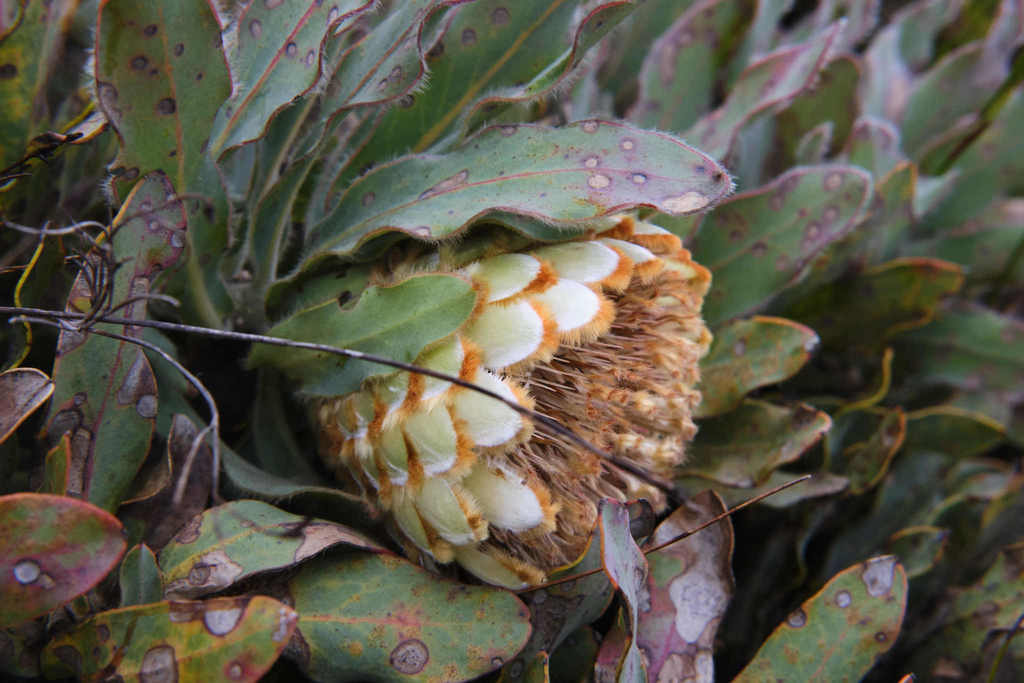
Sawedge Sugarbush
Protea holosericea
Protea holosericea, commonly known as the Sawedge Sugarbush, is a flowering shrub belonging to the Protea genus. The plant is endemic to South Africa and is found only on Sawedge Peak and Rabiesberg, two adjacent peaks in the Kwadousberg Mountains in the Western Cape.
The shrub has an erect to sprawling habit, grows up to 1.2 metres (3 ft 11 in) high, and blooms from September to October. Possible wildfires can destroy the mature plants, but the seeds will survive such an event. The seeds are stored in the flowerheads, released after fires and spread by the wind. The plant is monoecious with both sexes in each flower. Pollination occurs through the action of birds. The plant grows on the dry, upper mountain slopes at altitudes of 1,200 to 1,300 metres (3,900 to 4,300 ft).
Where it lives
Recorded sightings
—
geo-referenced records in GBIF, from museums, herbaria and field observers.
Drag the globe to turn it. Dots are where records exist, not a range map; darker means more records.
In the stacks
Searching the stacks…
Every page naming Protea holosericea in the Biodiversity Heritage Library →
This page is assembled live from iNaturalist, GBIF, Wikipedia, the Source Library and the Internet Archive. It is not yet part of the hand-edited codex. iNaturalist taxon 592514.