- Plants
- ›Vascular Plants
- ›flowering plants
- ›Dicots
- ›proteas, lotuses, planes, and allies
- ›Protea family
- ›Singlet Proteas
- ›Hairiseed Proteoid Clade
- ›Protea
- ›Speciosae
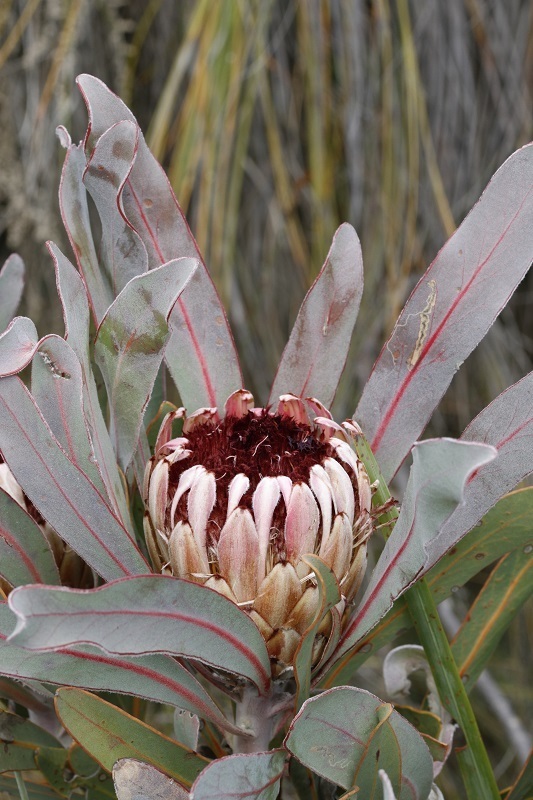
Strapleaf Sugarbush
Protea lorifolia
Protea lorifolia, in English called the strap-leaved sugarbush, strap-leaved protea or strap-leaf sugarbush is a flowering shrub which belongs to the genus Protea.
In Afrikaans this species is known by the vernacular name of riemblaar-suikerbos.
From the article Protea lorifolia on Wikipedia (CC BY-SA), quoted section by section
Description
The compact, round-shaped shrub grows up to three metres in height, and blooms from April to October. The plant is monoecious with both sexes in each flower.
Range & habitat
The plant is endemic to the Cape Provinces of South Africa. Its distribution covers a wide area, from the Koue Bokkeveld Mountains through the Swartberg, Riviersonderend and Langeberg Mountains, to the Baviaanskloofberge and Kouga Mountains. It can be seen near the towns of Makhanda and Riebeek East, and on the Boschberg mountain in Somerset East.
Wikipedia: “Distribution”
What it does
Potential wildfires destroy the adult plants, but the seeds can survive such events, being safely stored in a cap. The seeds are eventually dispersed by means of the wind. Pollination occurs through the action of birds. The plant grows on dry slopes in sandstone-derived soils, and is found at altitudes of 450 to 1,400 metres.
Wikipedia: “Ecology”
Where it lives
Recorded sightings
—
geo-referenced records in GBIF, from museums, herbaria and field observers.
Drag the globe to turn it. Dots are where records exist, not a range map; darker means more records.
In the stacks
Searching the stacks…
Every page naming Protea lorifolia in the Biodiversity Heritage Library →
This page is assembled live from iNaturalist, GBIF, Wikipedia, the Source Library and the Internet Archive. It is not yet part of the hand-edited codex. iNaturalist taxon 592523.