- Plants
- ›Vascular Plants
- ›flowering plants
- ›Dicots
- ›Mints, Plantains, Olives, and Allies
- ›Mint Family
- ›Nepetoideae
- ›Mentheae
- ›Melissas and sages
- ›Salvia
- ›Salvia
- ›Hymenosphace
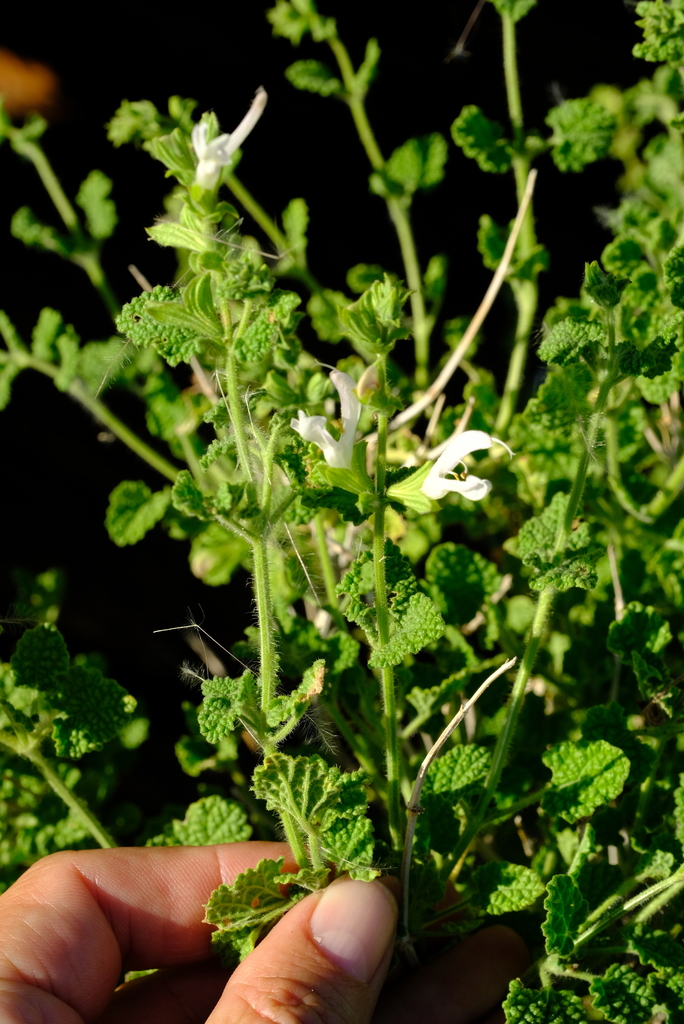
Gariep Sage
Salvia garipensis
Salvia garipensis is a species of sage, commonly called Gariep sage. It is native to Namibia and South Africa′s Northern Cape province, where it grows on well-drained stony slopes and along water courses at 630–2200 m in altitude.
The epithet garipensis has its origins in the Khoekhoegowab word for ″river″ as applied to the Orange River, which forms a border between South Africa and Namibia. Its spelling has been treated inconsistently in the literature. While some global databases (e.g. Plants of the World Online) adopt gariepensis as a corrected form, South African floristic works (including Flora Capensis, vol. 5, 1912) and several nomenclatural sources retain the original published spelling garipensis E.Mey. ex Benth..
From the article Salvia garipensis on Wikipedia (CC BY-SA), quoted section by section
Description
It is a much-branched shrub growing to about 1–2 m (3 ft 3 in – 6 ft 7 in) in height. The stems are quadrangular and may be woody or herbaceous. They are covered in a mixture of long, spreading, non-glandular hairs, shorter glandular hairs, and oil globules, giving the surface a glandular-pubescent texture. The leaves are highly variable in shape, ranging from oblong to broadly ovate or triangular. They are simple, 1.2–4.5 cm (0.47–1.77 in) long and 1–3 cm (0.39–1.18 in) wide, with irregularly eroded to toothed margins. The leaf base may be truncate, heart-shaped, or rounded. Both glandular and non-glandular hairs are present on the leaves, along with oil globules. The petiole is up to 1.5 cm (0.59 in) long. The flowers are arranged in whorls, with up to ten of them per inflorescence, each bearing two to four flowers. The whorls are spaced up to about 1.5 cm (0.59 in) apart on the lower part of the inflorescence and become more closely packed towards the top. The floral leaves are broadly ovate, tapering to a point, and persist after flowering; bracts are present. Flower stalks are up to 4 mm (0.16 in) long and spread outward or slightly upward. The calyx is bell-shaped, 10–12 mm (0.39–0.47 in) long, and expands to about 16 mm (0.63 in) as the fruit develops. It has 13 veins and is glandular-pubescent, with long non-glandular hairs and shorter glandular hairs. …
Where it lives
Recorded sightings
—
geo-referenced records in GBIF, from museums, herbaria and field observers.
Drag the globe to turn it. Dots are where records exist, not a range map; darker means more records.
In the stacks
Searching the stacks…
Every page naming Salvia garipensis in the Biodiversity Heritage Library →
This page is assembled live from iNaturalist, GBIF, Wikipedia, the Source Library and the Internet Archive. It is not yet part of the hand-edited codex. iNaturalist taxon 593701.