- Plants
- ›Vascular Plants
- ›flowering plants
- ›Dicots
- ›Mints, Plantains, Olives, and Allies
- ›Mint Family
- ›Nepetoideae
- ›Mentheae
- ›Melissas and sages
- ›Salvia
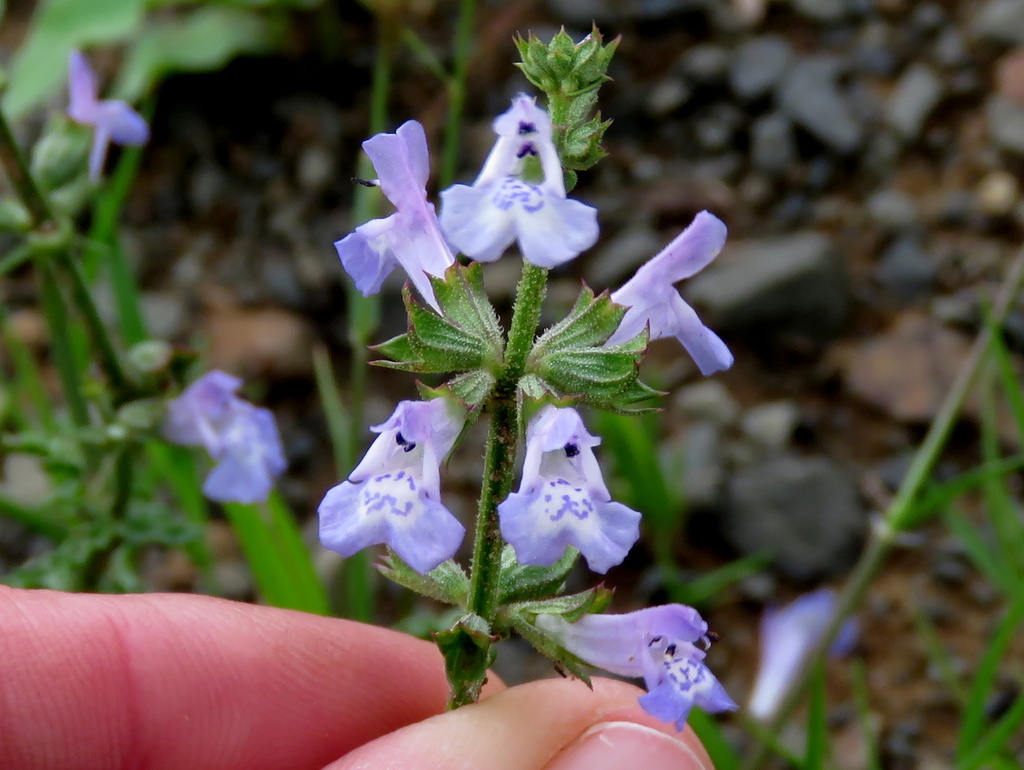
Fineleaf Sage
Salvia stenophylla
Salvia stenophylla (Blue Mountain sage) is a perennial shrub native to a wide area of Southern Africa: South Africa (the Cape Provinces, Lesotho, KwaZulu-Natal, the Free State and the Northern Provinces), Botswana and Namibia. It grows on grassy or stony slopes, and in open countryside or among shrubs. It has been used traditionally as a disinfectant by burning it in huts after sickness, and it is also mixed with tobacco for smoking. Its specific epithet, stenophylla, refers to the narrow leaves.
From the article Salvia stenophylla on Wikipedia (CC BY-SA), quoted section by section
Description
Salvia stenophylla is a many-branched and upright shrub that reaches up to 2 feet (0.61 m) tall and wide in the wild, less in cultivation. The stems are square and lightly covered with hairs. The leaves are long and narrow with deep lobes. They have a strong fragrance and are rough to the touch. The sparsely spaced leaves are pinnatid, growing up to 2 inches (5.1 cm) long and 0.5 inches (1.3 cm) wide, with ten pairs of narrow segments that have glands. These glands give off a wood-like aroma when brushed. The stem and leaves contain the essential oils. The tiny pale blue flowers appear during the summer months. They grow in whorls of six to eight, and are held in a calyx that is hairy and covered with oil glands.
At the table
The leaves of Blue Mountain sage can be made into a tea and used to soothe digestive problems, colds, coughs, chest congestion, and relieve breathing issues. A poultice may be put on wounds such as scrapes, sores, and bites, giving relief by providing a cooling sensation. The herbage contains antibacterial and anti-inflammatory agents. The leaves of this plant are natural insect repellents when burned.
Wikipedia: “Uses”
Where it lives
Recorded sightings
—
geo-referenced records in GBIF, from museums, herbaria and field observers.
Drag the globe to turn it. Dots are where records exist, not a range map; darker means more records.
In the stacks
Searching the stacks…
Every page naming Salvia stenophylla in the Biodiversity Heritage Library →
This page is assembled live from iNaturalist, GBIF, Wikipedia, the Source Library and the Internet Archive. It is not yet part of the hand-edited codex. iNaturalist taxon 593710.