- Plants
- ›Vascular Plants
- ›flowering plants
- ›monocots
- ›Agaves, Orchids, Irises, and Allies
- ›iris family
- ›Iridoideae
- ›Irideae
- ›Iris
- ›Iris
- ›Iris
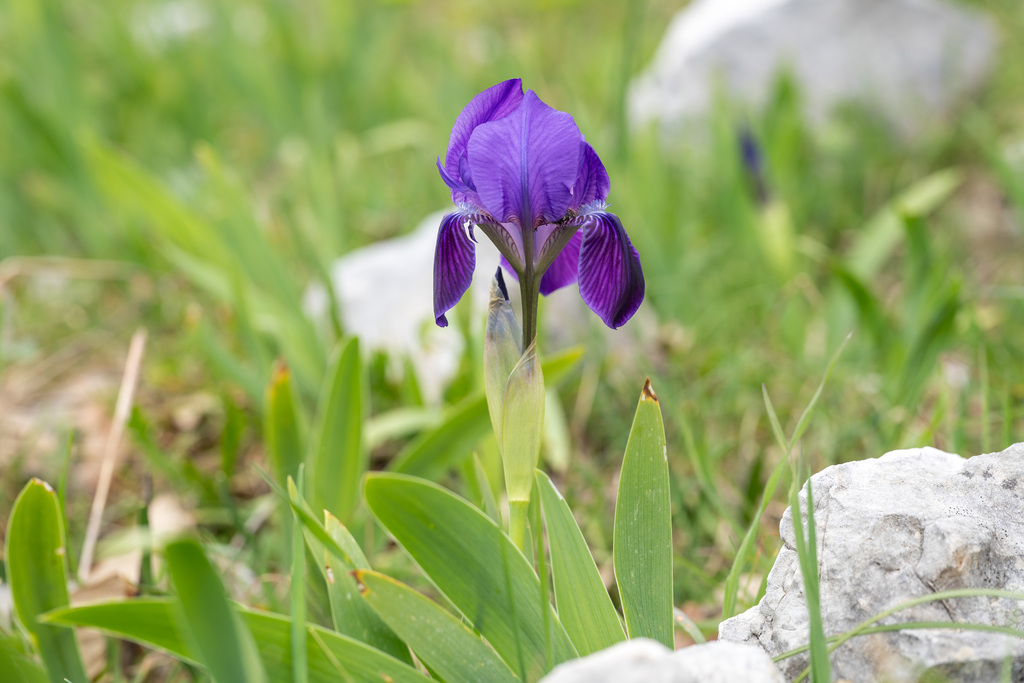
Two-flowered Iris
Iris bicapitata
Iris bicapitata is a plant species in the genus Iris, it is also in the subgenus Iris. It is a rhizomatous perennial, from the Gargano Peninsula, Italy. It has sickle or pointed leaves, shorter than the flowering stem. It has two flowers, which come in variable shades from yellow, white, lilac, blue and violet. They can also be bi-coloured. It is thought to have been derived from Iris pseudopumila. It is cultivated as an ornamental plant in temperate regions.
From the article Iris bicapitata on Wikipedia (CC BY-SA), quoted section by section
Description
Iris bicapitata is similar in form to Iris germanica but a slightly smaller. It has a thick horizontal, fleshy rhizome. That is similar in form to other bearded irises. It has linear, falcate (sickle shaped), or acuminate (pointed) leaves. They can grow up to between 30–50 cm (12–20 in) long, (they are shorter than the flowering stem,) and around 2.5 cm wide. The tip of the leaves is membranous. It has a slender stem or peduncle, that can grow up to between 30–40 cm (12–16 in) tall. But can reach up to 60 cm (24 in) in cultivation. The stem has carinated (ridged or keeled) spathes (leaves of the flower bud). They have (scarious) membranous or papery tips and violet tinged edges. The stems hold 2 terminal (top of stem) flowers. Although rarely it can have 3 flowers. Compared to other native irises, such as Iris lutescens and Iris pseudopumila who have one flower. The fragrant flowers, (similar to roses, and violets,) bloom between March and May. The flowers are very variable in colour, they are polymorphic. They can come in shades from white, yellow, blue, lilac, to violet. They also can be bi-coloured. The flower also can very rarely be pale yellow with violet veins, similar (but less than) to Iris variegata. The most common colour is deep blue violet, or purple blue. …
Range & habitat
It is found in Italy, in Apulia, including within the Gargano Peninsula, and the near the town of Monte St Angelo.
Wikipedia: “Range”
Toxicity
Like many other irises, most parts of the plant are poisonous (rhizome and leaves), and if mistakenly ingested can cause stomach pains and vomiting. Handling the plant may cause skin irritation or an allergic reaction.
How it is grown
It is hardy to USDA Zone 9, It probably can tolerate more than −15 °C, but in its habitat (Italy), the winters are normally not colder than −10 °C. It can tolerate mild wet winters and hot dry summers. It prefers to grow in well-drained soils, containing limestone, or calcareous soils. It likes positions in full sun It can be grown in a rock garden. In cultivation, it is thought that this species can re-bloom in the autumn. It is not very well found in plant nurseries, only grown by plant collectors.
Wikipedia: “Cultivation”
Where it lives
Recorded sightings
—
geo-referenced records in GBIF, from museums, herbaria and field observers.
Drag the globe to turn it. Dots are where records exist, not a range map; darker means more records.
In the stacks
Searching the stacks…
Every page naming Iris bicapitata in the Biodiversity Heritage Library →
This page is assembled live from iNaturalist, GBIF, Wikipedia, the Source Library and the Internet Archive. It is not yet part of the hand-edited codex. iNaturalist taxon 59430.