- Plants
- ›Vascular Plants
- ›flowering plants
- ›monocots
- ›grasses, sedges, cattails, and allies
- ›grasses
- ›Pooideae
- ›needlegrasses and allies
- ›Stipa
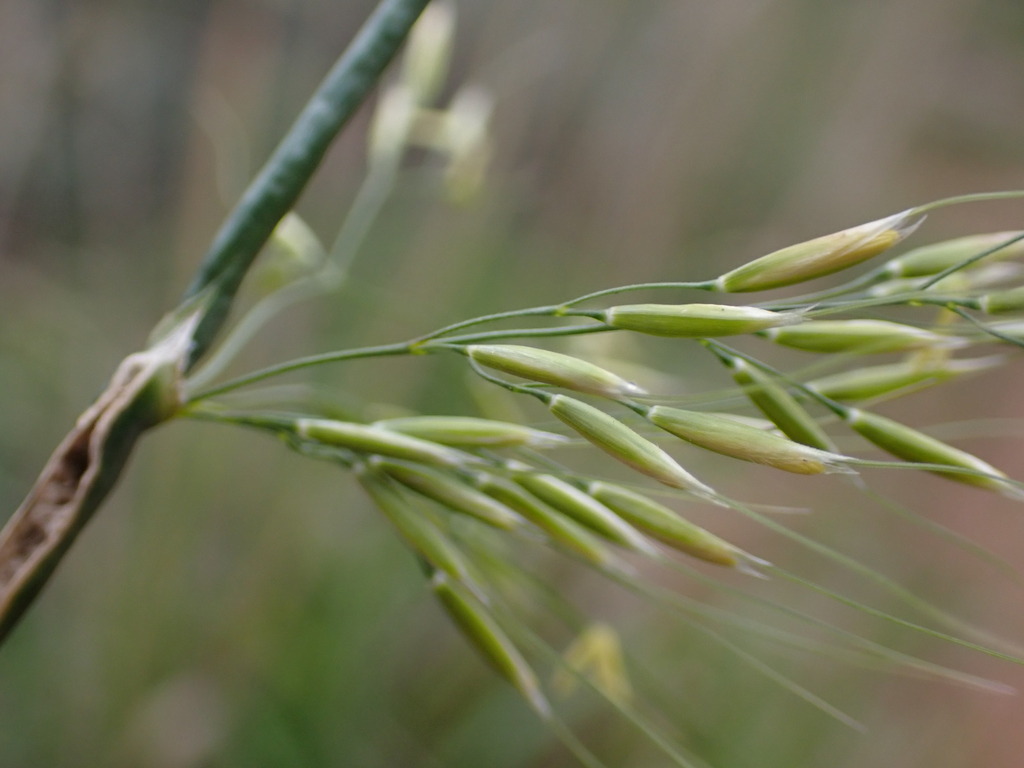
Stipa dregeana
Stipa dregeana is a species of grass. It is a perennial native to the Cape Provinces of South Africa.
From the article Stipa dregeana on Wikipedia (CC BY-SA), quoted section by section
Description
Stipa dregeana is a perennial, tufted grass that grows in clumps, with stems usually exceeding 1 m and sometimes reaching up to 1.5 m in height. The leaves are linear and relatively broad, 30–60 cm long and 6–12 mm wide, with surfaces that may be smooth or sparsely hairy, giving the plant a variable texture. The ligule is a short, membranous structure, 2–3 mm long, and without hairs. The inflorescence is a panicle that may be open and loose or more contracted, elliptic in outline, and 15–40 cm long. Its branches spread or ascend, often scabrous to the touch, and may bear spikelets almost to the base. Spikelets are solitary, pedicelled, and measure 5–7 mm in length, each containing a single fertile floret that detaches at maturity. The glumes are thin, three‑veined, and slightly longer than the florets, ranging from 5–10 mm long, with acute to acuminate tips. The fertile lemma is 5–6 mm long, densely hairy, and ends in a two‑toothed apex from which a straight awn arises, typically 10–18 mm long. The palea is equal in length to the lemma, keeled, and pubescent along its sides. Flowers bear two lodicules, three small anthers with brush‑like tips, and two stigmas. The ovary is glabrous. The fruit is a caryopsis with a linear hilum and an adherent pericarp. Flowering has been recorded from August to May. …
Range & habitat
Stipa dregeana is native to southern and eastern Africa. In South Africa it occurs from the Cape Peninsula eastwards, extending through Lesotho and Eswatini into tropical East Africa. The species is typically found along forest margins and in montane grasslands, where it grows in clumps among other grasses. Flowering has been recorded from August to May.
== References ==
Wikipedia: “Distribution and habitat”
Where it lives
Recorded sightings
—
geo-referenced records in GBIF, from museums, herbaria and field observers.
Drag the globe to turn it. Dots are where records exist, not a range map; darker means more records.
In the stacks
Searching the stacks…
Every page naming Stipa dregeana in the Biodiversity Heritage Library →
This page is assembled live from iNaturalist, GBIF, Wikipedia, the Source Library and the Internet Archive. It is not yet part of the hand-edited codex. iNaturalist taxon 594809.