- Animals
- ›Molluscs
- ›Gastropods
- ›Heterobranchs
- ›Euthyneura
- ›Ringipleura
- ›Nudipleura
- ›Nudibranchs
- ›Aeolidina
- ›Fionoidea
- ›Trinchesiidae
- ›Catriona
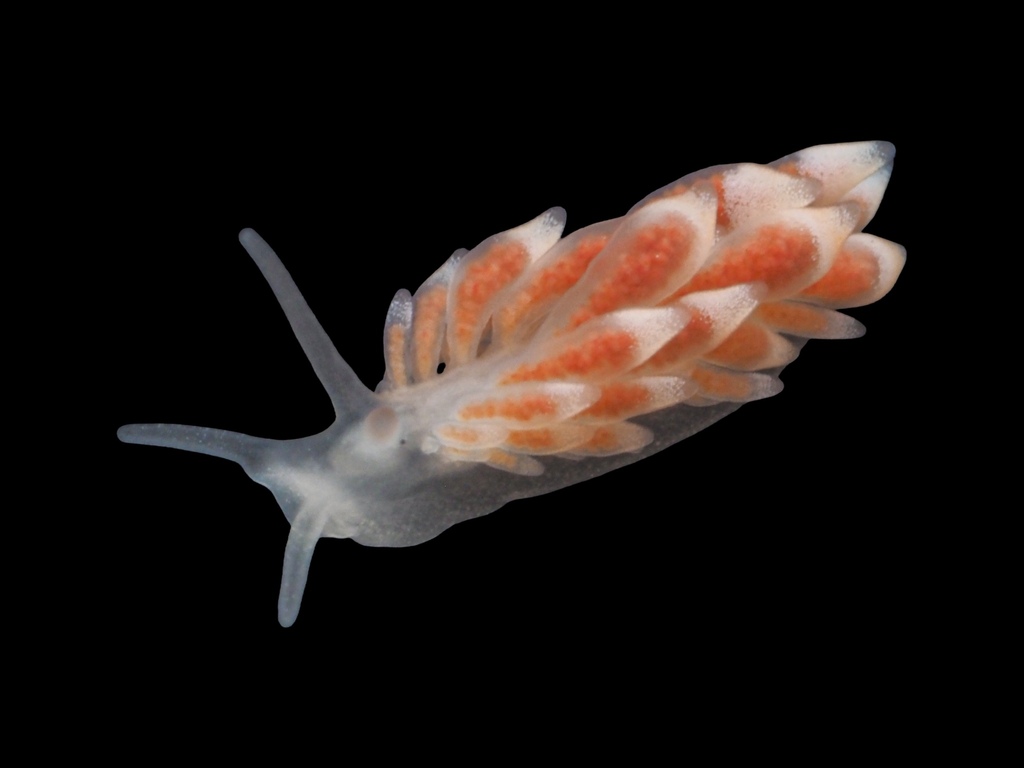
Catriona aurantia
Catriona aurantia is a species of sea slug, an aeolid nudibranch, a marine gastropod mollusk in the family Trinchesiidae. It was incorrectly synonymised with Catriona gymnota from the Western Atlantic but shown to be a distinct species by DNA analysis.
From the article Catriona aurantia on Wikipedia (CC BY-SA), quoted section by section
Description
This species has a translucent white body and slightly swollen cerata. The digestive gland is orange pink in colour and the tips of the cerata have a broad white band of tiny epidermal glands. In larger specimens the rhinophores develop a pale orange suffusion. The foot is broad and rounded anteriorly. Large individuals may exceed 20 mm in length.
Range & habitat
Feeds on the hydroid Tubularia larynx. Individuals are thought to feed by eating through the stems of the hydroid rather than on the polyps. Usually found in exposed places, in strong tidal streams, and in shallow water, from 0 m to 20 m depth. The spawn consists of lozenge-shaped packets of eggs.
== References ==
Wikipedia: “Habitat”
Where it lives
Recorded sightings
—
geo-referenced records in GBIF, from museums, herbaria and field observers.
Drag the globe to turn it. Dots are where records exist, not a range map; darker means more records.
In the stacks
Searching the stacks…
Every page naming Catriona aurantia in the Biodiversity Heritage Library →
This page is assembled live from iNaturalist, GBIF, Wikipedia, the Source Library and the Internet Archive. It is not yet part of the hand-edited codex. iNaturalist taxon 596505.