- Plants
- ›Vascular Plants
- ›flowering plants
- ›Dicots
- ›myrtles, evening primroses, and allies
- ›myrtle family
- ›Myrtoideae
- ›Melaleuceae
- ›Melaleuca
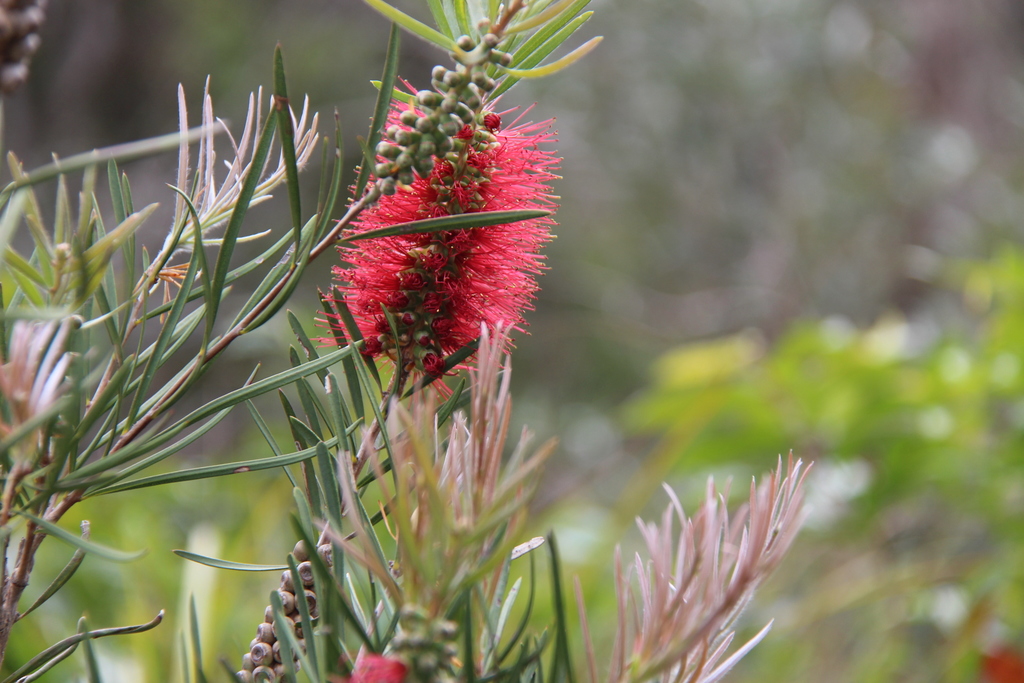
Narrow-leaved Bottlebrush
Melaleuca linearis
Melaleuca linearis, commonly known as narrow-leaved bottlebrush, is a plant in the myrtle family, Myrtaceae and is endemic to New South Wales and Queensland in Australia. (Some Australian state herbaria continue to use the names Callistemon linearis, Callistemon pinifolius and Callistemon rigidus.) It is a medium-sized shrub with narrow leaves which have a rigid point, and red flower spikes in late spring or early summer.
From the article Melaleuca linearis on Wikipedia (CC BY-SA), quoted section by section
Description
Melaleuca linearis is a shrub growing to 3 metres (10 ft) tall with grey, hard, fibrous bark. Its leaves are arranged alternately and are 35–115 millimetres (1–5 in) long, 0.7–2.7 millimetres (0.03–0.1 in) wide, narrow linear in shape and flat to channelled or semi-circular in cross section. There is a mid-vein but the lateral veins are inconspicuous. The flowers are a shade of red, rarely green and arranged in spikes on the ends of branches that continue to grow after flowering and also on the sides of the branches. The spikes are 40–65 millimetres (2–3 in) in diameter and 5–10 centimetres (2.0–3.9 in) long with 20 to 90 individual flowers. The petals are 3.2–7 millimetres (0.1–0.3 in) long and fall off as the flower ages and there are 23–73 stamens in each flower. Flowering occurs from late spring to early summer and is followed by fruits that are woody capsules, 3.8–8.2 millimetres (0.1–0.3 in) long.
Range & habitat
Melaleuca linearis occurs in and between the south-east corner of Queensland, Nowra on the south coast of New South Wales and inland as far as Gilgandra. It grows in damp situations in a range of vegetation associations.
Wikipedia: “Distribution and habitat”
How it is grown
Melaleuca linearis has long been in cultivation (as Callistemon linearis, C. pinifolius and C. rigidus). Although not common in gardens, it is a hardy plant, thriving in most soils but preferring full sun. It is more resistant to pests such as sawfly than other melaleucas. It has received the Royal Horticultural Society's Award of Garden Merit.
Wikipedia: “Use in horticulture”
Where it lives
Recorded sightings
—
geo-referenced records in GBIF, from museums, herbaria and field observers.
Drag the globe to turn it. Dots are where records exist, not a range map; darker means more records.
In the stacks
Searching the stacks…
Every page naming Melaleuca linearis in the Biodiversity Heritage Library →
This page is assembled live from iNaturalist, GBIF, Wikipedia, the Source Library and the Internet Archive. It is not yet part of the hand-edited codex. iNaturalist taxon 596690.