- Animals
- ›Arthropods
- ›Hexapods
- ›Insects
- ›Winged and Once-winged Insects
- ›Beetles
- ›Water, Rove, Scarab, Long-horned, Leaf, and Snout Beetles
- ›Cucujiform Beetles
- ›Longhorn Beetles and Allies
- ›Longhorn Beetles
- ›Tooth-necked and Aberrant Longhorn Beetles
- ›Prionini
- ›Prionus
- ›Prionus
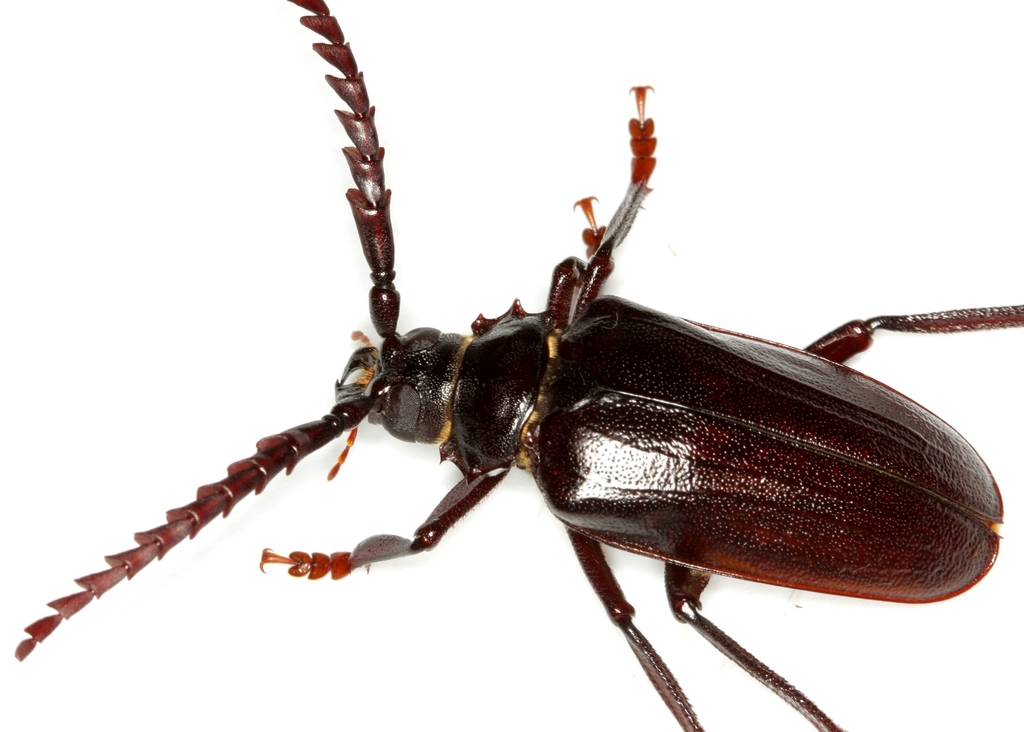
California Root Borer
Prionus californicus
Prionus californicus, commonly known as the California root borer, is a species of insect in the longhorn beetle family (Cerambycidae). It is native to the American west where it is often a pest of orchard and vine crops.
From the article Prionus californicus on Wikipedia (CC BY-SA), quoted section by section
Description
The 2.5 to 5.7 cm adults, which are reddish-brown with smooth shiny wing-cases, emerge from the soil from June to early August. The males are smaller than the females and have more strongly serrated antennae. The adults do not feed. They fly at night, seeking mates. Males appear to be more active, while females produce a pheromone to attract males. The female-produced sex pheromone compound has been identified as an isomer of 3,5-dimethyldodecanoic acid. A synthetic mixture of all four possible isomers of 3,5-dimethyldodecanoic acid is highly attractive to male P. californicus in field trials. The life span of the adult P. californicus is 10 – 20 days. Shortly after mating the female lays cream to yellow-brown 4.8 mm long eggs, of which she can produce up to 200 in her lifetime. She lays them 1.25 to 3.8 cm below the soil surface near the roots of suitable hosts. The larvae, cream to brown in color and strongly segmented, seek out roots shortly after hatching. They furrow and tunnel through the roots as they consume tissue, moving upward and inward and often killing apical regions. Age distribution data suggests that larvae move from smaller to larger diameter roots as they age and grow from 6.5 mm to 7.6 cm, eventually reaching the root crown. Pupation occurs near the soil surface in a cell constructed of soil and root material. …
Wikipedia: “Description and life cycle”
Range & habitat
The California root borer occurs widely in western North America from Alaska to Mexico. It spends most of its life underground feeding on the roots of most deciduous trees and shrubs, as well as some conifers, brambles, and agricultural crops such as hops and grape vines.
Wikipedia: “Distribution”
Listen
Looking for field recordings…
Where it lives
Recorded sightings
—
geo-referenced records in GBIF, from museums, herbaria and field observers.
Drag the globe to turn it. Dots are where records exist, not a range map; darker means more records.
In the stacks
Searching the stacks…
Every page naming Prionus californicus in the Biodiversity Heritage Library →
This page is assembled live from iNaturalist, GBIF, Wikipedia, the Source Library and the Internet Archive. It is not yet part of the hand-edited codex. iNaturalist taxon 59892.