- Plants
- ›Vascular Plants
- ›flowering plants
- ›Dicots
- ›Heathers, Balsams, Primroses, and Allies
- ›heath family
- ›monotropes
- ›Monotropa
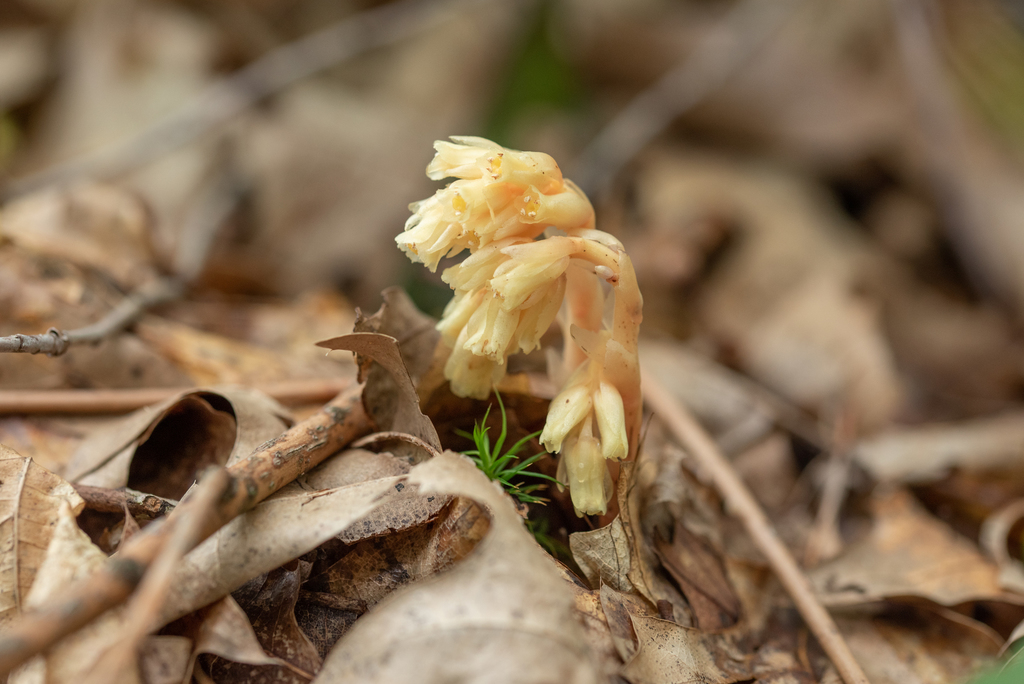
pinesap
Monotropa hypopitys
Monotropa hypopitys, syn. Hypopitys monotropa, also known as yellow bird's nest in Britain and Ireland, pinesap and false beechdrops in Canada and the United States, is a herbaceous perennial plant of the Monotropoideae subfamily of the family Ericaceae. It is native to temperate regions of the Northern Hemisphere and is scarce within its range. M. hypopitys is a mycotrophic plant which means it obtains nutrients and fixed carbon by parasitizing the mycorrhizal networks of trees. It lacks chlorophyll and does not photosynthesize. The species name, M. hypopitys, is from Latinized Greek hypo-, "under", and pitys, "pine", referring to where it often grows.
From the article Monotropa hypopitys on Wikipedia (CC BY-SA), quoted section by section
Range & habitat
Monotropa hypopitys is the most widespread member of its subfamily (Monotropoideae). Outside of North America, its wide distribution includes India, China, Pakistan, Russia, and much of Europe. In the United States, the heath family (Ericaceae) mycotrophic species are most common in the western mixed coniferous forests. M. hypopitys distribution is influenced by the host distribution, specifically that of Tricholoma fungi.
Wikipedia: “Distribution”
What it does
M. hypopitys flowering phenology typically ranges from April to December but is dependent on the geographic region and flower morph. Its two dominant color forms, red and yellow, have non-overlapping reproductive phenologies. The yellow form blooms in mid-summer while the red morph is known to flower in the fall. While both forms are self-compatible, the yellow form has higher rates of autogamous reproduction. Pollinator diversity within the Monotropa genus is low with bumblebees being the predominant pollen dispersal agent. The red and yellow morphs also have distinct floral systems with the red form displaying approach herkogamy. The yellow form is devoid of the spatial separation of reproductive structures associated with herkogamy.
Wikipedia: “Reproductive ecology and phenology”
In human culture
M. hypopitys non-photosynthetic nature is attributed to its significantly reduced chloroplast genome. When it was originally classified, only two species, M. hypopitys and M. uniflora, made up the Monotropa genus. Recent analysis of morphological characteristics and genetic information suggests that M. hypopitys is more closely related to the other members of the Monotropoideae subfamily than it is to M. uniflora.
Wikipedia: “Evolutionary history”
Where it lives
Recorded sightings
—
geo-referenced records in GBIF, from museums, herbaria and field observers.
Drag the globe to turn it. Dots are where records exist, not a range map; darker means more records.
In the stacks
Searching the stacks…
Every page naming Monotropa hypopitys in the Biodiversity Heritage Library →
This page is assembled live from iNaturalist, GBIF, Wikipedia, the Source Library and the Internet Archive. It is not yet part of the hand-edited codex. iNaturalist taxon 59986.