- Plants
- ›Vascular Plants
- ›flowering plants
- ›Dicots
- ›Sunflowers, Bellflowers, Fanflowers, and Allies
- ›Sunflowers, Daisies, Asters, and Allies
- ›Asteroideae
- ›Sunflowers and Allies
- ›Cockleburs, Ragweeds, and Wild Quinines
- ›Ambrosia
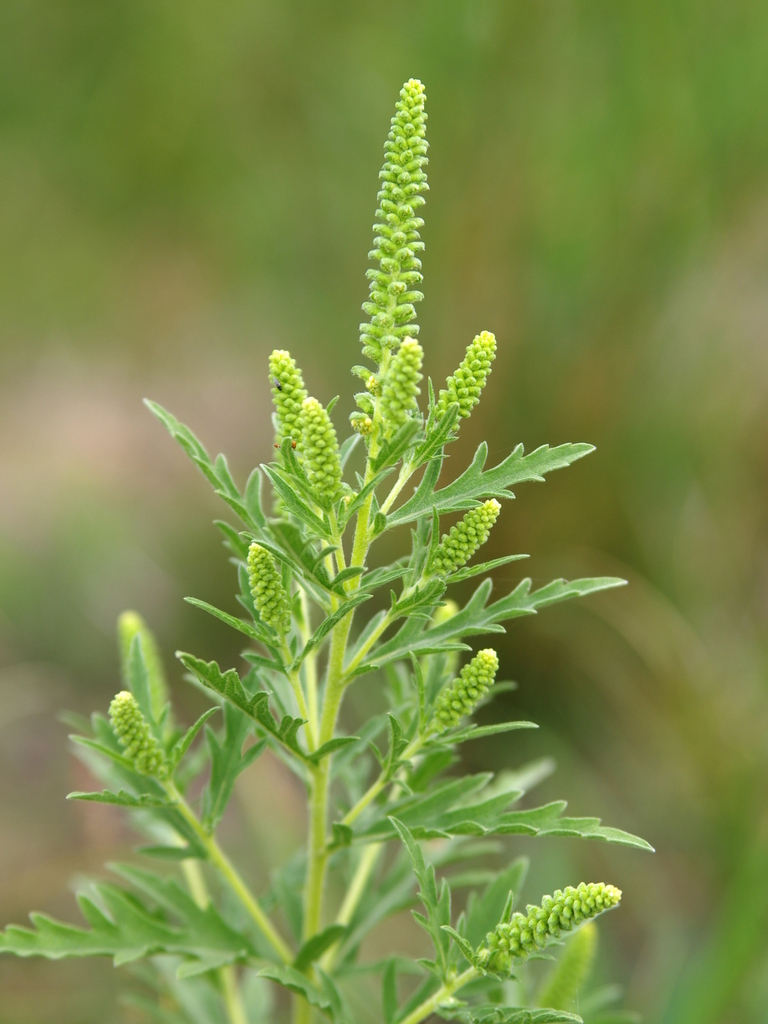
western ragweed
Ambrosia psilostachya
Ambrosia psilostachya is a species of ragweed known by the common names Cuman ragweed and perennial ragweed, and western ragweed.
From the article Ambrosia psilostachya on Wikipedia (CC BY-SA), quoted section by section
Description
Ambrosia psilostachya is an erect perennial herb growing a slender, branching, straw-colored stem to a maximum height near two meters, but more often remaining under one meter tall. Leaves are up to 12 centimeters long and vary in shape from lance-shaped to nearly oval, and they are divided into many narrow, pointed lobes. The stem and leaves are hairy. The top of the stem is occupied by an inflorescence which is usually a spike. The species is monoecious, and the inflorescence is composed of staminate (male) flower heads with the pistillate heads located below and in the axils of leaves. This bloom period is from June through November. The pistillate heads yield fruits which are achenes located within oval-shaped greenish-brown burs about half a centimeter long. The burs are hairy and sometimes spiny. The plant reproduces by seed and by sprouting up from a creeping rhizome-like root system.
Range & habitat
The plant is widespread across much of North America (United States, Canada, and northern Mexico). It is also naturalized in parts of Europe, Asia, Australia, and South America. It is a common plant in many habitat types, including disturbed areas such as roadsides.
Wikipedia: “Distribution and habitat”
What it does
Ambrosia psilostachya is a host plant for the caterpillars of Bucculatrix transversata, Cosmopterix opulenta, Exaeretia gracilis, Gnorimoschema saphirinella, Schinia sexplagiata; the beetles Calligrapha disrupta, Calligrapha suturalis; and the grasshopper Spharagemon collare.
Wikipedia: “Ecology”
At the table
This plant had a number of medicinal uses among several different Native American tribes, including the Cheyenne, Kumeyaay (Diegueno), and Kiowa people.
Wikipedia: “Medicinal uses”
Where it lives
Recorded sightings
—
geo-referenced records in GBIF, from museums, herbaria and field observers.
Drag the globe to turn it. Dots are where records exist, not a range map; darker means more records.
In the stacks
Searching the stacks…
Every page naming Ambrosia psilostachya in the Biodiversity Heritage Library →
This page is assembled live from iNaturalist, GBIF, Wikipedia, the Source Library and the Internet Archive. It is not yet part of the hand-edited codex. iNaturalist taxon 60129.