- Plants
- ›Vascular Plants
- ›flowering plants
- ›Dicots
- ›Buttercups, Poppies, and Allies
- ›moonseed family
- ›Cyclea
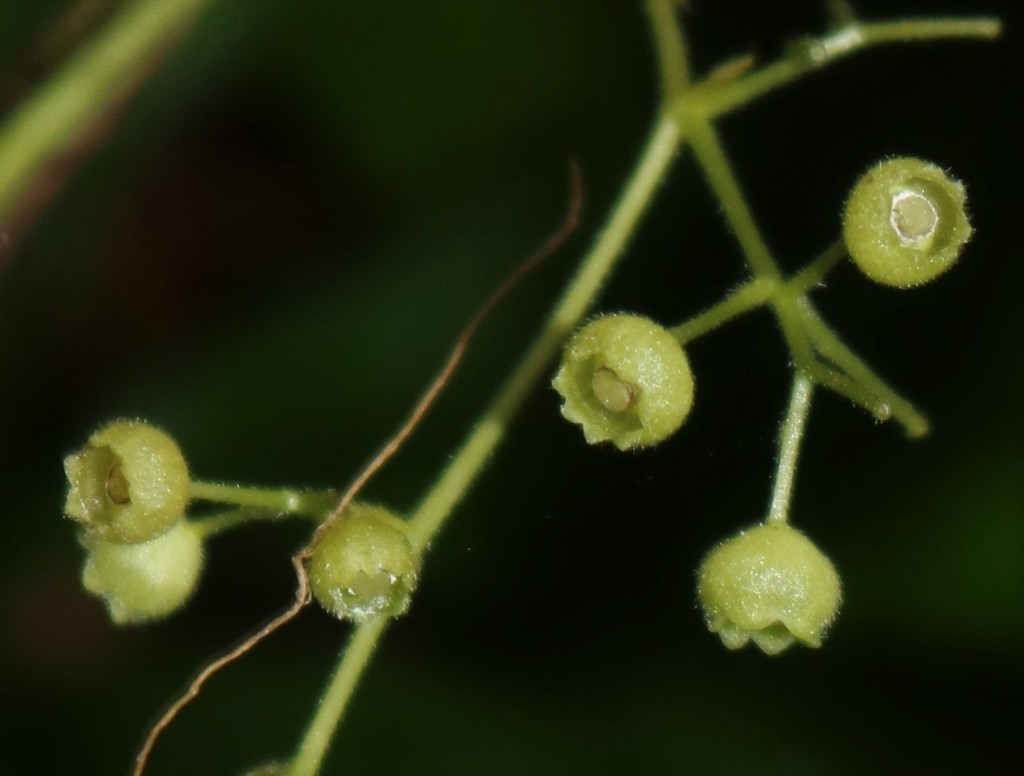
Cyclea peltata
Cyclea peltata, also called patha or Indian moon-seed (not to be confused with Tinospora cordifolia or "heart-leaved moonseed", from the same family Menispermaceae), is a climbing shrub found across India and Sri Lanka, in habitats ranging from Moist Deciduous Forests to Tropical Forests and Plains.
From the article Cyclea peltata on Wikipedia (CC BY-SA), quoted section by section
Description
A slender climbing vine that has alternately-arranged heart shaped leaves. Flowers between April-June and then again during November-January, depending on the local climate. Flowers are pale yellow and dioecious. Pollination is mostly through insects. The fruits are white, spherical or oval drupes.
At the table
Cyclea peltata is used in Indigenous Indian medicinal systems as a wound healer, an antidote to poisons, and for various digestive, skin and inflammatory disorders. It is a common component of the traditional Ayurvedic Polyherbal formulation Shaddharana Choornam, along with Plumbago zeylanica, Holarrhena antidysenterica, Picrorhiza kurroa, Aconitum heterophyllum, Terminalia chebula, Berberis aristata and Cyperus rotundus, whose formulation is mentioned in Vagbhata's Ashtāṅgasaṅgraha and Charaka's Charaka Samhita.
== References ==
Wikipedia: “Uses”
Where it lives
Recorded sightings
—
geo-referenced records in GBIF, from museums, herbaria and field observers.
Drag the globe to turn it. Dots are where records exist, not a range map; darker means more records.
In the stacks
Searching the stacks…
Every page naming Cyclea peltata in the Biodiversity Heritage Library →
This page is assembled live from iNaturalist, GBIF, Wikipedia, the Source Library and the Internet Archive. It is not yet part of the hand-edited codex. iNaturalist taxon 602290.