- Plants
- ›Vascular Plants
- ›flowering plants
- ›monocots
- ›grasses, sedges, cattails, and allies
- ›grasses
- ›Panicums, Bluestems, Paspalums, and Allies
- ›bristle, rosette, and barnyard grasses, and allies
- ›Panicinae
- ›Panicum
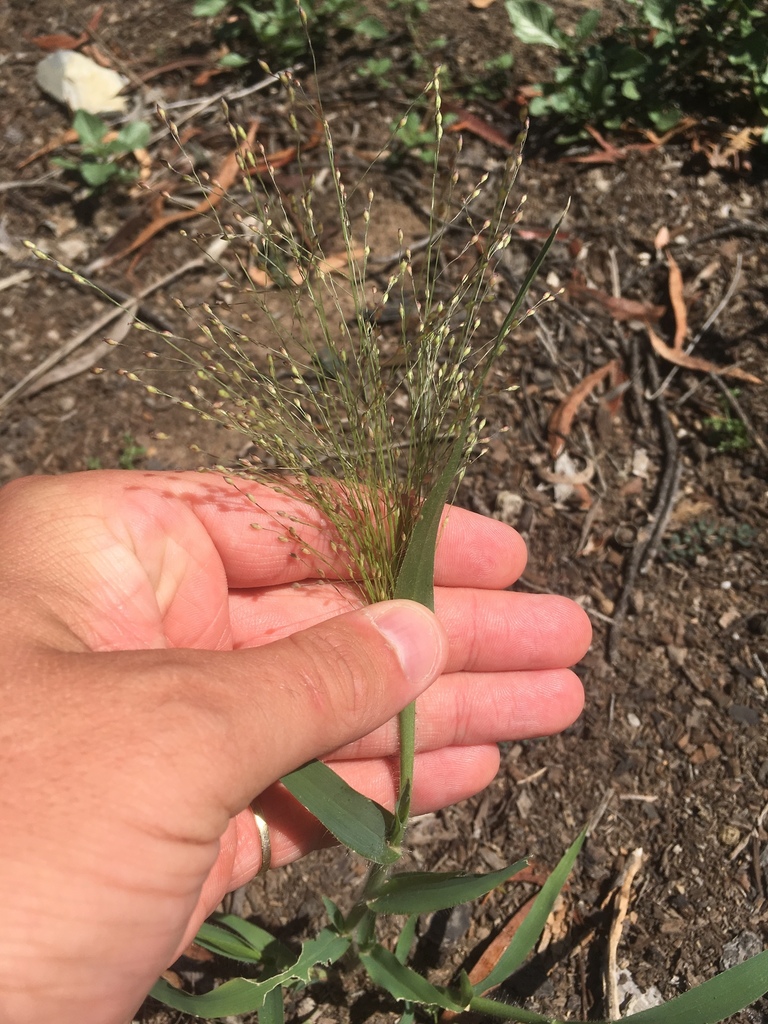
hillman's panic grass
Panicum hillmanii
Panicum hillmanii, commonly known as Hillmann's panicgrass, is a grass from genus Panicum native to Southwestern United States. It has been introduced to many other areas, notably including southern Australia where it became widespread, and several parts of Europe.
From the article Panicum hillmanii on Wikipedia (CC BY-SA), quoted section by section
Description
Panicum hillmannii is a perennial grass that resembles the related P. capillare (hairy panic) in habitat and appearance. It is distinguished by slightly stiffer panicles, firmer foliage, the rachilla shortly developed between the upper and lower glumes, the sterile floret which has the palea developed; and larger darker fertile lemma (up to 2mm long) with a prominent crescent-shaped scar at its base.
Range & habitat
Panicum hillmannii is native to the Southwest United States. It was introduced to Australia in the early 20th century, and has spread across South Australia, Victoria, New South Wales and Tasmania, sharing the habitat with related native witchgrass (P. effusum). It was also introduced to Europe, and specimens have been found in France, Belgium, Austria and Germany, although it remains relatively rare there, as an agricultural weed in maize fields and habitats such as roadsides. Like several other Panicum species (P. capillare and P. effusum), Hillman's panicgrass can become a tumbleweed under extremely dry conditions, and can become a nuisance in residential areas due to the accumulation of grass stalks. Dry tumbleweed poses a serious fire danger. The plant is potentially harmful for grazing livestock, as it contains saponins causing liver damage in animals.
Wikipedia: “Distribution and habitat”
Where it lives
Recorded sightings
—
geo-referenced records in GBIF, from museums, herbaria and field observers.
Drag the globe to turn it. Dots are where records exist, not a range map; darker means more records.
In the stacks
Searching the stacks…
Every page naming Panicum hillmanii in the Biodiversity Heritage Library →
This page is assembled live from iNaturalist, GBIF, Wikipedia, the Source Library and the Internet Archive. It is not yet part of the hand-edited codex. iNaturalist taxon 60293.