- Animals
- ›Molluscs
- ›Bivalves
- ›Autobranchia
- ›Pteriomorphia
- ›Oysters and Allies
- ›Ostreoidea
- ›True Oysters
- ›Cupped Oysters
- ›Magallana
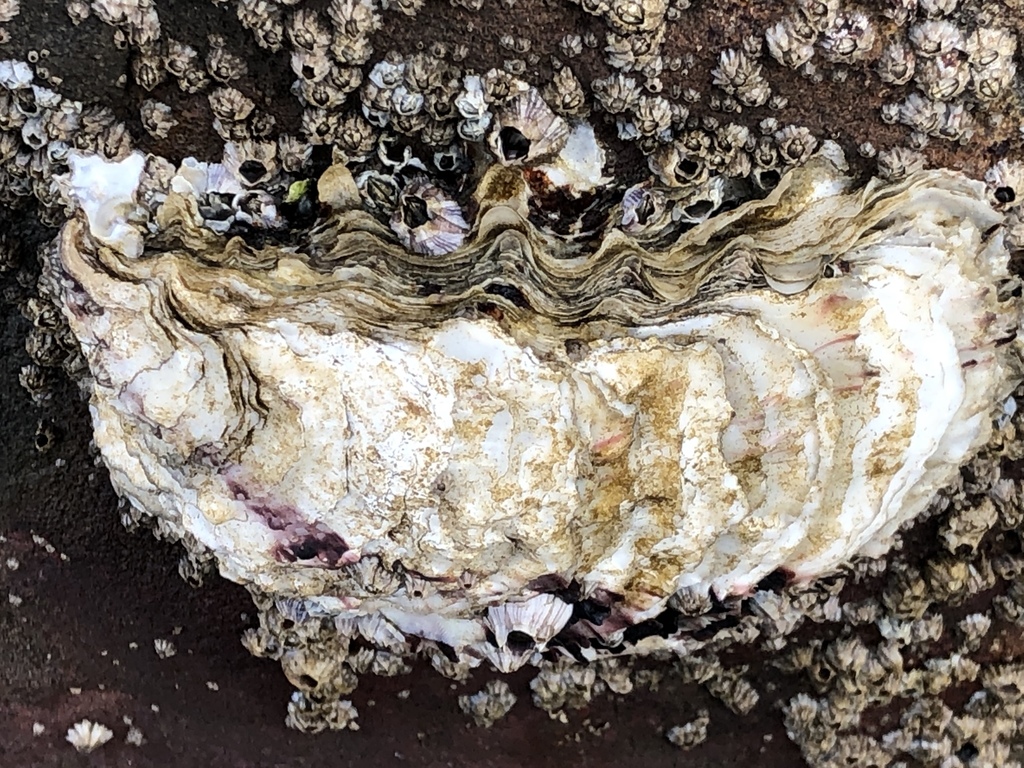
Pacific Oyster
Magallana gigas
The Pacific oyster, Japanese oyster or Miyagi oyster (Magallana gigas) (previously Crassostrea gigas), is an oyster native to the Pacific coast of Asia. It has become an introduced species in North America, Australia, Europe, and New Zealand.
From the article Pacific oyster on Wikipedia (CC BY-SA), quoted section by section
Description
The shell of M. gigas varies widely with the environment where it is attached. Its large, rounded, radial folds are often extremely rough and sharp. The two valves of the shell are slightly different in size and shape, the right valve being moderately concave. Shell colour is variable, usually pale white or off-white. Mature specimens can vary from 80 to 400 mm long.
Range & habitat
M. gigas is an estuarine species, but can also be found in intertidal and subtidal zones. They prefer to attach to hard or rocky surfaces in shallow or sheltered waters up to 40 m deep, but have been known to attach to muddy or sandy areas when the preferred habitat is scarce. The Pacific oyster can also be found on the shells of other animals. Larvae often settle on the shell of adults, and great masses of oysters can grow together to form oyster reefs. The optimum salinity for Pacific oysters is between 20 and 35 parts per thousand (ppt), and they can tolerate salinities as high as 38 ppt; at this level, however, reproduction is unlikely to occur. The Pacific oyster is also a very temperature tolerant species, as it can withstand a range from −1.8 to 35 °C.
Wikipedia: “Habitat”
What it does
The larvae of the Pacific oyster are planktotrophic, and are about 70 μm at the prodissoconch 1 stage. The larvae move through the water column via the use of a larval foot to find suitable settlement locations. They can spend several weeks at this phase, which is dependent on water temperature, salinity, and food supply. Over these weeks, larvae can disperse great distances by water currents before they metamorphose and settle as small spat. Similar to other oyster species, once a Pacific oyster larva finds a suitable habitat, it attaches to it permanently using cement secreted from a gland in its foot. After settlement, the larva metamorphoses into a juvenile spat. The growth rate is very rapid in optimum environmental conditions, and market size can be achieved in 18 to 30 months. Unharvested Pacific oysters can live up to 30 years.
Wikipedia: “Life cycle”
At the table
Increasing numbers of frames for oysters to grow on has led to claims that the character of the beach is changed and that other users may be endangered. In the preparations for the Tokyo 2020/2021 Summer Olympics, equipment for the canoeing and rowing was found to be contaminated with 14 metric tons (15 short tons) of M. gigas, necessitating US$1,280,000/£930,000 in removal expenditures.
Wikipedia: “Competition with other uses of the seashore”
How it is grown
This stage of oyster culture is almost completely sea-based. A range of bottom, off-bottom, suspended, and floating cultures are used. The technique used depends on site-specific conditions, such as tidal range, shelter, water depth, current flow, and nature of substrate. Pacific oysters take 18–30 months to develop to the market size of 70–100 g live weight (shell on). Growth from spat to adults in this species is very rapid at temperatures of 15–25 °C and at salinities of 25 to 32 ppt.
Wikipedia: “Ongrowing techniques”
In human culture
The genus Magallana is named for the Portuguese explorer Ferdinand Magellan and its specific epithet gígās is from the Greek for "giant". It was placed in the genus Crassostrea until 2017; from the Latin crass meaning "thick", ostrea meaning "oyster". In 2017, the WoRMS, following the DNA-based opinion of Salvi et al., moved all pacific members of Crassostrea to Magallana. Parts of the scientific community resist this change and continue to argue that Crassostrea gigas should be the proper name. They argue that Salvi's DNA sampling is incomplete, and that criteria other than the genetic sequence should have been considered.
Wikipedia: “Etymology”
Where it lives
Recorded sightings
—
geo-referenced records in GBIF, from museums, herbaria and field observers.
Drag the globe to turn it. Dots are where records exist, not a range map; darker means more records.
In the stacks
Searching the stacks…
Every page naming Magallana gigas in the Biodiversity Heritage Library →
This page is assembled live from iNaturalist, GBIF, Wikipedia, the Source Library and the Internet Archive. It is not yet part of the hand-edited codex. iNaturalist taxon 605992.