- Plants
- ›Vascular Plants
- ›flowering plants
- ›Dicots
- ›pinks, cactuses, and allies
- ›knotweed family
- ›Polygonoideae
- ›Docks, Sorrels and Rhubarbs
- ›Rumex
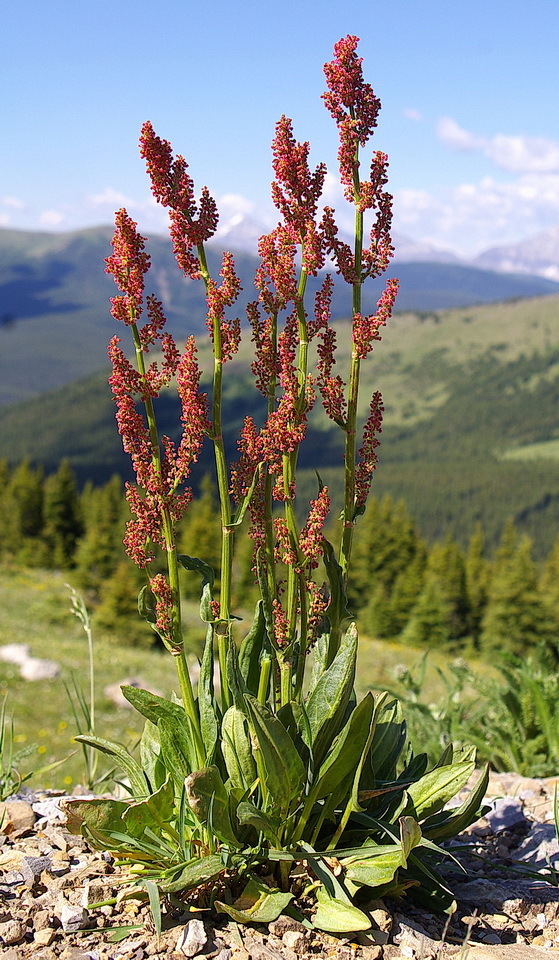
Lapland mountain sorrel
Rumex lapponicus
Rumex lapponicus, known commonly as Lapland mountain sorrel is a perennial flowering herb species in the family Polygonaceae. It is commonly found in meadows and rock outcrops, as well as montane, arenicolous, and alluvial habitats.
From the article Rumex lapponicus on Wikipedia (CC BY-SA), quoted section by section
Description
Rumex lapponicus is a herbaceous perennial plant with several or a single branched erect stem. Branching in the distal portion of the stem and inflorescence differentiates R. lapponicus from other species of Rumex, namely R. acetosa, of which R. lapponicus was initially mischaracterized as a subspecies. It has stems usually reaching 20-60 centimeters (8-24 inches) high, and broadly ovate, terminally sagittate leaves that are 3–10 cm long and 1–4 cm wide. It is dioecious.
Range & habitat
Rumex lapponicus occurs between 0–2500 meters in elevation in montane and submontane meadow and outcrop environments throughout Canada (British Columbia, Alberta, Yukon, and the Northwest Territories), the United States (Montana, Wyoming, and Alaska), Greenland, and throughout North Eurasia. It is most successful in silty, fine soils along rivers and streams in montane and tundra zones.
Wikipedia: “Distribution”
At the table
The Norwegian name for Rumex lapponicus, setersyre, has led to some speculation that it was used on Mid-Norwegian summer farms as an acidifying agent. The United States Department of Agriculture has listed Rumex lapponicus as a noxious weed in the state of Arkansas, indicating that members of the genus Rumex "can directly or indirectly injure or cause damage to crops (including nursery stock or plant products), livestock, poultry or other interests of agriculture, irrigation, navigation, the natural resources of the United States, the public health, or the environment", in an official profile on the USDA website, and thus subject to interstate travel restrictions within the US.
== References ==
Wikipedia: “Uses”
Where it lives
Recorded sightings
—
geo-referenced records in GBIF, from museums, herbaria and field observers.
Drag the globe to turn it. Dots are where records exist, not a range map; darker means more records.
In the stacks
Searching the stacks…
Every page naming Rumex lapponicus in the Biodiversity Heritage Library →
This page is assembled live from iNaturalist, GBIF, Wikipedia, the Source Library and the Internet Archive. It is not yet part of the hand-edited codex. iNaturalist taxon 607138.