- Plants
- ›Vascular Plants
- ›flowering plants
- ›monocots
- ›grasses, sedges, cattails, and allies
- ›grasses
- ›Pooideae
- ›Wheats, ryes, barleys and relatives
- ›barleys, ryes, and relatives
- ›Leymus
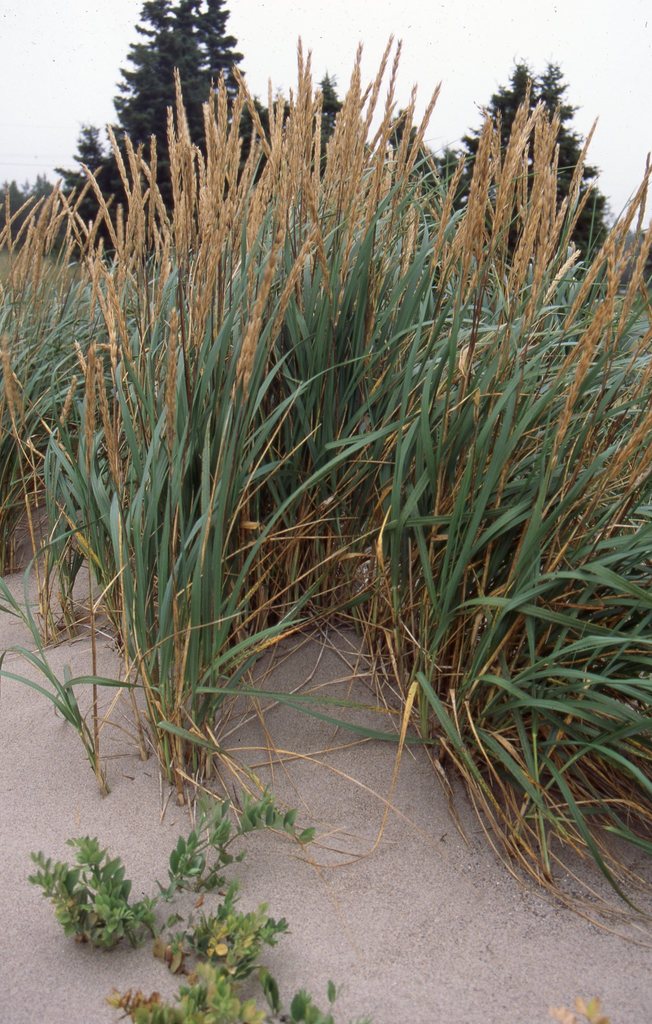
American lyme grass
Leymus mollis
Leymus mollis (syn. Elymus mollis) is a species of grass known by the common names American dune grass, American dune wild-rye, sea lyme-grass, strand-wheat, and strand grass. Its Japanese name is hamaninniku. It is native to Asia, where it occurs in Japan, China, Korea, and Russia, and northern parts of North America, where it occurs across Canada and the northern United States, as well as Greenland. It can also be found in Iceland.
From the article Leymus mollis on Wikipedia (CC BY-SA), quoted section by section
Range & habitat
This grass usually grows in coastal habitat, especially on dunes. It can be an important part of dune ecology. The grass usually grows on the foredune and on embryo dunes, less often on the backdune. It is one of the first plants to establish in the process of ecological succession in the early stages of the development of a sand dune. In these loose dunes facing the ocean the plants tolerate salt spray, salty sand, little to no fresh water, unstable substrates, occasional inundation during storms, low nutrient levels, and abrasion by wind, water, and ice storms. Seedlings may become buried. This type of environment causes stress in a plant. The grass grows from a large rhizome that anchors it into shifting and unstable sands. When there are many plants on a dune, their rhizomes form a network that helps to stabilize it, preventing erosion. The network becomes "the skeleton of the foredune." This makes the grass a valuable species for landscape rehabilitation in native beach habitat.
Wikipedia: “Habitat”
At the table
This grass has had a number of other uses. In addition to possible wheat breeding, the drought resistance of L. mollis is suggested to be used in restoration initiatives. The Makah, Nitinaht, and Quileute used bunches of the thick roots to rub the body during bathing. Yupik peoples use the leaves to make mats, baskets, bags, and ropes for hanging fish to dry. The Hesquiat weave the leaves into handles for sacks. The Kwakwaka'wakw make baskets and hats from the leaves and traditionally have used them to line the boxes in which they cooked lupine roots. The Nitinaht used the pointed leaves to sew and tie. The Haisla and Hanaksiala used the grass to line pits in which they prepared the oil of the eulachon fish. The Quinault placed salal fruits on a bed of the leaves to dry. Inuit in Canada have traditionally used Leymus mollis to treat stomach problems and to weave baskets. They used dried leaves to insulate their boots.
Wikipedia: “Human uses”
Where it lives
Recorded sightings
—
geo-referenced records in GBIF, from museums, herbaria and field observers.
Drag the globe to turn it. Dots are where records exist, not a range map; darker means more records.
In the stacks
Searching the stacks…
Every page naming Leymus mollis in the Biodiversity Heritage Library →
This page is assembled live from iNaturalist, GBIF, Wikipedia, the Source Library and the Internet Archive. It is not yet part of the hand-edited codex. iNaturalist taxon 61067.