- Plants
- ›Vascular Plants
- ›flowering plants
- ›monocots
- ›Aroids, Water Plantains, Seagrass, and allies
- ›Arum Family
- ›Aroideae
- ›Arum tribe
- ›Arum
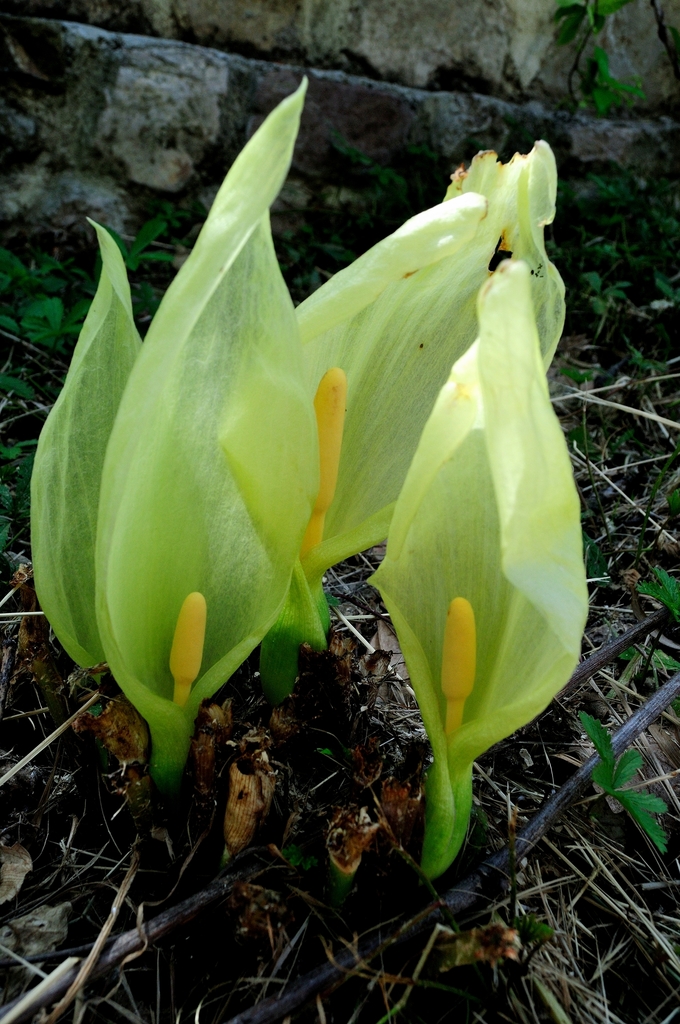
Italian arum
Arum italicum
Arum italicum is a species of flowering herbaceous perennial plant in the family Araceae, also known as Italian arum and Italian lords-and-ladies. It is native to the Mediterranean region (southern Europe, northern Africa, and the Middle East) plus Great Britain, the Netherlands, Crimea, Caucasus, Canary Islands, Madeira, and the Azores. It is also naturalized in Argentina and in scattered locations in the United States.
From the article Arum italicum on Wikipedia (CC BY-SA), quoted section by section
Description
Arum italicum grows 30–46 cm (1–1.5 ft) high, with equal spread. It blooms in spring with white flowers that turn to showy red fruit. By relative inflorescence height, Arum species are divided into "cryptic" species, whose inflorescences are borne on a short peduncle amid or below the leaves, and "flag" species, whose inflorescences are above leaf level at the end of long peduncles. A. italicum is a cryptic species. In 1778, Lamarck noticed that the inflorescence of this plant produces heat. A. italicum generally has a chromosome count of 2n = 84, except that a few subspecies (such as subsp. albispathum) have 2n = 56.
Range & habitat
Arum italicum nativity by subspecies is as follows:
A. italicum subsp. italicum is native to Albania, Algeria, Baleares, Bulgaria, Corse, Cyprus, France, Greece, Iraq, Italy, Kriti, Krym, Morocco, Portugal, Sardegna, Sicilia, Spain, Switzerland, Tunisia, Turkey, Turkey-in-Europe, and Yugoslavia. A. italicum subsp. albispathum is native to Krym, North Caucasus, Transcaucasus, and Turkey. A. italicum subsp. canariense is native to Azores, Canary Islands, and Madeira. A. italicum subsp. neglectum is native to Algeria, France, Great Britain, Morocco, and Spain. Subspecies italicum has a multi-continental introduced presence, including in northeast Argentina, Austria, Belgium, Germany, Great Britain, Ireland, the Netherlands, north New Zealand, and the U.S. states of Illinois, California, Maryland, Missouri, New York, and North Carolina.
Wikipedia: “Distribution and habitat”
Toxicity
Leaves, fruits and rhizomes contain compounds that make them poisonous. Notably, the plants are rich in oxalates. The ingestion of the tuber may be fatal, as it affects the kidneys, digestive tract, and brain. Additionally, the sap of the plant can cause skin irritation, so it is recommended that gloves should be worn when removing it from an area.
How it is grown
It is cultivated as an ornamental plant for traditional and woodland shade gardens. Subspecies italicum (the one normally grown in horticulture) has distinctive pale veins on the leaves, whilst subspecies neglectum (known as late cuckoo pint) has faint pale veins, and the leaves may have dark spots. Nonetheless, intermediates between these two subspecies also occur, and their distinctiveness has been questioned. Some gardeners use this arum to underplant with Hosta, as they produce foliage sequentially: when the Hosta withers away, the arum replaces it in early winter, maintaining ground-cover. Numerous cultivars have been developed for garden use, of which A. italicum subsp. italicum 'Marmoratum' has gained the Royal Horticultural Society's Award of Garden Merit.
Wikipedia: “Cultivation”
Where it lives
Recorded sightings
—
geo-referenced records in GBIF, from museums, herbaria and field observers.
Drag the globe to turn it. Dots are where records exist, not a range map; darker means more records.
In the old herbals & bestiaries

In the stacks
Searching the stacks…
Every page naming Arum italicum in the Biodiversity Heritage Library →
This page is assembled live from iNaturalist, GBIF, Wikipedia, the Source Library and the Internet Archive. It is not yet part of the hand-edited codex. iNaturalist taxon 61168.