- Plants
- ›Vascular Plants
- ›flowering plants
- ›monocots
- ›lilies, supplejacks, and allies
- ›Herb-Paris, False Hellebores, Trilliums and allies
- ›Melanthieae
- ›Toxicoscordion
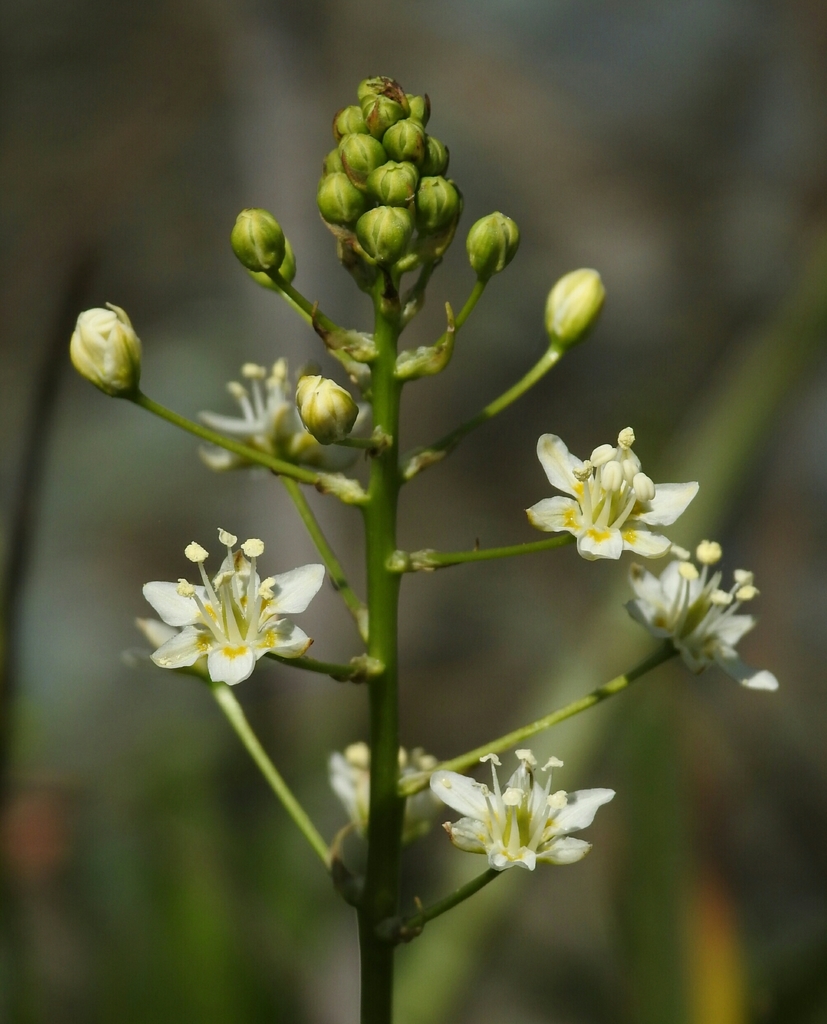
Smallflower Deathcamas
Toxicoscordion fontanum
Toxicoscordion fontanum, common name small-flower death camas, is a rare plant species known only from serpentine marshes in California. It is found primarily in the Coast Ranges from Mendocino County to San Luis Obispo County, with an additional report of an isolated population in the Sierra Nevada foothills in Kern County east of Bakersfield.
Toxicoscordion fontanum is a bulb-forming perennial herb. Bulbs are egg-shaped, up to 40 mm (1.6 inches) long, not clumped together. Inflorescences are paniculate, sometimes with as many as 100 flowers. Tepals are cream-colored, up to 12 mm (0.5 inches) long; filaments shorter than the tepals.
From the article Toxicoscordion fontanum on Wikipedia (CC BY-SA), quoted section by section
What it does
It is not unusual to find species that specialize in growing on serpentine soil. There are scattered pocket of this soil in various parts of California, Oregon, and elsewhere. Metamorphic rocks such as serpentinite are formed well below the earth's surface then carried upward by geologic activity. Soils made from such rocks tend to be low in nutrients such as nitrogen, potassium and phosphorus but high in nickel and chromium. Such conditions are toxic to most plants, but some species such as T. fontanum have evolved with adaptations allowing them to tolerate serpentine soils.
== References ==
Wikipedia: “Ecology”
Toxicity
As with many other species formerly included in Zigadenus, this species is highly toxic and potentially lethal to humans and to livestock. Some people have eaten it confusing it with wild onion, Allium spp. Zigadenus, despite Toxicoscordion not having the characteristic onion scent associated with Allium spp.
Where it lives
Recorded sightings
—
geo-referenced records in GBIF, from museums, herbaria and field observers.
Drag the globe to turn it. Dots are where records exist, not a range map; darker means more records.
In the stacks
Searching the stacks…
Every page naming Toxicoscordion fontanum in the Biodiversity Heritage Library →
This page is assembled live from iNaturalist, GBIF, Wikipedia, the Source Library and the Internet Archive. It is not yet part of the hand-edited codex. iNaturalist taxon 61194.