- Plants
- ›Vascular Plants
- ›flowering plants
- ›Dicots
- ›Roses, Elms, Figs, and Allies
- ›rose family
- ›Amygdaloideae
- ›Maleae
- ›Malus
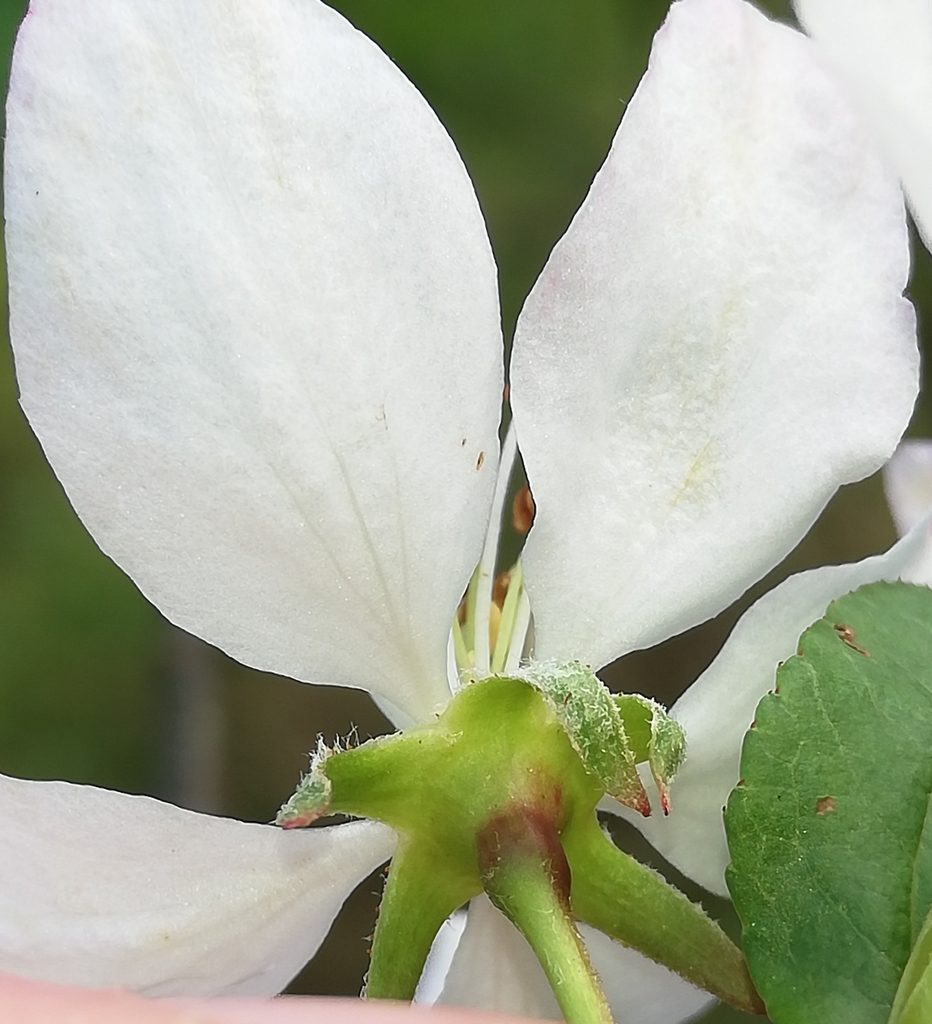
European Wild Apple
Malus sylvestris
Malus sylvestris, the European crab apple, also known as the European wild apple or simply the crab apple, is a species of the genus Malus. Its scientific name means "forest apple", reflecting its habitat. It is native from central Europe to western Asia.
From the article Malus sylvestris on Wikipedia (CC BY-SA), quoted section by section
Description
The wild apple is a deciduous small to medium-sized tree, but can also grow into a multi-stemmed bush. It can live 80–100 years and grow up to 14 metres (46 feet) tall with trunk diameters of usually 23–45 centimetres (9–17+1⁄2 inches), although diameters exceeding 90 cm (35 in) have been recorded. The leaves are roundish-oval and sometimes hairy on the underside. The hermaphrodite flowers appear in May to June, slightly preceding hawthorn, have white or pinkish petals and are insect-pollinated. The small pome-fruits are around 3 cm (1+1⁄4 in) in diameter, ripen in autumn and fall to the ground. The bark is light brown and breaks up in flakes. The branches are spiny, especially in response to pruning or browsing.
Identification. European wild apples hybridise readily with domesticated apples, which can make identification difficult, as hybrids commonly exhibit transitional traits from both parent species. While certain identification relies on genetic testing, field identification can be made by examining the following features. The crown of wild apples is densely branched, whereas the crown of domesticated apples tends to be more loosely arranged with fewer, straighter branches. Wild apple leaves tend to be somewhat smaller, stiffer and shinier. …
Range & habitat
The tree is widespread throughout Europe, with the exception of the extreme north and south. Additionally, it is also distributed in Anatolia and further into the south Caucasus. It occurs in a scattered distribution pattern as single individuals or in small groups. Due to its weak competitiveness and high light requirement, the wild apple is found mostly at sites where competition is reduced, such as the wet edge of forests, in wood pasture, farmland hedges or on very extreme, marginal sites. In the British Isles it occurs throughout Ireland, England and Wales and with reduced frequency in Scotland. In Scotland, it is most commonly found in woodlands and wood pastures.
Wikipedia: “Distribution and habitat”
What it does
The European wild apple is dispersed primarily by mammals, which eat the fruits. In a study from Mols, Denmark, it was determined that cattle accounted for the bulk of dispersal, followed by horses, despite the presence of wild animals. In Britain, the crab apple is associated with 93 species of insect. Its leaves are food of the hawthorn moth (Scythropia crataegella). Throughout its range, the wild apple is threatened and rare. Threats include the introgression from domesticated apples, the lack of natural regeneration and modern forestry practice, which promotes the closure of forest canopy cover, as opposed to the formerly prevailing coppice. In many aspects, the wild apple exhibits adaptations to grazing and the presence of large herbivores, and consequently also a high degree of dependence on them. It is thorny, suitable for coppice due to pronounced resprouting abilities and a very hardy tree. Wild apples may survive crown collapse and the breakage of major branches. In dispersal, it appears to be strongly reliant on bovines and equines. Since the extinction of both wild horses and aurochsen, and the near-extinction of the European bison, domesticated livestock seems to have assumed this role and replaced their extinct relatives. …
Wikipedia: “Ecology and threats”
How it is grown
In the past M. sylvestris was thought to be the most important ancestor of the cultivated apple (M. domestica), which has since been shown to have been primarily derived from the central Asian species M. sieversii. As confirmed by DNA analyses, M. sylvestris has contributed significantly to the genome. Secondary introgression from other species of the genus Malus has greatly shaped the genome of M. domestica, with M. sylvestris being the largest secondary contributor. Current populations of M. domestica are more closely related to M. sylvestris than to M. sieversii, while in more pure strains of M. domestica, the M. sieversii ancestry still predominates.
Wikipedia: “Progenitor of cultivated apples”
Where it lives
Recorded sightings
—
geo-referenced records in GBIF, from museums, herbaria and field observers.
Drag the globe to turn it. Dots are where records exist, not a range map; darker means more records.
In the stacks
Searching the stacks…
Every page naming Malus sylvestris in the Biodiversity Heritage Library →
This page is assembled live from iNaturalist, GBIF, Wikipedia, the Source Library and the Internet Archive. It is not yet part of the hand-edited codex. iNaturalist taxon 61223.