- Plants
- ›Vascular Plants
- ›flowering plants
- ›Dicots
- ›myrtles, evening primroses, and allies
- ›lythrum family
- ›Lythrum
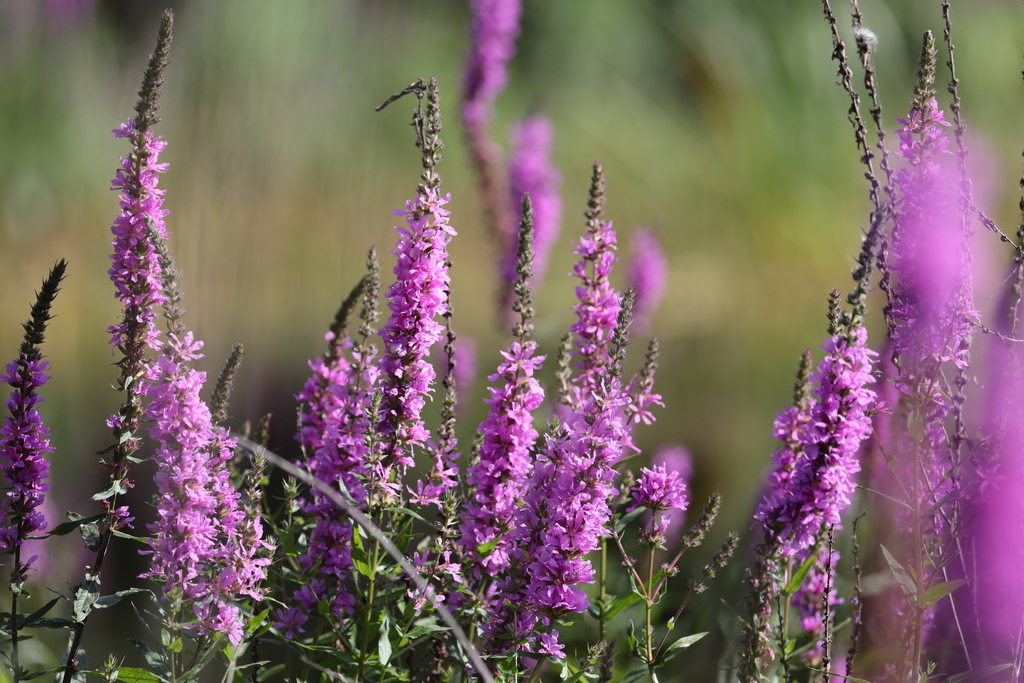
purple loosestrife
Lythrum salicaria
Lythrum salicaria or purple-loosestrife is a flowering plant belonging to the family Lythraceae. It should not be confused with other plants sharing the name loosestrife that are members of the genus Lysimachia in the family Primulaceae. This herbaceous perennial plant is native to temperate regions of Europe, Asia, northern Africa, and eastern Australia.
From the article Lythrum salicaria on Wikipedia (CC BY-SA), quoted section by section
Description
Lythrum salicaria can grow 1–2 m (3 ft 3 in – 6 ft 7 in) tall, forming extensive clonal colonies, with numerous erect stems growing from a single woody root mass. The stems are reddish-purple and square in cross-section. The leaves are lanceolate, 3–10 centimetres (1–4 in) long and 5–15 millimetres (3⁄16–9⁄16 in) broad, downy and sessile, and arranged opposite or in whorls of three.
The flowers are reddish purple, 10–20 millimetres (1⁄2–3⁄4 in) in diameter, with six petals (occasionally five) and 12 stamens, and are clustered tightly in verticillasters in the axils of bracts or leaves. There are three different flower types, with the stamens and style of different lengths, short, medium or long; each flower type can only be pollinated by one of the other types, not the same type, thus ensuring cross-pollination between different plants. For instance, if the pistil is medium length, then the stamens will be long and short, but not medium. The flowers are visited by many types of insects, and can be characterised by a generalised pollination syndrome. The fruit is a small 3–4 millimetres (1⁄8–5⁄32 in) capsule containing numerous minute seeds. Flowering lasts throughout the summer. When the seeds are mature, the leaves often turn bright red through dehydration in early autumn; the red autumn colour may last for almost two weeks. …
Range & habitat
Lythrum salicaria is native to Europe, temperate Asia, northern Africa, and Australia. It is also naturalised in many temperate parts of the world, including parts of southern Africa, North America, and South America. The species was thought to be a recent introduction to Australia, but pre-colonial pollen samples have been found in New South Wales, indicating natural colonisation before modern human plant introductions; the question is considered unresolved by Australian authorities.
Wikipedia: “Distribution”
What it does
Found in ditches, wet meadows and marshes and along sides of lakes. In North America, purple-loosestrife can invade sedge meadows.
Wikipedia: “Ecology”
At the table
It has been used as an astringent medicinal herb to treat diarrhea and dysentery; it is considered safe to use for all ages, including babies. It is also cultivated as an ornamental plant in gardens, and is particularly associated with damp, poorly drained locations such as marshes, bogs and watersides. However, it will tolerate drier conditions. The flowers are showy and bright, and a number of cultivars have been selected for variation in flower colour, including:
'Atropurpureum' with dark purple flowers 'Brightness' with deep pink flowers 'Happy' with red flowers on a short (60 cm or 24 in) stem 'Purple Spires' with purple flowers on a tall stem 'Roseum Superbum' with large pink flowers. The cultivars 'Blush' with blush-pink flowers, and 'Feuerkerze' with rose-red flowers have gained the Royal Horticultural Society's Award of Garden Merit. It has also been introduced in many areas of North America by bee keepers, due to its abundance of flowers which provide an important source of nectar.
As an invasive species. Purple-loosestrife has been introduced into temperate New Zealand and North America where it is now widely naturalised (spreading on its own) and officially listed in some controlling agents. …
Wikipedia: “Cultivation, uses and impact”
In human culture
The generic name Lythrum is derived from the Greek 'lythron', meaning blood, in reference to the flower colour in some species. The specific epithet salicaria probably derives from the similarity of the leaves to those of willows or Salix species, though Linnaeus did not specify this in his choice of the name. The English calque 'loosestrife' first appeared in written form in the 16th century. It was coined by English naturalist William Turner in his 1548 work A New Herball, in which he states: "Lycimachia purpurea, … may in englishe be called red loosstryfe or purple losestryfe". Purple-loosestrife was referred to several times as 'long purples' by John Clare, such as in his 1821 poem The Wildflower Nosegay:
"Where on the water op'd the lily buds And fine long purples shadow'd in the lake..."
Wikipedia: “Etymology and other names”
Where it lives
Recorded sightings
—
geo-referenced records in GBIF, from museums, herbaria and field observers.
Drag the globe to turn it. Dots are where records exist, not a range map; darker means more records.
In the old herbals & bestiaries

Notable Commentaries on the History of Plants
Leonhart Fuchs · 1549 · p.523

Notable Commentaries on the History of Plants
Leonhart Fuchs · 1542 · p.525

A New Herbal, or History of Plants
Rembert Dodoens (trans. Henry Lyte) · 1578 · p.98

Complete Treatise on Agricultural Administration
Xu Guangqi · 1909 · p.668
In the stacks
Searching the stacks…
Every page naming Lythrum salicaria in the Biodiversity Heritage Library →
This page is assembled live from iNaturalist, GBIF, Wikipedia, the Source Library and the Internet Archive. It is not yet part of the hand-edited codex. iNaturalist taxon 61321.