- Animals
- ›Arthropods
- ›Hexapods
- ›Insects
- ›Winged and Once-winged Insects
- ›True Bugs, Hoppers, Aphids, and allies
- ›Plant-parasitic Hemipterans
- ›Aphids and Allies
- ›Phylloxeroidea
- ›Adelgids
- ›Adelges
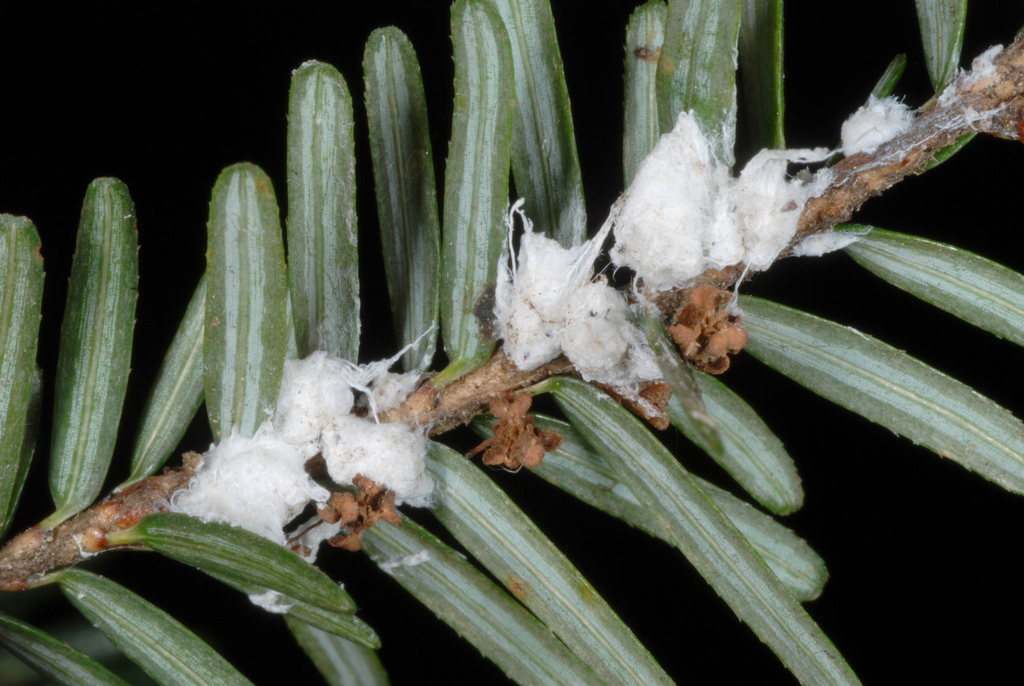
Hemlock Woolly Adelgid
Adelges tsugae
Adelges tsugae, the hemlock woolly adelgid () or HWA, is an insect of the order Hemiptera (true bugs) native to East Asia. It feeds by sucking sap from hemlock and spruce trees (Tsuga spp.; Picea spp.). In its native range, HWA is not a serious pest because populations are managed by natural predators and parasitoids and by host resistance. In eastern North America it is a destructive pest that threatens the eastern hemlock (Tsuga canadensis) and the Carolina hemlock (Tsuga caroliniana). HWA is also found in western North America, where it has likely been present for thousands of years. In western North America, it primarily attacks western hemlock (Tsuga heterophylla) and has only caused minor damage due to natural predators and host resistance. Accidentally introduced to North America from Japan, HWA was first found in the eastern United States near Richmond, Virginia, in 1951. The pest is now found from northern Georgia to coastal Maine and southwestern Nova Scotia as well as areas of western Michigan near the eastern Lake Michigan shoreline. As of 2015, HWA has affected 90% of the geographic range of eastern hemlock in North America.
From the article Hemlock woolly adelgid on Wikipedia (CC BY-SA), quoted section by section
Description
An adult individual body length is typically 0.8 mm, and is oval in shape. The tiny brown-colored insect has four thread-like stylets that are bundled together and function as a mouthpart. Three times the length of its body, the stylet bundle pierces the host plant's parenchymatic ray tissue to derive nutrition from stored reserves. It may also inject a toxin while feeding. The resulting desiccation causes the tree to lose needles and not produce new growth. Hemlocks stricken by HWA frequently become grayish-green rather than a healthy dark green. In the northern portion of the hemlock's range, death typically occurs 4 to 10 years after infestation. Trees that survive the direct effects of the infection are usually weakened and may die from secondary causes. The presence of HWA can be identified by its egg sacs, which resemble small tufts of cotton clinging to the underside of hemlock branches. In North America, the hemlock woolly adelgid asexually reproduces and can have two generations per year. Both generations are parthenogenetic and exclusively female. In its native Asian habitat, a third winged generation called sexupera occurs. This generation's sexual reproduction requires a species of spruce not found in the Eastern United States. Between 100 and 300 eggs are laid by each individual in the woolly egg sacs beneath the branches. …
Wikipedia: “Characteristics”
Listen
Looking for field recordings…
Where it lives
Recorded sightings
—
geo-referenced records in GBIF, from museums, herbaria and field observers.
Drag the globe to turn it. Dots are where records exist, not a range map; darker means more records.
In the stacks
Searching the stacks…
Every page naming Adelges tsugae in the Biodiversity Heritage Library →
This page is assembled live from iNaturalist, GBIF, Wikipedia, the Source Library and the Internet Archive. It is not yet part of the hand-edited codex. iNaturalist taxon 61513.