- Animals
- ›Arthropods
- ›Hexapods
- ›Insects
- ›Winged and Once-winged Insects
- ›Flies
- ›Brachyceran Flies
- ›Orthorrhaphan Flies
- ›Asiloidea
- ›Robber Flies
- ›Asilinae
- ›Apocleini
- ›Mallophora
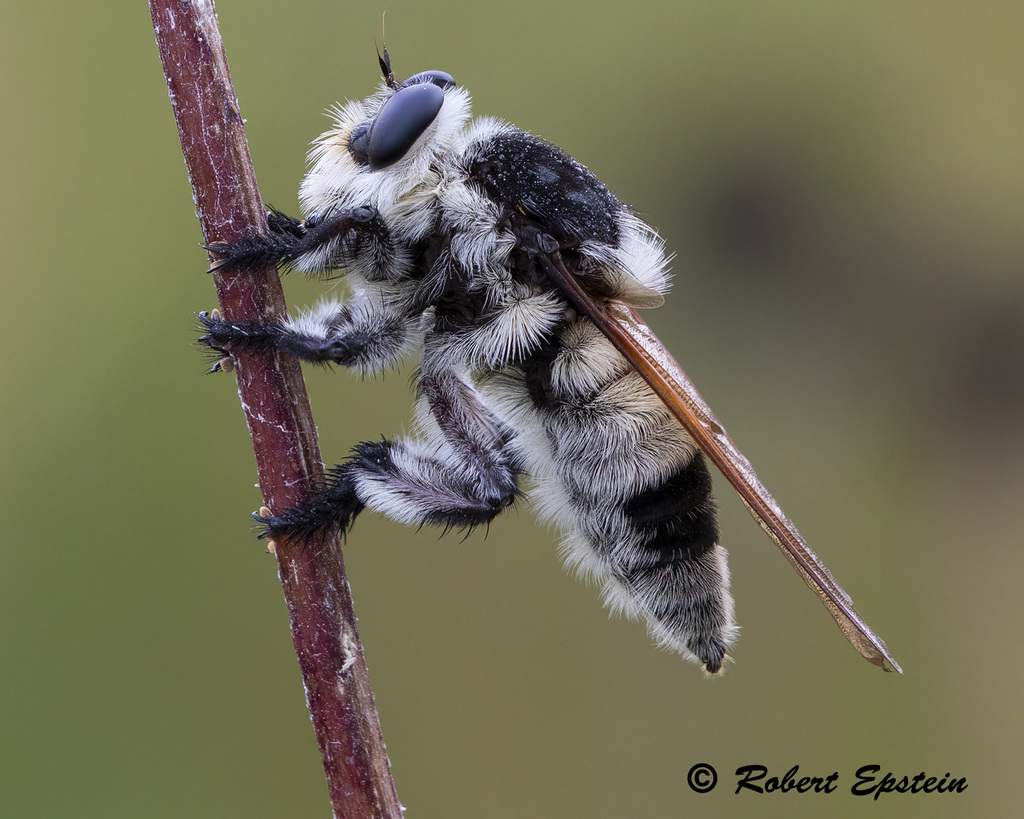
Florida Bee-Killer
Mallophora bomboides
Mallophora bomboides, also known as the Florida bee killer, is a predaceous species of robber fly of the family Asilidae that feeds primarily on bumblebees. M. bomboides is a noteworthy instance of Batesian mimicry given its close resemblance to its prey, the bumblebee. These bees are typically found in the Eastern and Southern regions of the United States like South Carolina and Florida.
From the article Mallophora bomboides on Wikipedia (CC BY-SA), quoted section by section
Range & habitat
M. bomboides occurs in the southeastern United States in states including North Carolina, South Carolina, Georgia, Florida, Alabama, and Mississippi.
Wikipedia: “Geographical distribution”
What it does
As a member of the family Asilidae, M. bomboides preys on various aculeate Hymenoptera species. M. bomboides in particular prey on bumblebees such as Bombus pensylvanicus, to which M. bomboides bears remarkable resemblances.
Wikipedia: “Diet”
In human culture
The similar appearances of some flies and bees have been noted since the time of Aristotle. In fact, in these ancient times, the confusion between the two insects led to the disproven notion that bees undergo spontaneous generation from decaying carcasses. British entomologists William Kirby and William Spence first theorized in 1817 that flies gained an advantage by resembling bees, reasoning that the physical similarity of hoverflies from genus Volucella to bumblebees enabled the invasion of bee nests. Having entered the bee nests without arousing suspicion, the flies then lay eggs and depart without being attacked. The same idea was later put forth by British naturalist Alfred Russel Wallace in 1871.
Initial classification. Classifying categories of mimicry in 1890, Edward Bagnell Poulton placed this into the category of aggressive mimicry, a deceptive mechanism in which one species resembles another in order to approach it without arousing suspicion to carry out a detrimental end. However, Gregory Bateson criticized this view in 1892 by pointing out that the Volucella example fits much better as an instance of protective mimicry, now commonly known as Batesian mimicry. By appearing as bees, palatable flies gain protection from predators that recognize bees as noxious and therefore unappetizing. …
Wikipedia: “History”
Listen
Looking for field recordings…
Where it lives
Recorded sightings
—
geo-referenced records in GBIF, from museums, herbaria and field observers.
Drag the globe to turn it. Dots are where records exist, not a range map; darker means more records.
In the stacks
Searching the stacks…
Every page naming Mallophora bomboides in the Biodiversity Heritage Library →
This page is assembled live from iNaturalist, GBIF, Wikipedia, the Source Library and the Internet Archive. It is not yet part of the hand-edited codex. iNaturalist taxon 61630.