- Animals
- ›Arthropods
- ›Hexapods
- ›Insects
- ›Winged and Once-winged Insects
- ›Beetles
- ›Water, Rove, Scarab, Long-horned, Leaf, and Snout Beetles
- ›Cucujiform Beetles
- ›Lady, Fungus, Scavenger, and Bark Beetles
- ›Lady Beetles
- ›Common Lady Beetles
- ›Plant-eating Lady Beetles
- ›Subcoccinella
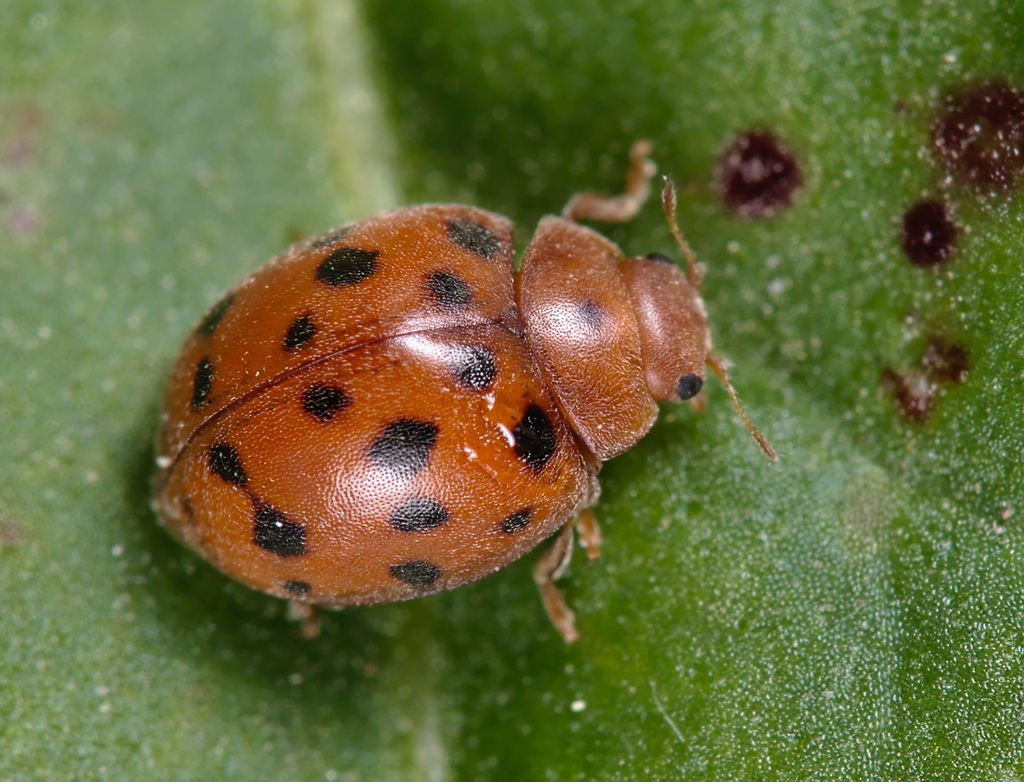
24-spot Ladybird
Subcoccinella vigintiquatuorpunctata
Subcoccinella vigintiquatuorpunctata (the 24-spot ladybird) is a beetle in the family Coccinellidae. It is the only member of the genus Subcoccinella (though this is disputed; see below). It has the typical, almost semi-spherical, ladybird shape and is patterned with spots. However it differs from many of the well-known ladybirds in being neither smooth and shiny nor an eater of aphids: the wing-cases look velvety and it eats the leaves of herbaceous plants.
From the article Subcoccinella vigintiquatuorpunctata on Wikipedia (CC BY-SA), quoted section by section
Description
The adult 24-spot is a small ladybird, usually 3 to 4 mm long. It has the quintessential ladybird shape, quite domed with the sides forming a smooth curve from head to pronotum to wing-cases. The wing-cases are covered with short pale hairs, and though these are hard to see without a hand lens, they give the ladybird a distinctive matt appearance. The ladybird is dark orange, including legs and antennae. There are black spots on the wing cases. These vary in number and size but there are often about 20 to 24 and usually no more than 26. Sometimes spots are joined together or they can be absent completely. Dark (melanic) forms are very rare. Another extremely rare form has yellow spots. Larvae are 4 to 6mm long and pale grey-green with darker speckles. They are covered with branched spines. These spines are also present in the pupa, enabling the pupa to secrete noxious alkaloids as a defence against predators. There are five European species in the subfamily Epilachninae, all herbivorous and somewhat hairy. The 24-spot Ladybird can be distinguished from the similarly patterned Bryony Ladybird - Henosepilachna argus (6 to 8 mm) by its small size (3 to 4 mm). Cynegetis impunctata, another small ladybird, is browner and has no spots. …
Range & habitat
This ladybird is an Old World species occurring across Europe, North Africa, European Russia, the Caucasus, Siberia, the Russian Far East, Belarus, Ukraine, Moldova, Transcaucasia, Kazakhstan, Middle Asia, Western Asia, Afghanistan, Mongolia, China, North and South Korea. It was introduced into North America some time last century with the first records from Pennsylvania in 1972. In Britain it is more common in the south.
Wikipedia: “Distribution”
Listen
Looking for field recordings…
Where it lives
Recorded sightings
—
geo-referenced records in GBIF, from museums, herbaria and field observers.
Drag the globe to turn it. Dots are where records exist, not a range map; darker means more records.
In the stacks
This page is assembled live from iNaturalist, GBIF, Wikipedia, the Source Library and the Internet Archive. It is not yet part of the hand-edited codex. iNaturalist taxon 61937.