- Animals
- ›Arthropods
- ›Hexapods
- ›Insects
- ›Winged and Once-winged Insects
- ›Dragonflies and Damselflies
- ›Dragonflies
- ›Libelluloidea
- ›Skimmers
- ›Orthetrum
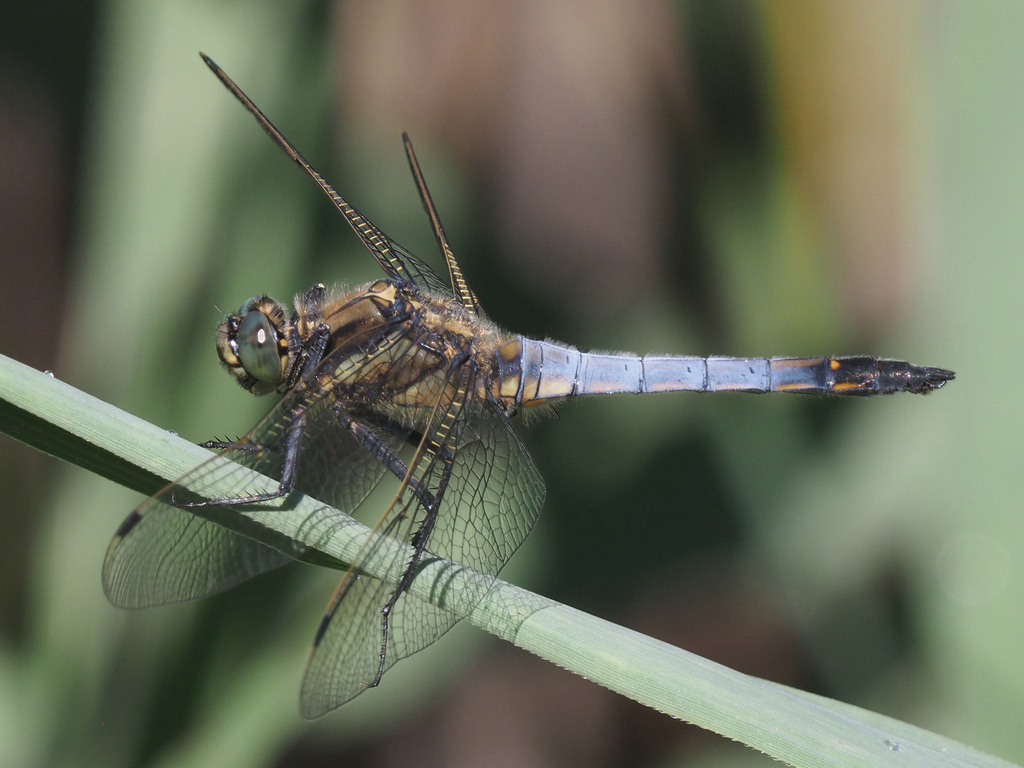
Black-tailed Skimmer
Orthetrum cancellatum
The black-tailed skimmer (Orthetrum cancellatum) is a dragonfly of Europe and Asia. It occurs nearly all of Europe except northern UK and Scandinavia; to the east, the range extends to Kashmir and Mongolia.
From the article Black-tailed skimmer on Wikipedia (CC BY-SA), quoted section by section
Description
It is a fairly large dragonfly (the length of 47–53 mm, 29–35 mm abdomen, rear wing 35–41 mm) with relatively broad, flattened abdomen, but not as broad as the chaser species. With age, adult males develop extensive blue pruinescence on their abdomen, offset by yellow lateral patches. The middle lobe of the pronotum is large and notched in the middle. The chest is yellow or yellowish-brown. The base of the hind wings do not show a dark opaque spots. The pterostigma is dark brown or black. On the front wings pterostigma 2–3 mm long. The anal appendages are black. The females and immature males are a deep yellow colour, with wavy black lines dorsally on their abdomen. Males and females have the costal vein (the leading edge of the wing) yellow or black. The species is similar to its much more localised congener the Orthetrum albistylum, but readily identifiable in the field. The males develop a blue pruinescence on the abdomen darkening to the rear with S8-10 becoming black. Its eyes are very dark green. They fly swift and low, skimming the water surface. Females retain their colour and markings though they become quite greyish brown with age. This species could be confused with Keeled skimmer or Scarce chaser.
Range & habitat
This species is widespread in Europe and Asia. It is found throughout the European continent including the Mediterranean islands but is absent in the far north of Britain and the northern half of Fennoscandia. This is one of the most common European species and it is still increasing its range northwards. To the east, the range extends over central Asia to Kashmir, Mongolia to the northern parts of China and Arunachal Pradesh in India. It is present in Albania, Algeria, Armenia, Austria, Azerbaijan, Belarus, Belgium, Bosnia and Herzegovina, Bulgaria, China, Croatia, Cyprus, Czech Republic, Denmark, Estonia, Finland, France (Corsica, and mainland), Georgia, Germany, Greece, Hungary, India, Iran, Ireland, Italy, Kazakhstan, Kyrgyzstan, Latvia, Lebanon, Lithuania, Luxembourg, Malta, Moldova, Mongolia, Montenegro, Morocco, Netherlands, North Macedonia, Norway, Poland, Portugal, Romania, Russia, Serbia, Slovakia, Slovenia, Spain, Sweden, Switzerland, Syria, Tajikistan, Tunisia, Turkey (including Turkey-in-Europe), Turkmenistan, Ukraine, United Kingdom, and Uzbekistan. The black-tailed skimmer is abundant throughout its range and is one of the most commonly seen dragonflies in Europe. …
Wikipedia: “Distribution”
What it does
The main flight period is June and July. Males characteristically perch horizontally on exposed surfaces. They fly swift and low, skimming the water surface, while defending their territories. Mating can occur in flight or on land. Females oviposit alone but with male in attendance. Eggs are laid in flight by dipping abdomen onto water surface. They hatch after five or six weeks and the larvae live partially hidden by bottom debris. They emerge after two or three years. Larvae prefer bottom areas rich in vegetation and decaying plant material.
Wikipedia: “Biology and behaviour”
Listen
Looking for field recordings…
Where it lives
Recorded sightings
—
geo-referenced records in GBIF, from museums, herbaria and field observers.
Drag the globe to turn it. Dots are where records exist, not a range map; darker means more records.
In the stacks
Searching the stacks…
Every page naming Orthetrum cancellatum in the Biodiversity Heritage Library →
This page is assembled live from iNaturalist, GBIF, Wikipedia, the Source Library and the Internet Archive. It is not yet part of the hand-edited codex. iNaturalist taxon 62067.