- Plants
- ›Vascular Plants
- ›flowering plants
- ›Dicots
- ›Roses, Elms, Figs, and Allies
- ›rose family
- ›brambles, roses, strawberries, and allies
- ›agrimonies and burnets
- ›burnet subtribe
- ›Sanguisorba
- ›Sanguisorba
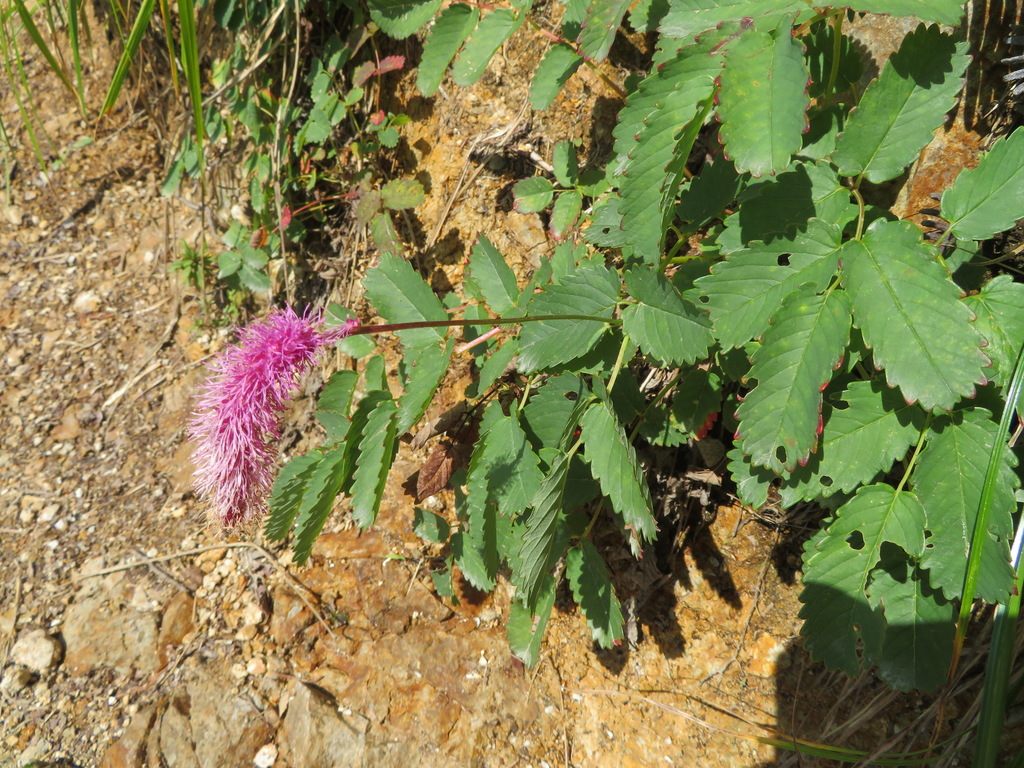
Sanguisorba hakusanensis
Sanguisorba hakusanensis, also called Korean mountain burnet or lilac squirrel is a species in the genus Sanguisorba (family Rosaceae), native to Korea and Japan. Its Japanese name means "coming from Haku", a mountain in Japan. It is attractive in the garden for its long lasting pink-lavender, fuzzy arching "plumes", as well as its gray-green, heavily scalloped leaves. This flowering plant grows to about 30 inches tall when in flower and prefers full sun to partial shade...
From the article Sanguisorba hakusanensis on Wikipedia (CC BY-SA), quoted section by section
Description
This perennial grows on mountain ridges or in sunny rock crevices or grasslands near them. The stem grows to heights of 40–80 cm (16–31 in) and has few hairs. The leaves are opposite. The basal leaves are pinnate with 4–6 pairs of leaflets. The stem leaves are smaller and often have hairs on the lower underside. The reddish purple flowers bloom in August–September, and hang iat the ends of branches in spike inflorescences . The fruit is a squarish berry. The number of stamens is 6–12.
Range & habitat
It is native to both Korea and Japan. In South Korea it is found on the mountains Jirisan and Gayasan (Gyeongsangnam-do), and Mudeungsan (Jeollanam-do), Deogyusan (Jeollabuk-do), and Seoraksan (Gangwon-do).
Wikipedia: “Distribution”
At the table
In South Korea, the young leaves are eaten, while the roots are used medicinally.
Wikipedia: “Uses”
How it is grown
It is attractive in the garden for its long-lasting pink or lavender, fuzzy, arching plumes, as well as its gray-green, heavily scalloped leaves. It grows to about 20–30 in (51–76 cm) tall when in flower, and prefers full sun to partial shade in moist, well-drained soil. Known cultivars include Sanguisorba hakusanensis 'Lilac Squirrel' (also known as Sanguisorba 'Lilac Squirrel',) it blooms from July to September.
== References ==
Wikipedia: “Cultivation”
Where it lives
Recorded sightings
—
geo-referenced records in GBIF, from museums, herbaria and field observers.
Drag the globe to turn it. Dots are where records exist, not a range map; darker means more records.
In the stacks
Searching the stacks…
Every page naming Sanguisorba hakusanensis in the Biodiversity Heritage Library →
This page is assembled live from iNaturalist, GBIF, Wikipedia, the Source Library and the Internet Archive. It is not yet part of the hand-edited codex. iNaturalist taxon 622522.