- Plants
- ›Vascular Plants
- ›flowering plants
- ›Dicots
- ›Sunflowers, Bellflowers, Fanflowers, and Allies
- ›bellflower family
- ›Lobelia subfamily
- ›Lobelia
- ›Lobelia
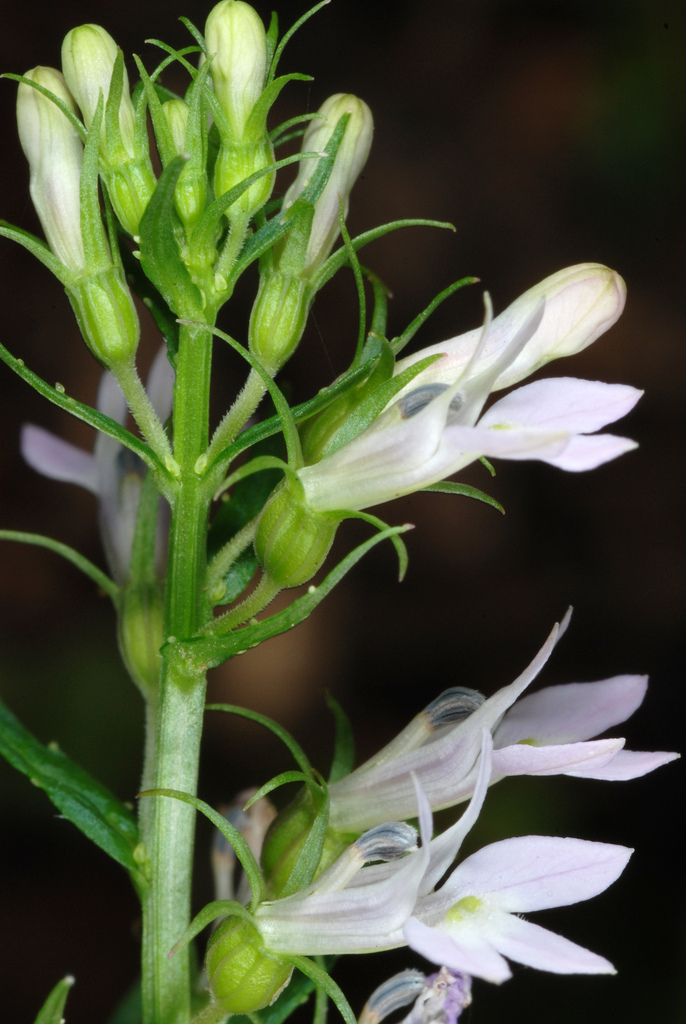
Indian tobacco
Lobelia inflata
Lobelia inflata, also known as Indian tobacco or puke weed, is a species of Lobelia native to eastern North America, from southeastern Canada (Nova Scotia to southeast Ontario) south through the eastern United States to Alabama and west to Kansas.
From the article Lobelia inflata on Wikipedia (CC BY-SA), quoted section by section
Description
Lobelia inflata is an annual or biennial herbaceous plant growing to 15–100 cm (5.9–39.4 in) tall, with stems covered in tiny hairs. Its leaves are usually about 8 cm (3.1 in) long, and are ovate and toothed. They are alternately arranged. It has violet colored flowers that are tinted yellow on the inside, and usually appear in mid-summer and continue to bloom into fall. The seedcases are small, brown, dehiscent, and papery.
At the table
Lobelia inflata has a long use as a medicinal plant as an entheogenic, emetic, and skin or respiratory aid. Native Americans used it for respiratory and muscle disorders, as a purgative, and as a ceremonial medicine. The leaves were chewed and smoked. The plant was used as a traditional medicinal plant by the Cherokee, Iroquois, Penobscot, and other indigenous peoples. The foliage was burned by the Cherokee as a natural insecticide, to smoke out gnats. Although it may be used medicinally, consuming lobelia causes adverse effects, which may include sweating, nausea, vomiting, diarrhea, tremors, rapid heartbeat, mental confusion, convulsions, hypothermia, coma, or possibly death. The root is toxic and can be fatal if eaten.
Wikipedia: “Traditional uses and adverse effects”
How it is grown
Propagation is usually accomplished by cuttings or seed. Seeds are sown in containers in mid spring or mid fall. The seeds take about 2 weeks to germinate.
Wikipedia: “Propagation”
Where it lives
Recorded sightings
—
geo-referenced records in GBIF, from museums, herbaria and field observers.
Drag the globe to turn it. Dots are where records exist, not a range map; darker means more records.
In the stacks
Searching the stacks…
Every page naming Lobelia inflata in the Biodiversity Heritage Library →
This page is assembled live from iNaturalist, GBIF, Wikipedia, the Source Library and the Internet Archive. It is not yet part of the hand-edited codex. iNaturalist taxon 62351.