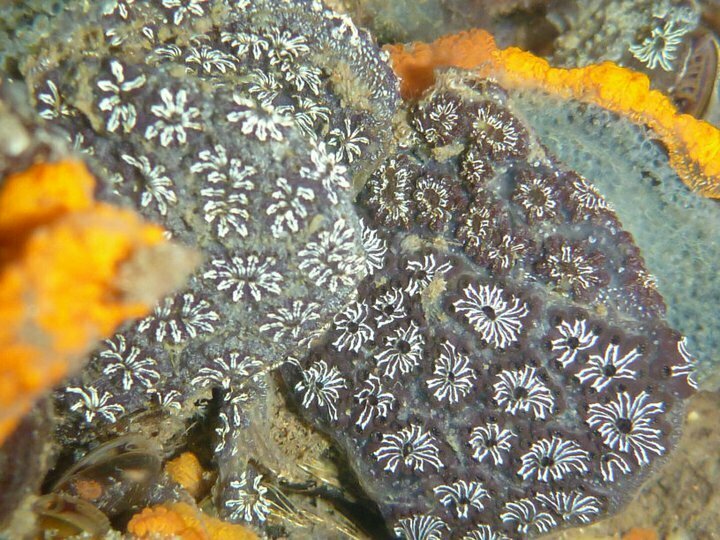
Star Tunicate
Botryllus schlosseri
Botryllus schlosseri is a colonial ascidian tunicate. It is commonly known as the star tunicate, but it also has several other common names, including star ascidian and golden star tunicate. Colonies grow on slow-moving, submerged objects, plants, and animals in nearshore saltwater environments.
From the article Botryllus schlosseri on Wikipedia (CC BY-SA), quoted section by section
Description
Individual zooids may grow to 3 millimetres (0.12 in) in size, with colonies reaching 50 millimetres (2.0 in) long . This species can be distinguished from Botrylloides sp. by the pattern of zooid growth. B. schlosseri zooids emanate from a center in the manner of the arms of a star. Also, there usually are fewer zooids per cluster (5–8 in B. schlosseri and 10 or more in Botrylloides). There are many colors in which this species can be found, ranging from orange, blue and grey. A colony can be easily be separated from the main body to form an independent colony usually referred to as a subclone. Two colonies may also fuse together if they share common alleles for historecognition.
Genome. The genome has been sequenced. It is 533 megabases in length organised into 16 chromosomes. It contains nearly 22,000 predicted genes The data also confirmed that the Tunicata are the closest invertebrate relative of humans.
Range & habitat
The native range of Botryllus schlosseri is the north eastern Atlantic Ocean, the Mediterranean Sea and the North Sea. Its range has spread over the last 100 years to a nearly worldwide extent. Ranging in the western Atlantic Ocean from the Bay of Fundy to North Carolina, it is regarded as an invasive species and is "the most common colonial tunicate in North America."
Wikipedia: “Distribution”
Where it lives
Recorded sightings
—
geo-referenced records in GBIF, from museums, herbaria and field observers.
Drag the globe to turn it. Dots are where records exist, not a range map; darker means more records.
In the stacks
Searching the stacks…
Every page naming Botryllus schlosseri in the Biodiversity Heritage Library →
This page is assembled live from iNaturalist, GBIF, Wikipedia, the Source Library and the Internet Archive. It is not yet part of the hand-edited codex. iNaturalist taxon 62408.