- Animals
- ›Arthropods
- ›Hexapods
- ›Insects
- ›Winged and Once-winged Insects
- ›Ants, Bees, Wasps, and Sawflies
- ›Narrow-waisted Wasps, Ants, and Bees
- ›Ants, Bees, and Stinging Wasps
- ›Bees and Apoid Wasps
- ›Bees
- ›Mason, Leafcutter, Carder, and Resin Bees
- ›Megachilinae
- ›Anthidiini
- ›Anthidium
- ›Anthidium
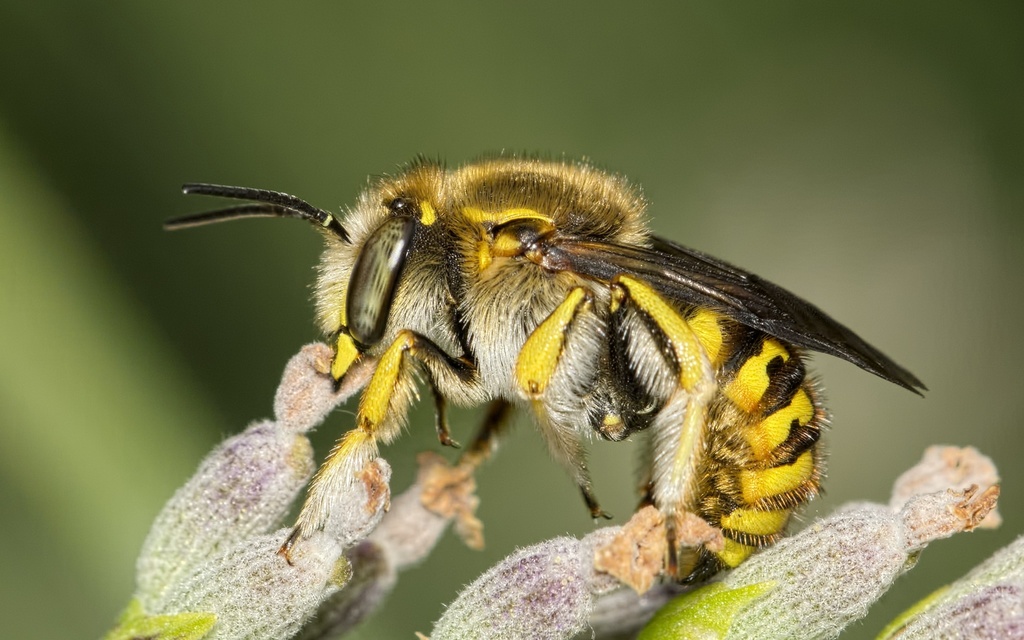
European Woolcarder Bee
Anthidium manicatum
Anthidium manicatum, commonly called the European wool carder bee, is a species of bee in the family Megachilidae, the leaf-cutter bees and mason bees.
They get the name "carder" from their behaviour of scraping hair from leaves such as lamb's ears (Stachys byzantina), similar to the way textile workers card fibers. They carry this hair bundled beneath their bodies to be used as a nest lining. Like other members of the tribe Anthidiini, these bees do not cut leaves or petals as is typical for megachilids. The males engage in territorial behaviour, aggressively chasing other males and pollinators from their territory.
From the article Anthidium manicatum on Wikipedia (CC BY-SA), quoted section by section
Description
Anthidium manicatum has a wingspan around 20 millimetres (0.79 in), with a body length of about 11–13 mm (0.43–0.51 in) for females, and 14–17 mm (0.55–0.67 in) for males. The males are substantially larger than females. A. manicatum bees are black and covered with yellow-grey hairs. Their faces and abdomens are covered in yellow spots. A male has a black head and thorax, coated with short yellowish-brown hairs. The cheeks below the antennae, a small spot behind each eye, a bilobate spot on the clypeus, and the mandibles (except the apex) are yellow. The wings are dusky in color. The abdomen is black with grey hairs, with a band of brown hairs at each segment's apex, as well as along the lateral margins. This feature distinguishes male A. manicatum from New World Anthidium species. A yellow spot is on each side of the segments except the seventh. A second pair of spots is often seen on the disks of the fourth and fifth segments. A spine occurs on each side of the sixth and seventh segments at the apex, the seventh having a third thin spine in the middle. The legs exhibit variegation of yellow and are covered with grey hairs. A female is smaller than the male, but has a similar color pattern. The abdominal spots are smaller and the apex is rounded. Female legs are almost completely black, with very small yellow spots. …
Wikipedia: “Description and identification”
Range & habitat
A. manicatum is native to parts of Europe, Asia, and North Africa. It is now also found in North America, South American countries such as Argentina, Brazil, Paraguay, and Uruguay, the Canary Islands, and New Zealand (where it was found to be established in 2006). This insect was accidentally introduced into the United States from Europe sometime prior to 1963, when it was discovered in New York. It has since spread from the northeastern U.S. and southeastern Canada across the United States to California, where it was first collected in 2007. This species' tendency to occupy ready-made nesting sites, usually movable objects, allows it to spread to new locations easily. In Europe, this species is normally found in gardens, fields, and meadows in the southern part of Wales and England, but is localized in other places within the United Kingdom, where they can be seen from May to September. A. manicatum is the only species of the genus Anthidium that can be found in England.
Wikipedia: “Distribution and habitat”
What it does
The mating system of A. manicatum is unlike those of most other bees. Females exhibit polyandry and continuously mate throughout their reproductive lives. The interval of time between copulations amongst different males can be as short as 35 seconds in length. Males exhibit resource defense polygyny. A. manicatum displays extreme polyandry, which is linked to male territoriality and resource defence of flowering plants. Males claim patches of floral plants, aggressively ward off conspecific males, bees, and other resource competitors, and mate with the females that forage in their territories. Copulations occur repeatedly and regularly in both sexes. Males that are unable to defend their own territory (usually because of their relatively small size) use an alternative "sneaking" tactic. These unfit males receive fewer copulation opportunities than females. Such mating and territorial behaviour in bees has also been observed in Anthidiellum notatum, Anthidiellum perplexum, and Anthidium banningense. However, males of the genus Anthidiellum chase away intruders rather than physically attacking them, so their aggressive behaviour differs significantly.
Resource defence and aggression. The territorial mating behaviour of males of A. manicatum occurs when foraging resources are amassed, allowing for monopolization and defence of territories by individual males. …
Wikipedia: “Mating behavior”
Listen
Looking for field recordings…
Where it lives
Recorded sightings
—
geo-referenced records in GBIF, from museums, herbaria and field observers.
Drag the globe to turn it. Dots are where records exist, not a range map; darker means more records.
In the stacks
Searching the stacks…
Every page naming Anthidium manicatum in the Biodiversity Heritage Library →
This page is assembled live from iNaturalist, GBIF, Wikipedia, the Source Library and the Internet Archive. It is not yet part of the hand-edited codex. iNaturalist taxon 62453.