- Plants
- ›Vascular Plants
- ›flowering plants
- ›monocots
- ›lilies, supplejacks, and allies
- ›lily family
- ›true lily subfamily
- ›true lilies and allies
- ›Lilium
- ›Pseudolirium
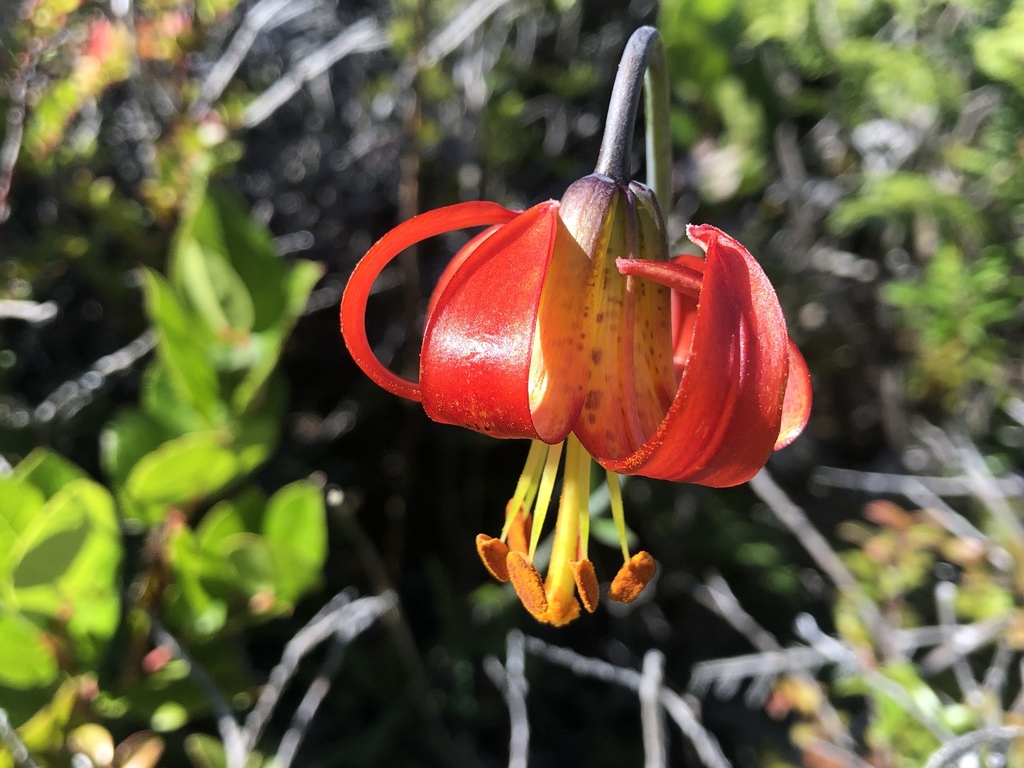
western lily
Lilium occidentale
Lilium occidentale is a rare North American species of lily known by the common name western lily. Its species name 'Occidentale' means 'westernmost' and refers to its location along the West Coast. It is native to northwestern California and southwestern Oregon. It grows in coastal prairie habitat, swamps and stagnant bogs with Drosera species, bluffs and sandy cliffs, and seaside spruce forests. This rare wildflower is limited in distribution and directly endangered by a number of environmental factors. It is a federally listed endangered species and it is listed as endangered by the states of California and Oregon.
It is found growing along a narrow 200 mile stretch of coast between Southern Oregon and Northern California usually within sight of the ocean. Its furthest northern distribution is Florence, Oregon to as far south as Eureka, California.
From the article Lilium occidentale on Wikipedia (CC BY-SA), quoted section by section
Description
Lilium occidentale is a perennial herb sometimes exceeding two meters in height. It grows from a scaly, elongated bulb which may be nearly 10 centimeters long. The leaves grow in a series of whorls around the stem. They may be linear to oval in shape and over 20 centimeters long. The inflorescence bears up to 35 showy nodding lily flowers. The flower has 6 recurved tepals each up to 8 centimeters long, sometimes curled back into complete rings. The tepals are usually red to orange to yellow-green, generally bicolored with more red on the inside and more greenish yellow on the outer surfaces. They are often spotted. There are six stamens with large red anthers up to 1.4 centimeters long, and a pistil which may be more than 5 centimeters in length. The flower is pollinated chiefly by hummingbirds, including Allen's hummingbird (Selasphorus sasin). Lilium occidentale produces more nectar than any other American lily, which is not surprising given that hummingbirds are the primary pollinator.
How it is grown
Lilium occidentale grows easily from seed with stratification. It can be easily grown in an artificial type bog or other wetland setting providing its need for constant moisture during the growing season is met. (McRae). There is considerable hybridization with other native lilies, in particular L. columbianum, in areas where the two species grow in close proximity. At some locations the two species grow side by side, with L. occidentale growing in low depressions (drainage ditches) that are clearly flooded during wet periods or periods of heavy rain, and L. columbianum growing just feet away on the steeper slope.(McRae). This leads to confusion with regards to "true" phenotype. Regardless of its relative ease of culture, Lilium occidentale is a federally protected species under the Endangered Species Act and C.I.T.E.S (Convention on International Trade in Endangered Species of Wild Fauna and Flora) and therefore it is illegal to own or process any plant material (seed, bulbs, leaves, ETC), or sell seed or bulbs without proper documentation and approval of U.S. Fish & Wildlife. Violators face prosecution and a possible felony conviction for possession of undocumented plant material.
Wikipedia: “Cultivation”
Where it lives
Recorded sightings
—
geo-referenced records in GBIF, from museums, herbaria and field observers.
Drag the globe to turn it. Dots are where records exist, not a range map; darker means more records.
In the stacks
Searching the stacks…
Every page naming Lilium occidentale in the Biodiversity Heritage Library →
This page is assembled live from iNaturalist, GBIF, Wikipedia, the Source Library and the Internet Archive. It is not yet part of the hand-edited codex. iNaturalist taxon 62759.