- Plants
- ›Vascular Plants
- ›flowering plants
- ›Dicots
- ›pepper plants, birthworts, and allies
- ›birthwort family
- ›Aristolochioideae
- ›Aristolochia
- ›Aristolochia
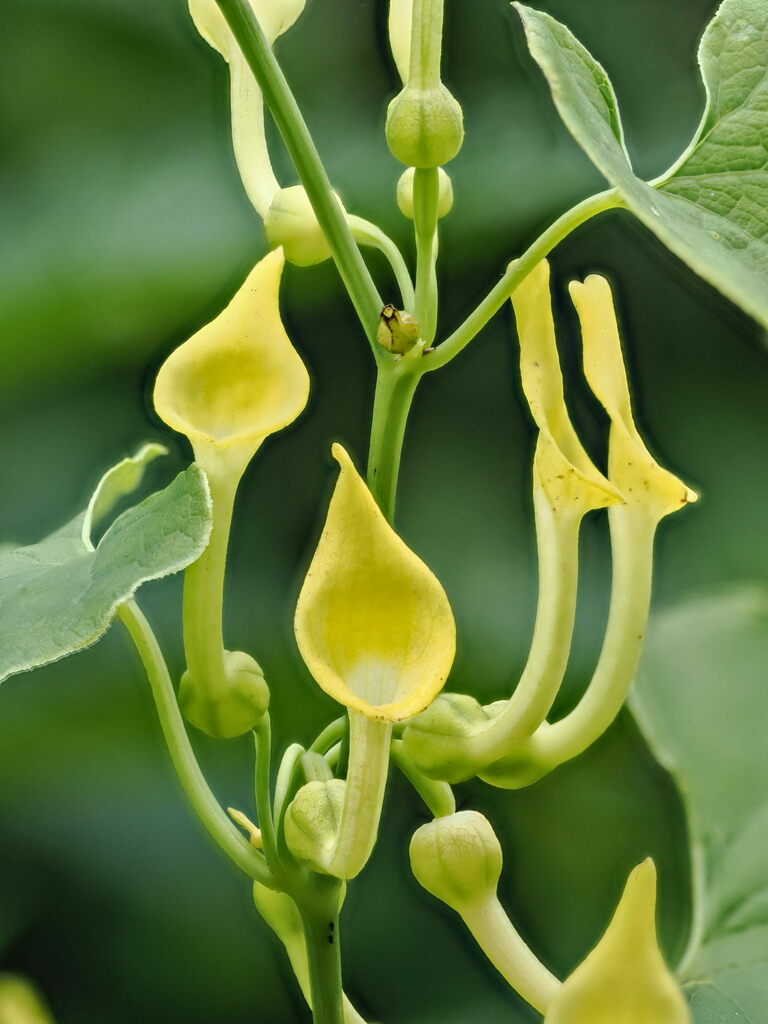
Birthwort
Aristolochia clematitis
Aristolochia clematitis, the (European) birthwort, is a twining herbaceous plant in the Aristolochiaceae family, which is native to Europe. The leaves are heart shaped and the flowers are pale yellow and tubular in form. The plant seeks light by ascending the stems of surrounding plants.
From the article Aristolochia clematitis on Wikipedia (CC BY-SA), quoted section by section
Description
It is a herbaceous scrambling or trailing rhizomatous perennial plant growing to 80 cm long. The leaves are heart-shaped, with a distinct petiole. The flowers are 2–3 cm long, pale yellow, tubular, with a broad lip at the top. The fruit is an oval capsule. All parts of the plant have a very strong unpleasant smell. The plant seeks light by ascending the stems of surrounding plants.
Toxicity
Formerly used to assist parturition, hence its name, it is now thought to be the cause of thousands of kidney failure cases in Romania, Bulgaria, Serbia, Bosnia and Herzegovina and Croatia. The initial hypothesis that seeds from the plant were unintentionally consumed through contaminated flour has come to be questioned. Urinary tract malignancies among those who have consumed the plant are also reported. The link between kidney failure and aristolochic acid, which the plant contains, was discovered after a clinic for obesity in Belgium used herbal products based on another plant of the same genus as a diuretic. After a few months, some of the patients experienced kidney failure.
Where it lives
Recorded sightings
—
geo-referenced records in GBIF, from museums, herbaria and field observers.
Drag the globe to turn it. Dots are where records exist, not a range map; darker means more records.
In the old herbals & bestiaries

Hortus Eystettensis
Basilius Besler · 1640 · p.389

Latin Herbal
1484 · p.37

Latin Herbal
1484 · p.39

Latin Herbal with German Synonyms
1486 · p.38

Herbal of Virtues
1499 · p.37

Garden of Health
1507 · p.35

On the Virtues of Herbs
Macer Floridus (Odo of Meung) · 1090 · p.81

Herbarius latinus (with Dutch synonyms)
1486 · p.35

Latin Herbal with German Synonyms
1486 · p.40

Garden of Health
Jacob Meydenbach · 1491 · p.44

Ortus sanitatis
1491 · p.42

Herbal of Virtues
1499 · p.39
In the stacks
Searching the stacks…
Every page naming Aristolochia clematitis in the Biodiversity Heritage Library →
This page is assembled live from iNaturalist, GBIF, Wikipedia, the Source Library and the Internet Archive. It is not yet part of the hand-edited codex. iNaturalist taxon 62771.