- Plants
- ›Vascular Plants
- ›flowering plants
- ›Dicots
- ›pepper plants, birthworts, and allies
- ›birthwort family
- ›Aristolochioideae
- ›Aristolochia
- ›Siphisia
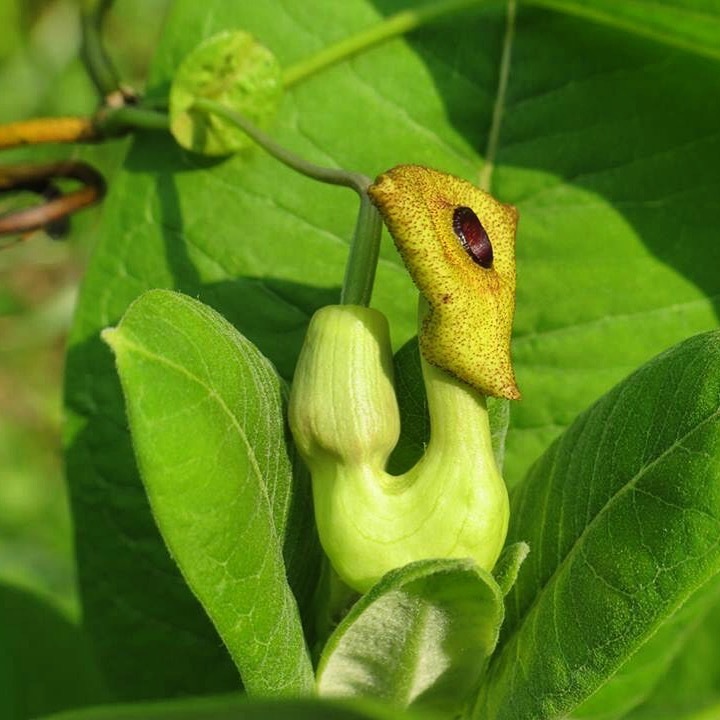
pipevine
Aristolochia macrophylla
Aristolochia macrophylla, Dutchman's pipe or pipevine, is a perennial vine native to the eastern United States. A. macrophylla belongs to the plant family Aristolochiaceae and is found primarily along the Cumberland Mountains and Blue Ridge Mountains in the eastern portion of the United States, as well as Ontario, Canada. This species of plant has received considerable attention in the past few decades for the discovery of a potent compound called aristolochic acid, which has been the focus of debate due its harmful side effects.
Aside from its decorative qualities, owing to its large leaves and dense growth, it is cultivated in gardens because it is a larval host for the pipevine swallowtail, Battus philenor.
From the article Aristolochia macrophylla on Wikipedia (CC BY-SA), quoted section by section
Description
This vine is a flowering plant that can grow up to 9 metres (30 ft) at a relatively fast rate. In the early stages of its development, the vines of A. macrophylla are very stiff and rigid, but as the plant develops, the vines become much more flexible and stable. This is because the plant is composed of sclerenchymatous cortical tissue, which has an outer cylinder, or layer, as well as an inner cylinder. Years of research showed that it is the outer sclerenchymatous cylinder that gives the stems of this plant its mechanical stability. This species flowers between the months of June and August in the U.S. with its seeds ripening in September and October. The large heart-shaped leaves can range between 15–30 cm (6–12 in). These dark green leaves can overlap and cover an arbor or trellis. Plants can also be used to provide extensive covers for pillars, sun porches, fences, walls as well as other things.
Flowers and fruit. The reason why A. macrophylla is often referred to as "Dutchman's pipe" is because of the 5 cm (2 in) yellowish-green flowers they produce. Each flower also sprouts from the calyx mouth to further produce 3 brownish-purple lobes. It is this complex of the flowers and lobes that gives the species a close resemblance to Dutch smoking pipes. …
Range & habitat
A. macrophylla has a relatively wide distribution. It is found from Maine to Alabama, and reaches all the way to Georgia, Tennessee and Kansas. The plant species generally ranges from the Eastern region of the United States up to Michigan, with the exception of Ohio, Indiana and Illinois, and reaches the southeast up until Florida where the presence of this species comes to an abrupt halt. It is also common in Mississippi and Alabama all the way up north to Maine and Ontario, Canada. A. macrophylla is considered to be a threatened species in Maryland. Although the species is not endangered yet, the pipevine could be well on its way to endangerment if measures are not taken to protect this species from the negative consequences of deforestation and other aspects of human disturbance.
Wikipedia: “Distribution”
What it does
A. macrophylla is native to the southeast of the United States, however it is also found in the northeast, as well as Ontario, Canada. This plant species resides largely in the Cumberland and Blue Ridge Mountains of southeastern United States. They are native to wooded slopes, gaps, as well as ravines which are mainly in the Cumberland and Blue Ridge Mountains from West Virginia, to Kentucky, Tennessee and northern Georgia. Pipevine eventually spread to other parts of the eastern coast of the United States. A. macrophylla is naturally found in light sandy soil, medium loamy soil and heavy clay soils, with a preference for drained soils. This species is also primarily found in alkaline soils with high pH. A. macrophylla has a strong preference for moist soils, while being intolerant to dry soils.
== References ==
Wikipedia: “Habitat and ecology”
Where it lives
Recorded sightings
—
geo-referenced records in GBIF, from museums, herbaria and field observers.
Drag the globe to turn it. Dots are where records exist, not a range map; darker means more records.
In the stacks
Searching the stacks…
Every page naming Aristolochia macrophylla in the Biodiversity Heritage Library →
This page is assembled live from iNaturalist, GBIF, Wikipedia, the Source Library and the Internet Archive. It is not yet part of the hand-edited codex. iNaturalist taxon 62772.