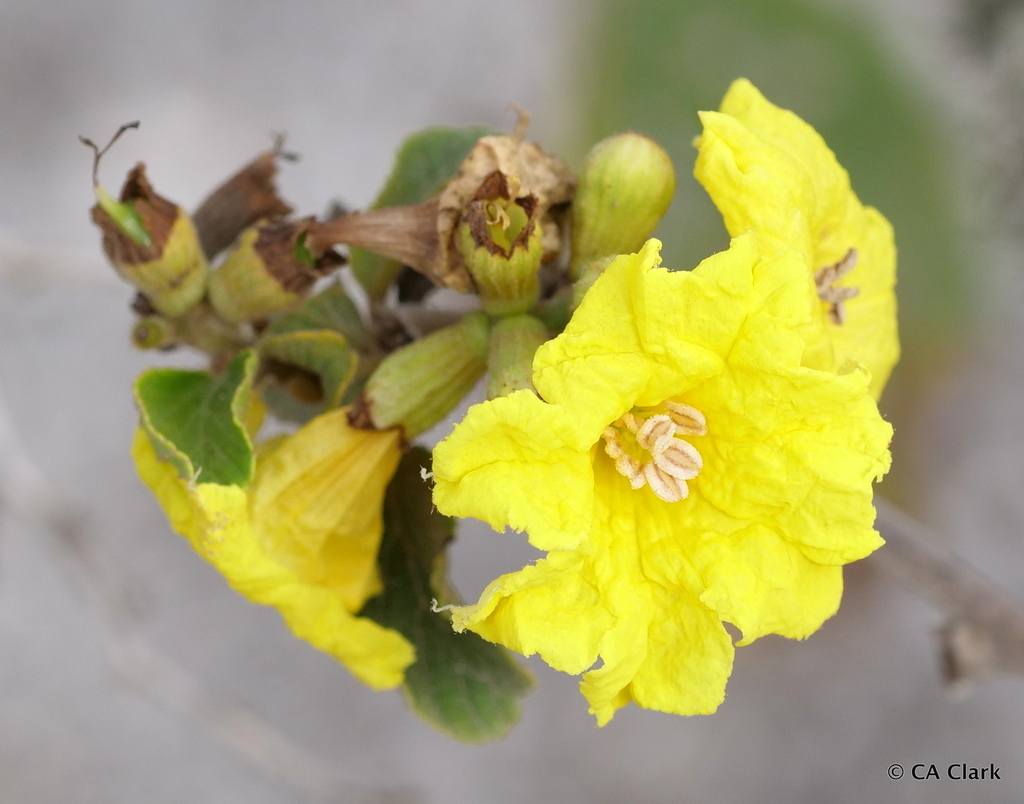
yellow geiger
Cordia lutea
Cordia lutea, known as yellow cordia or in Spanish muyuyo, is a shrubby plant in the borage family (Boraginaceae), native to the Galápagos Islands, mainland Ecuador, Peru, and the Marquesas Islands in Polynesia. Common in the arid lowlands of the Galápagos, its relatively large yellow flowers make it easy to identify.
From the article Cordia lutea on Wikipedia (CC BY-SA), quoted section by section
Description
Cordia lutea grows as a shrub or a small tree, up to 8 m (26 ft) tall. The young branches are hairy. The undivided leaves are arranged alternately, and are 4–10 cm (1.6–3.9 in) long, ovate to round in shape, with very finely toothed margins. The upper side of the leaf is rough in texture but hairless; the lower side bears hairs. The yellow flowers are arranged in cymes and are sweetly scented. The petals of each flower are fused together to form a trumpet shape, 2–4 cm (0.8–1.6 in) across at the mouth, which has five to eight lobes. Inside the flower there are five to eight stamens. After fertilization, a globular white fruit (a drupe) forms, 8–12 millimetres (0.3–0.5 in) across, containing from one to four seeds. The fruit has a fleshy pulp that is initially slimy when the fruit is opened, but becomes sticky on exposure.
Range & habitat
Cordia lutea is native to Ecuador, both the western part of the mainland and the Galápagos Islands, Peru, and the Marquesas Islands in Polynesia. It grows in arid regions. In the Galápagos, it is found in the lowlands, often close to the sea. In the Galápagos, the leaves are mined by the moth Bucculatrix cordiaella.
Wikipedia: “Distribution, habitat, and ecology”
Where it lives
Recorded sightings
—
geo-referenced records in GBIF, from museums, herbaria and field observers.
Drag the globe to turn it. Dots are where records exist, not a range map; darker means more records.
In the stacks
Searching the stacks…
Every page naming Cordia lutea in the Biodiversity Heritage Library →
This page is assembled live from iNaturalist, GBIF, Wikipedia, the Source Library and the Internet Archive. It is not yet part of the hand-edited codex. iNaturalist taxon 62830.